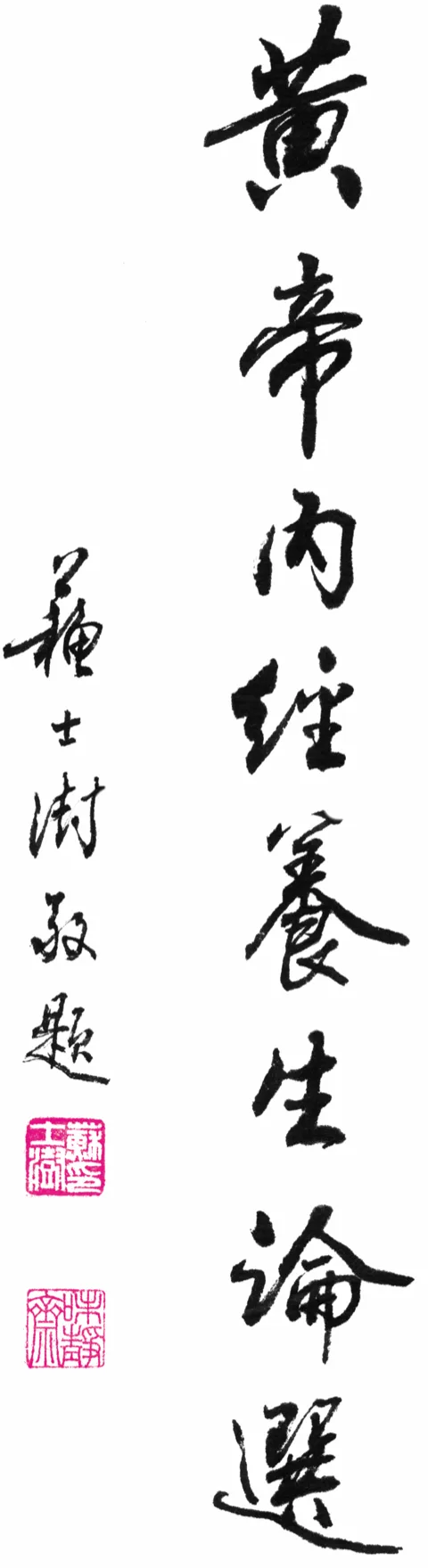
Selections from the Huangdi Neijing on Cultivating Life
黃帝內經養生論選
Contents (42 passages)
- Holding Heaven and Earth, Grasping Yin and Yang
- Leaving the World Behind, Storing Essence and Completing the Spirit
- Abiding in the Harmony of Heaven and Earth, Following the Principle of the Eight Winds
- Taking Heaven and Earth as Model, Emulating Sun and Moon
- The Faculty of Contented Tranquility
- Coming and Going Alone, to the Subtlest Breath
- Born of Earth, Suspended from Heaven
- The Way Has No Ghosts or Gods; It Comes and Goes Alone
- A Human Being Arises from the Qi of Heaven and Earth, Forms by the Law of the Four Seasons
- Whoever Can Measure the Transformations of Yin-Yang Will Not Lose the Four Seasons
- Patterned on Yin and Yang, in Tune with Method and Number
- Holding the Fullness, Mastering the Spirit
- The Yin-Yang of the Four Seasons Is the Root of the Ten Thousand Things
- The Yin-Yang of the Four Seasons Is the End and the Beginning of the Ten Thousand Things
- The Sage Treats Not What Has Become Illness but What Has Not Yet
- The Essential of Yin and Yang: When the Yang Is Tight, It Is Firm
- Do Not Disturb the Sinews and Bones; Do Not Show Yourself to Mist and Dew
- Yin and Yang Are the Way of Heaven and Earth
- Adapt to Cold and Heat, Settle the Dwelling, Tune the Hard and the Soft
- Spring: Lie Late and Rise Early, Walk Broadly in the Courtyard
- Summer: Lie Late and Rise Early, Do Not Tire of the Day
- Autumn: Lie Early and Rise Early, Get Up with the Cock
- Winter: Lie Early and Rise Late, Wait for the Sunlight
- Do Not Go Against the Four Seasons
- Contented Tranquility, Empty Non-Being — and the True Qi Follows
- Putting the Spirit to Use
- Ordering the Spirit
- When Essence and Spirit Are Held Within, From Where Should Illness Come?
- Find the Food Sweet, Wear the Clothing Easily, Take Joy in One's Customs
- Quiet the Will, Few Desires
- Heart at Peace, Qi Following Smoothly
- Heart Levelled, Qi at Harmony
- The Flavors Have Their Storehouses, Nourishing the Five Qi
- The Yin Arises With Its Root in the Five Flavors
- Carefully Harmonize the Five Flavors, Long Hold the Heavenly Mandate
- Pungent, Sour, Sweet, Bitter — Each Has Its Use
- Five Grains for Nourishment, Five Fruits for Aid, Five Beasts for Benefit, Five Vegetables for Filling
- Grain, Meat, Fruit, Vegetables — Food's Nurture Completes It
- Avoid Damp
- Keep Away from Great Heat
- Live in Ease
- Guard Against Wind
Preface
The Huangdi Neijing is a canonical work of Chinese-medicine culture, and a canonical work of the Chinese cultural tradition at large. "Writing carries the Way" — this cultural classic discloses the objective law of life.
From antiquity to the present, the thing people find hardest to know is themselves — life itself. Over the last century-plus, under the impact of Western civilization, life has been cleaved from nature and society, dissected by a shallow, mechanical gaze. This rootless, impoverished mode of knowing has led us further and further from the truth of life.
Everyone longs for health and long life, yet few know the Way of cultivating life. Some take mental exhaustion for diligence, skipping sleep and meals to prove their industry; some take rich food for beauty, taking pleasure in sights and sounds and horses, and know nothing of timing the seasons, moderating desire, measuring labor, or levelling the heart. To seek vigor at a hundred years by such a path — is it not to face south while driving north?
"To ascend the high mountain without a path, to reach the Fusang tree without a boat" — the book before you offers precisely that path up the mountain of health and that boat across its sea. Some readers may feel it too simple, but in truth the Great Way is simple: chant its words, see its reasoning, follow its path, awaken to its Way, and you have enough for the cultivation of life.
We invited Mr Fu Jinghua and Mr Fan Zhenglun, with their deep Chinese-medicine grounding, to select and annotate; Mr Su Shishu, with his spirited calligraphy, to transcribe the text; and Mr Zhang Xiaotong, with his disciplined seal-carving, to add the embroidery on brocade — in the hope that the book itself becomes a thing pleasing to the eye and nourishing to the spirit. May it grant you leisure in which the heart opens, and a lift for the hours after meals or over tea.
A clear breeze carries sweet-osmanthus; golden autumn is cool; New China celebrates its sixty-year cycle; Pingxintang joyously marks its tenth. Old friends and new, raising cups to the moon, composing poems, singing softly — sharing peace, harmony, health and happiness together. Is this not cause for delight?
The editors · 9 September 2009
Holding Heaven and Earth, Grasping Yin and Yang
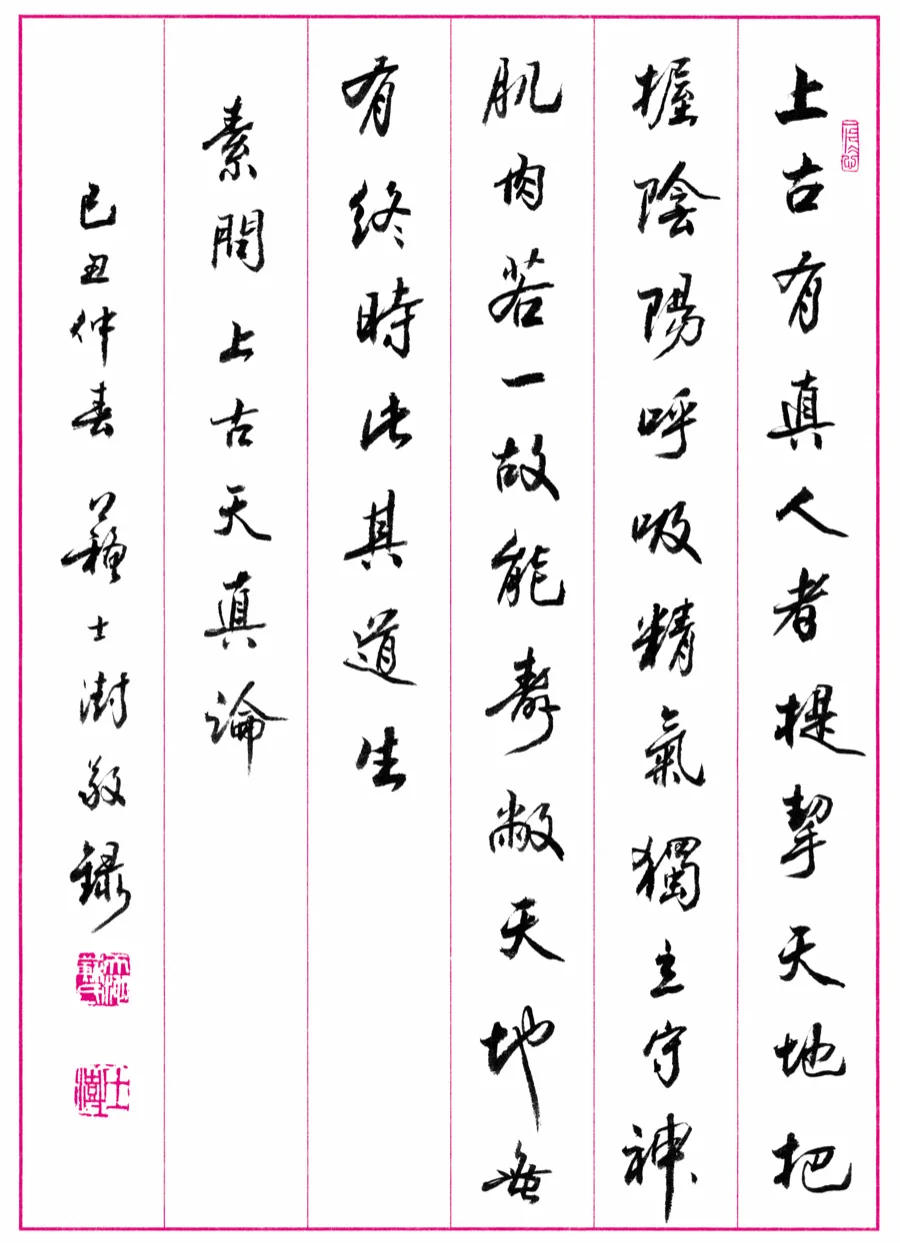
In high antiquity there were the True Persons〔1〕. They held fast to Heaven and Earth〔2〕, grasped yin and yang, breathed in the essential qi〔3〕, stood alone and guarded the spirit〔4〕, their flesh one undivided whole〔5〕 — and so their lifespan matched the span of Heaven and Earth〔6〕, having no terminal time〔7〕. This was their being-born with the Way. (Suwen · Discourse on the Heavenly Innateness of High Antiquity)
Notes: 【1】True Person (真人): "true" in oracle-bone script depicts a covered ritual ding — its root sense is a sacred vessel, by extension that which passes through Heaven and Earth. Here it points to furnace-and-cauldron cultivation, fused with the spontaneous. Shuowen: "A true person is an immortal who, changing shape, ascends to Heaven." Wang Bing glosses it as "one who has accomplished the Way," kin to the Perfected Person (至人) that follows. Some read it as "one who keeps essence and true qi whole," which approaches the Sage. The Zhuangzi · Keyi: "What is plain is what has no admixture; what is pure is what does not lose its spirit. One who can embody plainness and purity is a True Person." In fact True Person was a real title in high antiquity — in the Shang, Wu Ding appointed True Persons, opened speech widely, trusted Fu Yue, and brought about a restoration. The flourishing of the oracle-bone record is related to the True Persons. 【2】Hold fast (提挈): 挈, pronounced qiè ("cut"), means to raise. Tijie is a synonym-doubled verb — here it means being in mutual rhythm with the rise and fall of Heaven-Earth space-time. "Heaven is round, earth is square; Heaven descends, earth rises"… 【3】Breathe the essential qi: to exhale is to open, to issue forth; to inhale is to close, to draw in. This points to the opening-closing, exit-entry of the space-time of life. "Essential qi" is the basic mode of vital activity and spontaneous motion. The image is of shape, qi, and spirit opening-closing, exiting-entering in harmony with the spontaneous — not merely "the lung breathing air." The wandering-out and entering-in of the spirit-qi should thread through the space-time of life, the process of life, the numerical ordering of life, the pivot of life, the transformations of life, the tendency of life, the shape and vessel of life, the light and minuteness of life… and what today we call the matter, energy, information, and field of life. Some read it as breathing the essential qi of the body — e.g. Ma Shi: "Breathing one's own essential qi, just as Heaven and Earth move silently." 【4】Stand alone (獨立): to come and go alone, not of the crowd, unbound, self-standing and self-strong. This is "qi standing," not bodily standing. Guard the spirit: the heart-spirit held within, not racing outward. Zhuangzi · Keyi: "The Way of plain purity: only the spirit is guarded; guard it and lose it not; be one with the spirit." 【5】Flesh one undivided whole: form and spirit transformed into one. The Taisu reads it as "body-flesh venerated as one." The New Commentary takes Quan Yuanqi's text as the same. Following the prior "stand alone and guard the spirit," it should mean body and spirit merged and finally transformed back to one. The one is born of the Way; it is the source of transformation and the beginning of the ten thousand things. Hence the next phrase: "this was their being-born with the Way." This refers to the Way of the spontaneous, not the "way of cultivating life." 【6】Match: to exhaust. The spirit transformed into one is at one with Heaven and Earth. Same-one, same-life — therefore the span is fully exhausted. "One" here is the spirit, not the bodily form. 【7】No existence-no thing: the "no" is the circling motion of the spontaneous, whose hidden sense is concealment; the "thing" is the spontaneous's manifestation. Laozi: "Its non-being and its being — this is the usefulness of the vessel."
In high antiquity there were True Persons, in rhythm with the rise and fall of Heaven-Earth space-time, grasping the tempo of yin-yang transformation, opening and closing the exits and entries of the spontaneous essential qi, walking with qi-that-stands while guarding the heart-spirit within. Shape and spirit met, merged, and were transformed into one — and so their lifespan matched the span of Heaven and Earth, their moving and stillness, hiding and showing, ended with time itself. This is because they were born with the Way.
Leaving the World Behind, Storing Essence and Completing the Spirit
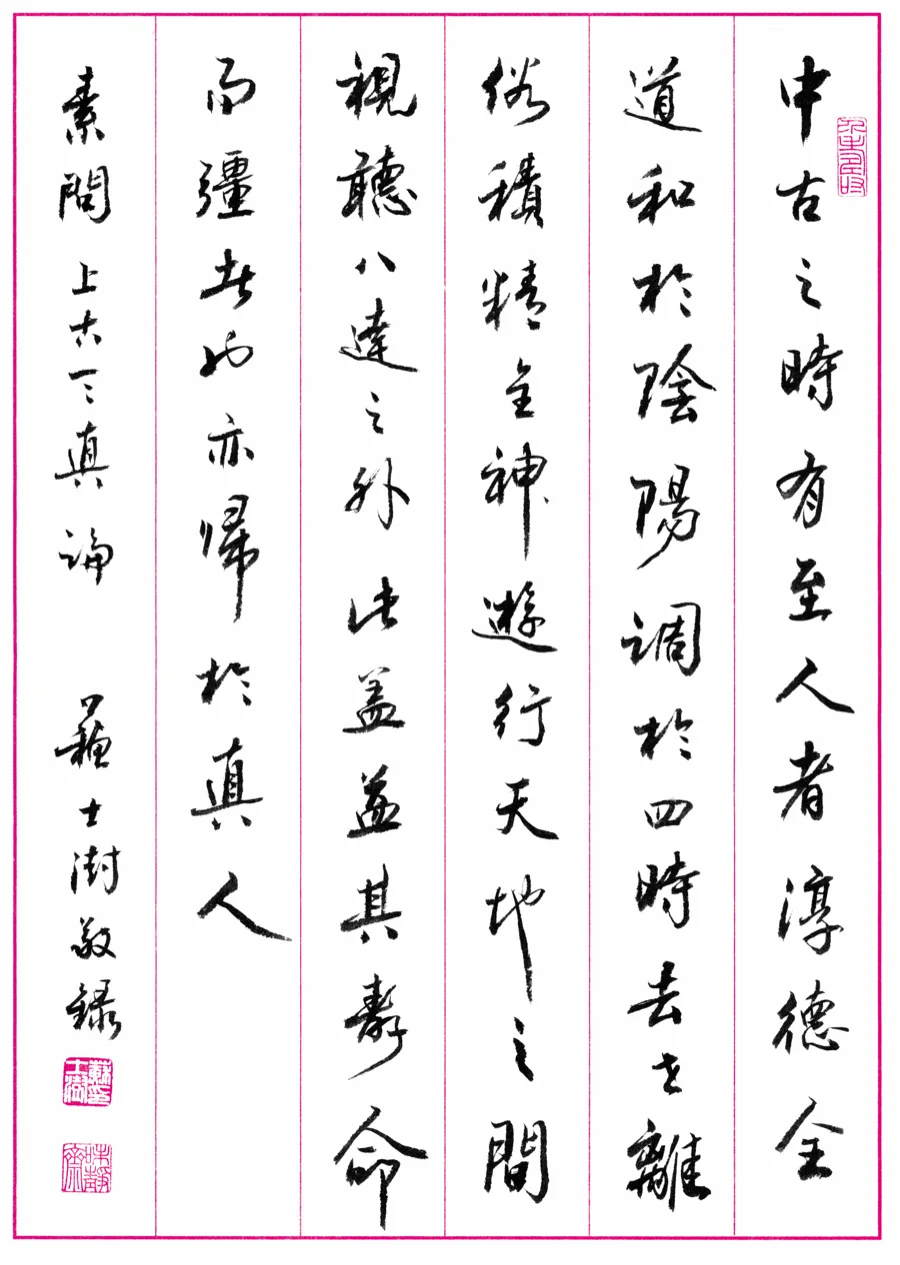
In middle antiquity there were the Perfected Persons〔1〕. Deep in virtue, whole in the Way〔2〕, in harmony with yin and yang, attuned to the four seasons — they left the world behind, parted from the common, stored their essence and completed their spirit, wandered between Heaven and Earth〔3〕, and their seeing-and-hearing reached beyond the eight directions〔4〕. These who strengthened themselves and extended their lifespan also belong, ultimately, with the True Persons. (Suwen · Discourse on the Heavenly Innateness of High Antiquity)
Notes: 【1】Perfected Person (至人): "至" means great. It points to one who, though not of the same Way, still attains the whole Way — so they come second to the True Persons. Zhuangzi · Tianxia: "One who does not part from the true is called a Perfected Person." 【2】Deep (淳): thick, harmonious — the fusing together in great virtue. Virtue (德) is the Way made manifest. The Way gives rise to the ten thousand things; their being-born is the great virtue; virtue is the Way in use, the Way is the root of virtue. "The great virtue of Heaven and Earth is called birth. Birth-upon-birth is called virtue." In the oracle-bone script the character 生 shows a sprouting seed — its root sense is manifesting, its implied sense is the arising of life. Here virtue is the Way appearing, not personal virtue. Whole (全): completely, arriving at. Here it is arriving at the ultimate Way. Laozi: "Containment is impartiality; impartiality is wholeness; wholeness is Heaven; Heaven is the Way; the Way is enduring." 【3】Heaven and Earth: up and down. Here it is the movement-transformation of the up-and-down space-time of Heaven and Earth, not what we today call "the celestial bodies" or "the earth." Space-time is also not the "time" and "space" constructed when translating from foreign languages. Space is the root of time; time is the movement of space. The movement of Heaven-Earth in space-time is e.g. "Heaven empty-earth full, Heaven closed-earth open, Heaven round-earth square"; its transformation in space-time is e.g. "Heaven hidden-earth shown, Heaven drawing-in-earth issuing-out, Heaven descending-earth rising"… Between (間): the oracle-bone character shows a moon atop a gate — its root sense is a gap through which moonlight enters; here it means the gap between movement-transformations of space-time. "Wander" here is not the body's movement but the wandering of spirit-qi. 【4】Beyond the eight directions: front-back, left-right, east-south-west-north are the four directions; crossed, we get the four cardinal and four intercardinal — the eight directions. The space of the eight directions is the quiet space. (Quiet is not non-movement; it is relative. Beyond thought's reach, beyond knowing's reach — not the "quiet" of Laozi's "attain the highest emptiness, guard the deepest stillness," nor that of "returning to the root is called stillness, stillness is called the return of destiny.") Because the ordinary person's seeing and hearing can reach this far, a spirit reaching as far is called "reaching the eight." Laozi: "Clear and reaching in the four directions — can it be without purposive action?" Beyond the quiet space of the eight is the active space of the eight great motions: reverse, forward, empty, full, opening, closing, square, round. One whose seeing and hearing reach beyond the eight is a Perfected Person. "Beyond" is a realm, not a location. The eight motions are everywhere, not far off.
In middle antiquity there were Perfected Persons. Fusing great virtue they arrived at the ultimate Way, resonating with the transformations of yin and yang, attuning themselves to the seasonal shift of the four seasons. They parted far from dust, left the common behind, gathered in their essence and joined with the luminous spirit, wandered amid the movement-transformations of Heaven and Earth, saw and heard beyond the quiet space of the eight directions. These who extended their lives and strengthened themselves can also be counted among the True Persons.
Abiding in the Harmony of Heaven and Earth, Following the Principle of the Eight Winds
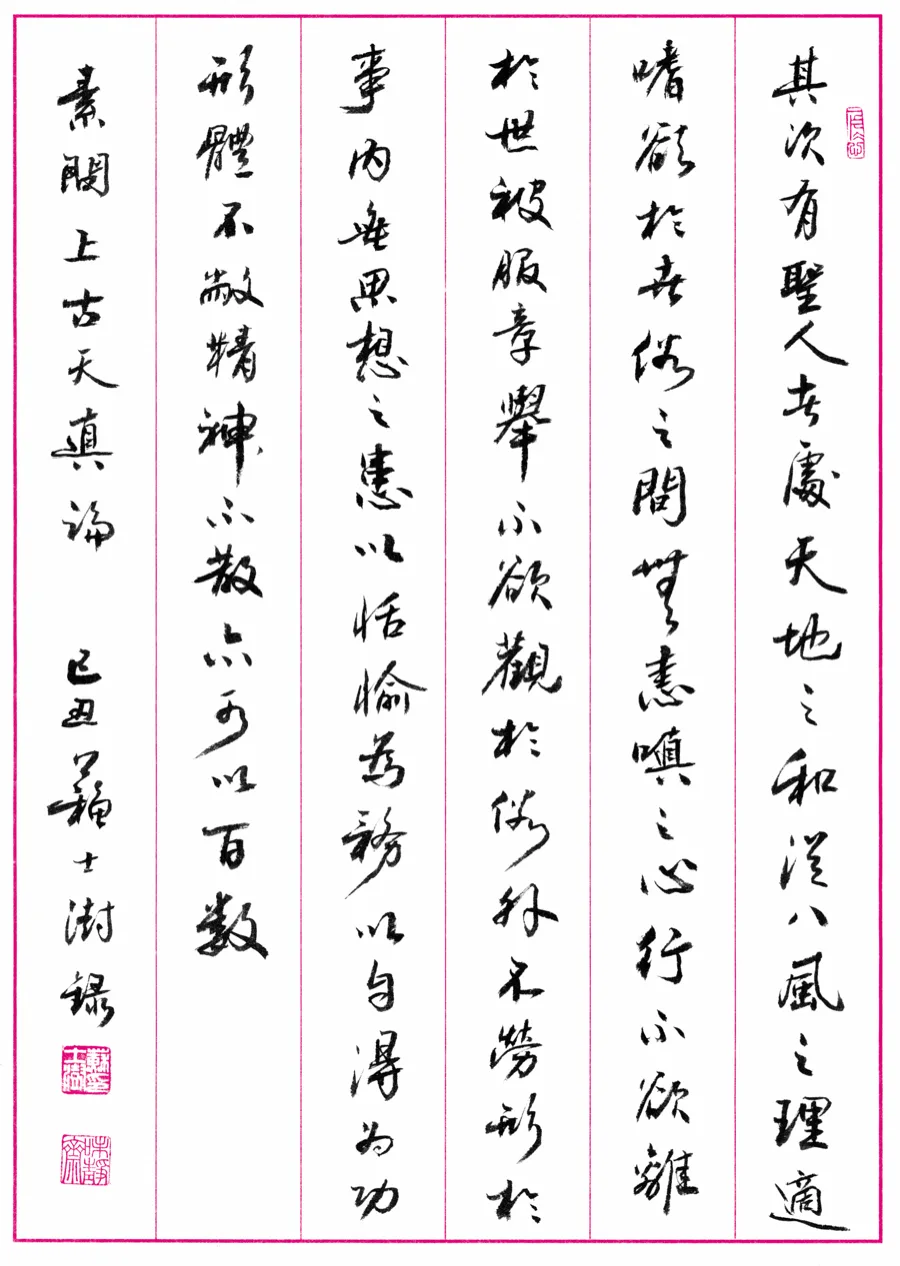
Next there were the Sages. They abode in the harmony of Heaven and Earth〔1〕, followed the principle of the eight winds〔2〕, moderated their desires in the midst of the ordinary world〔3〕, had no resentful or angry heart〔4〕, did not wish to separate their conduct from the world〔5〕, wore robes of color and pattern〔6〕, did not wish their bearing to be a show for the crowd〔7〕. Outside they did not wear out their forms in affairs; inside they had no worry of thought. Their work was calm gladness; their achievement was inner contentment. Their shape and body did not weary〔8〕; their essence and spirit did not scatter〔9〕. They too could reach a hundred. (Suwen · Discourse on the Heavenly Innateness of High Antiquity)
Notes: 【1】Abide (處): to govern, dispose — here it is "dispose of," not "reside in." Harmony (和): 禾 (grain) on the left, 口 (mouth) on the right; its root sense is mutual interaction, and its implied sense is the fit-together of mutual interactions. 【2】Principle of the eight winds: "Eight" names eight kinds of mutually-interacting motion, not the "quantity" called eight today. "Wind" is a mode of motion that travels well and changes often, not the "climatic wind" of today. "Principle" is the relational manifestation of the spontaneous process, not the "theory" called principle today. One who follows the principle of the eight winds is a Sage. One who sees and hears beyond the eight is a Perfected Person. One who "can preserve the transformation of the eight motions" — the phrase in Suwen · Discourse on Preserving Life in Fullness — is a True Person, going out and coming in alone. 【3】Moderate (適): here it is to regulate, restrain. 【4】Resentful-angry (恚嗔): huì chēn, "resentful and irate." 【5】Separate (離): communes with 麗, "to cleave to." 【6】Wear robes of color and pattern: bei is to cover; here, to wear clothing. Fu is garment and style. Zhang is color and pattern. The phrase figures a form distinct from the common world; the next phrase figures a spirit utterly different from the common world. The Neijing's prose is rich with implied meanings. Wang Bing: "Zhang is a cap." The New Commentary suspects the three characters are interpolated. 【7】Bearing (舉): conduct, manner. Be a show for the crowd (觀於俗): "observed" — here, letting the world watch. 【8】Form-body (形體): form and body — not the "human body" of today. Form manifests as vessel, base, thing; thing manifests as light, subtle, body. 體 was originally 體 — the terminal of form — hence "does not wither." 【9】Essence-spirit (精神): essence and spirit — not the "spirit" of today. Essence is the essential qi, spirit is the spirit-qi — hence "do not scatter."
Next there were those called Sages. They governed the working of Heaven-Earth space-time, followed the relational movements of the eight winds, moderated their desires in the common world, carried no resentful or angry heart, did not wish to cling to the fashions of the age, wore clothing of style and ornament, did not carry themselves for the eyes of the common. Outside they did not wear out their form in affairs; inside they submerged the worries of thought. Their work was the calm-gladness of stillness; their achievement was inner definition and contentment. Their form and body did not tire and decay; their essence and spirit did not scatter and exhaust. They too could reach the years Heaven allotted.
Taking Heaven and Earth as Model, Emulating Sun and Moon
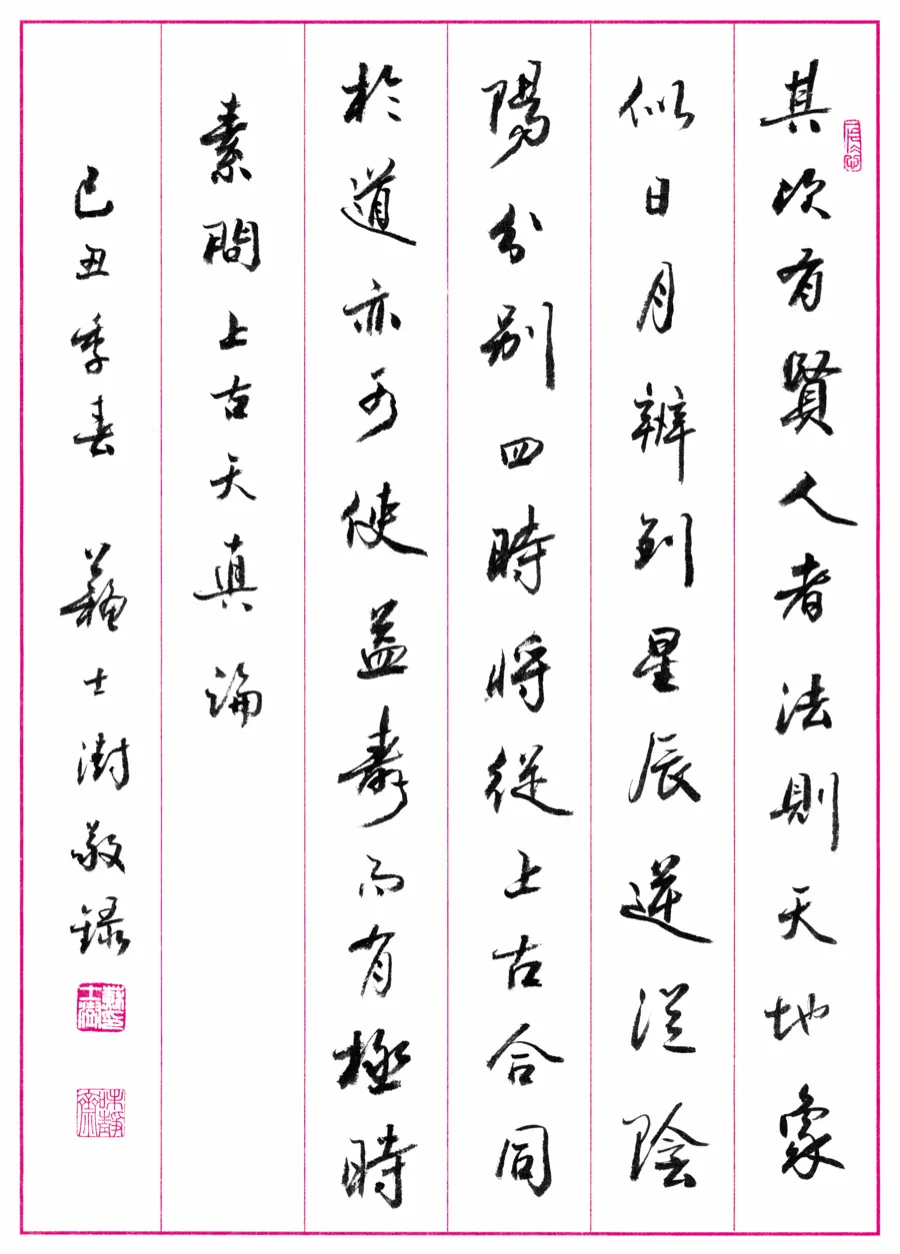
Next there were the Worthies. They took Heaven and Earth as their model〔1〕, emulated the sun and moon〔2〕, distinguished and set in order the stars and constellations〔3〕, accorded with yin and yang〔4〕, discerned the four seasons, and, following the True Persons of high antiquity, sought to enter into the Way〔5〕. They too could extend their lifespan and exhaust the span allotted them〔6〕. (Suwen · Discourse on the Heavenly Innateness of High Antiquity)
Notes: 【1】Model (法則): the oracle-bone 法 shows water moving on the left, a water-ox on the right — its root sense is "follow." The bronze-inscription 則 shows a ding on the left, a knife on the right — representing inscribing text on a ding, thereby setting up a standard; its root sense is "inscribe a ding," implying "norm." As verbs, both mean to follow or accord with. "Heaven and earth, sun and moon, stars, yin and yang, the four seasons" below — all figure space-time movements in different realms, not the material structures of a physical layer. 【2】Emulate (象): imitate. Similar to (似): communes with 以. 【3】Distinguish (辯): communes with 辨. Stars and constellations: in parallel with "sun and moon." Generally the pole star and the other stars. By their positions in the celestial court one can discern the cyclical movements of space-time. Guoyu · Zhou, "The chen is in the dipper's handle," annotated: "Chen is the meeting of sun and moon." Taiyuan · Yuanji, "Stars and constellations do not collide," annotated: "Chen is the pole." 【4】Accord / oppose (逆從): 逆 is "run counter to"; 從 is "follow." A lopsided compound — the sense here leans to "follow." 【5】Will seek (將): wish to. High antiquity (上古): here, the True Persons of high antiquity. Enter into the Way (合同於道): the True Persons of high antiquity were born with the Way; the Perfected Persons of middle antiquity were deep in virtue and whole in the Way. This means the Worthies follow after the True Persons, also wishing to merge and align with the Way. Laozi: "One in the Way — the Way also gladly takes one in; one in virtue — virtue gladly takes one in; one in Heaven — Heaven gladly takes one in." 【6】Exhaust (極): limit.
Next there were those called Worthies. They followed the space-time movements of Heaven and Earth, imitated the day-and-night circuits of sun and moon, discerned and set in order the positions of the stars, accorded with the waxing and waning of yin and yang, distinguished the birth-growth-harvest-storage of the four seasons, and sought to follow the True Persons in entering into the Way. They too could extend their lifespan, reaching the full term allotted them.
The Faculty of Contented Tranquility
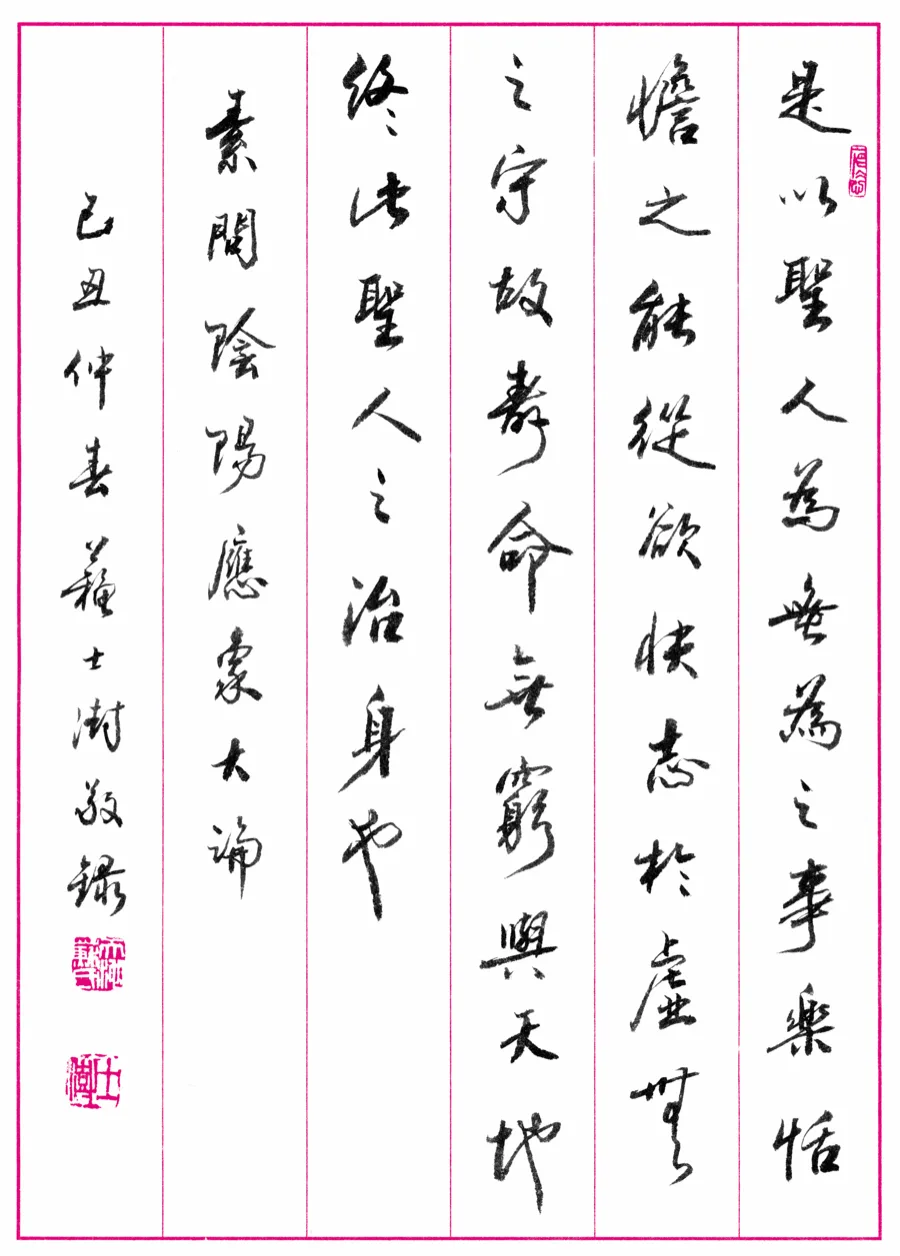
Thus the Sage engages in the work of non-doing〔1〕, takes joy in the faculty of contented tranquility〔2〕, follows his desires and satisfies his intent within the guarding of the Empty Void〔3〕. Therefore his lifespan is without limit — it ends with Heaven and Earth. This is the Sage's way of governing himself. (Suwen · Great Treatise on the Correspondence of Yin and Yang)
Notes: 【1】Non-doing (無為): the oracle-bone 無 shows a person whirling pine branches in a round dance — its root sense is "circling motion," the motion of the spontaneous. Because in such a dance the pine branches are all committed to the fire, its implied sense is "hide." "Absence" is a derived sense. The oracle-bone 為 shows a great elephant on the right with a hand guiding by the trunk — its root sense is "human doing," that is, action with private interest and purpose. "Making/doing" is a derived sense. Non-doing thus means action from which private purpose has been hidden. The Great Way is spontaneous, not human-made — hence "the Great Way is non-doing." Laozi: "The Sage dwells in the matter of non-doing." "Do non-doing, and nothing is not governed." 【2】Faculty (能): state. "Illness-state" (病能) in the Suwen means "pathological state." State belongs to transformation, transformation belongs to the pivot, the pivot issues and transformation follows, transformation gives birth to tendency. State is the way of transformation; tendency is the property of transformation. There are states of spirit, of qi, of form. What today is called "state" belongs to the physical-thing side of form and carries a Westernized sense. Here "state" means state of spirit. 【3】Follow desire and satisfy intent (從欲快志): "desire" here is the desire of non-doing — the very "matter of non-doing" above. "Intent" is the intent of the spirit-qi — that is, the kidney among the five spirit-storehouses. Clear, still, focused — contentedly empty — the heart-spirit is allowed to follow its desire; the kidney-intent is allowed to reach its course. Guard: keep within, hold the center. The center is the empty void without thing or self. Some read 守 as a scribal error for 宇, which rhymes with the prior characters. Hu Shu: "守 should be 宇." Mozi · Jingshang: "宇 is the pervading of distinct places" — the limitless space. The empty "space" of the empty void is the limitless empty space of circling motion. Either reading is intelligible.
The Sage focuses on the cultivation of life in spontaneous non-doing, takes joy in maintaining the stopped-still-settled-peaceful state of spirit, follows his desires and reaches his intent in the guarding of the empty void within. Thus his lifespan is made long, reaching the full measure allotted by Heaven and Earth. This is the Sage's way of governing himself.
Coming and Going Alone, to the Subtlest Breath
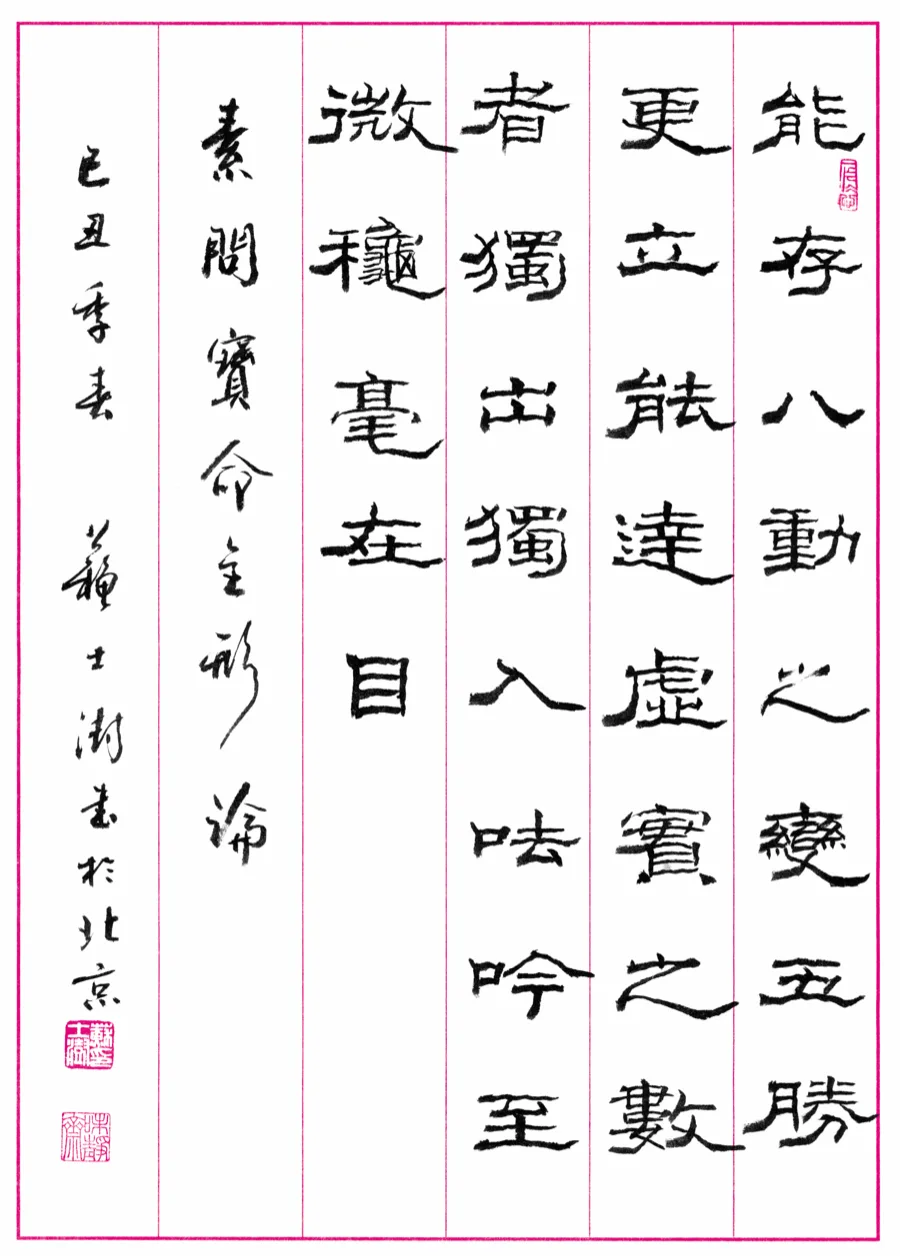
One who can preserve the transformation of the eight motions〔1〕, the alternation of the five overcomings〔2〕, reaching the mathematics of emptiness and fullness〔3〕 — coming and going alone, breathing open-and-shut down to the subtlest〔4〕 — can see the autumn hair clearly before the eye. (Suwen · Discourse on Preserving Life in Fullness)
Notes: 【1】Preserve the transformation of the eight motions (存八動之變): preserve is to observe closely. Erya · Shigu: "To preserve is to observe." Eight motions are the eight great active spaces, or the movement of space-time. Transformation are the eight great transforming spaces, the transformations of space-time. Movements of space-time: reverse, forward, empty-full, open-close, square-round. Transformations of space-time: hidden-bright, concealed-manifest, exit-enter, rise-descend. Space is the root of time; time is the movement of space. Laozi: "Reversal is the motion of the Way." The root of the Way is space. "The Way is empty and when used never fills." 衝 (sharp-edge) communes with 空 (empty). Motion gives rise to reversal; reversal gives rise to the forward; the forward gives rise to empty and full; full gives rise to open and close; open gives rise to square and round. Reverse-transform gives rise to the hidden, forward-transform to the bright, empty-transform to the concealed, full-transform to the manifest, open-transform to issuing-out, close-transform to drawing-in, square-transform to rising, round-transform to descending. Many past commentaries take these as "the eight winds" — and only the Sage truly knows such "wind." Reducing them to "climatic winds" is to grade down to the ordinary and become their kind. How then to reach the mathematics of emptiness and fullness, and come and go alone? 【2】Alternation of the five overcomings (五勝更立): the five-phase cycle of mutual overcoming — wood, fire, earth, metal, water. Wood overcomes earth, earth overcomes water, water overcomes fire, fire overcomes metal, metal overcomes wood. 立 is "to preside." This is the alternating presiding of the five-overcoming qi by season. 【3】Emptiness and fullness (虛實): here, the hidden and manifest of space-time movement and transformation — not the so-called "empty pattern" or "full pattern" of illness. Mathematics (數): here, the way of mutual interaction, not "quantity." 【4】Breathing open-and-shut (呿吟): 呿 (qū, "district") is to open the mouth; 吟 (jìn, "silent") communes with 噤, "to close the mouth." Tongya: "Singing turns to silencing." This figures the opening-closing exit-entry of space-time movement and transformation. Some gloss it as "yawn and groan" — a reading from a different world entirely.
One who can observe closely the movements of the eight great space-times, and the alternating presidings of the five overcoming-qi, and can reach the relational mathematics of the hidden and manifest, whose spirit-qi comes and goes alone between Heaven and Earth — such a one, even at the minutest movements of opening-closing and exit-entry, sees clearly as if the autumn hair were right before the eye.
Born of Earth, Suspended from Heaven
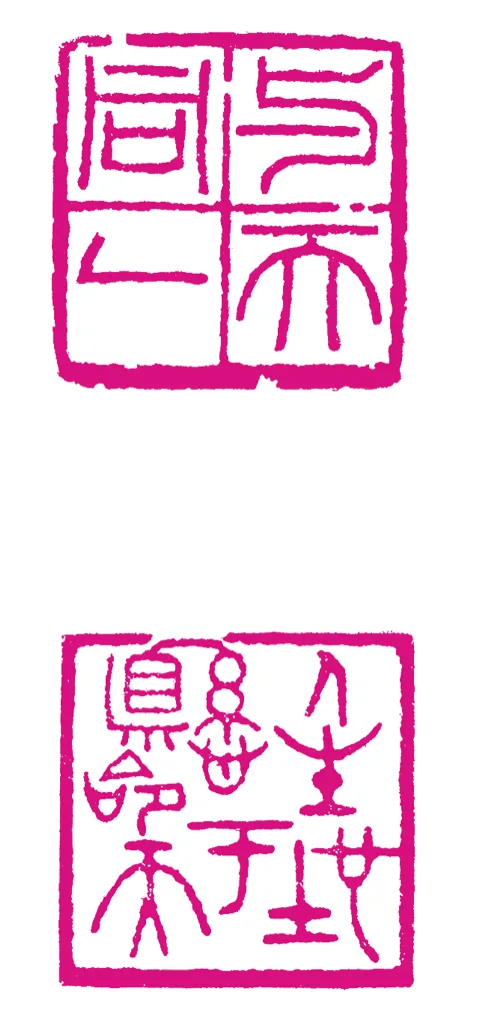
Human beings are born of Earth and suspended from Heaven〔1〕; the qi of Heaven and Earth combine, and what they constitute is called human. One who can respond to the four seasons has Heaven and Earth as parents; one who knows the ten thousand things〔2〕 is called a child of Heaven. (Suwen · Discourse on Preserving Life in Fullness)
Notes: 【1】Born of Earth, suspended from Heaven: "suspended" means tied, related. The oracle-bone form of 命 (destiny) shows a phallic image above and a kneeling person below — its root sense is reverence for procreation; it figures unceasing generation, the continuation of life. Birth is what is shown; destiny is what is hidden. Nature is the showing of the spirit; destiny is the hiding of the spirit. In its broadest sense Heaven is the One; from One arise the Two, which are Heaven and Earth. Heaven and Earth is a zhongming-name (a Chinese name in the deeper sense), not the modern concept. Zhongming-names have no fixed concept; concept is a Westernized notion. Zhongming-names carry nine great senses, with implied infinite meaning. Heaven and Earth thread through every great realm of the Way and are not the modern "sky" and "ground." For example: in the realm of containment-and-bearing, Heaven contains, Earth bears. In the realm of male and female, Heaven is male, Earth is female. In the realm of parents, Heaven is father, Earth is mother. In the realm of yin and yang, Heaven is yang, Earth is yin… In the realm of forward and reverse, Heaven is reverse, Earth is forward. In the realm of empty and full, Heaven is empty, Earth is full. In the realm of opening and closing, Heaven closes, Earth opens. In the realm of square and round, Heaven is round, Earth is square. In the realm of hidden and bright, Heaven is hidden, Earth is bright. In the realm of concealed and manifest, Heaven conceals, Earth manifests. In the realm of exit and entry, Heaven enters, Earth issues out. In the realm of rise and descent, Heaven descends, Earth rises… So it is said: a person's birth is shown forth on Earth, while the person's destiny is hidden, tied to Heaven. The four seasons, parents, the ten thousand things — all the same. 【2】Knowing the ten thousand things: 知 (know) in oracle bone is an arrow on the left and a mouth on the right — its root sense is to be able to speak; the implied sense is "to grasp clearly." The ten thousand things are everything together. Movement of space births time; movement of time births the pivot; movement of the pivot births form. Only beneath form-and-vessel are there things. Laozi: "The Way births one; one births two; two births three; three births the ten thousand things." Space is root; the ten thousand are tip. The Way is root; things are tip. Things have root and tip; affairs have end and beginning. Only one who knows the root and tip, the end and beginning, can be called a child of Heaven and Earth.
A person's birth is shown forth on Earth, and the person's destiny hidden and tied to Heaven; the qi of Heaven and Earth combine in mutual harmony, and what arises as life is called human. One who can move with the yin-yang of the four seasons has Heaven and Earth as parents; one who has grasped the root and tip, the end and beginning, of the ten thousand things — that one can be called a child of Heaven and Earth.
The Way Has No Ghosts or Gods; It Comes and Goes Alone
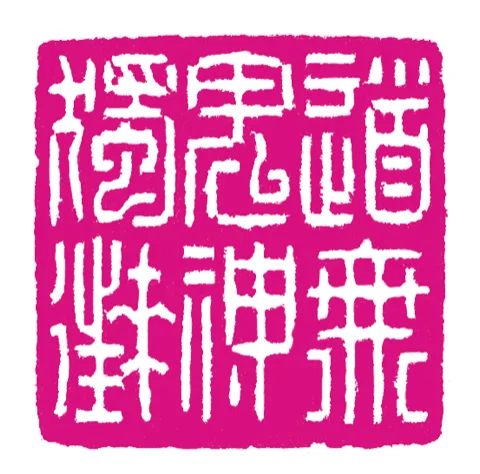
If one can take Heaven as model and Earth as standard〔1〕, moving in resonance with what one meets, the harmonious response is like the rebound of struck bronze, the answering presence like the shadow that follows a body. The Way has no ghosts or gods — it comes and goes alone〔2〕. (Suwen · Discourse on Preserving Life in Fullness)
Notes: 【1】Take Heaven as model and Earth as standard: 法 means to follow; 則 means to keep to. Heaven is the Way of Heaven; Earth is the Way of Earth. The Way of Heaven and Earth is the Way of space-time. Below it are the virtue of Heaven and Earth, the technique of Heaven and Earth, the principle of Heaven and Earth… Heaven and Earth pertain to every great realm of the Way: their birth, their spirit, their qi, their essence, their harmony, their number, their order, their kinds… their pivot, their transformation, their mutation, their state, their tendency, their image… their form, their vessel, their base, their thing, their light, their minuteness… The body of Heaven and Earth is the very last terminal of all of these. 【2】Comes and goes alone: 獨 means singularly one, without second. Comes is to enter; goes is to exit. Exit-and-entry is the transformation of space-time; coming-and-going is the working of the spirit-pivot. Suwen · Great Treatise on the Six Subtleties: "If exit-and-entry stop, the spirit-pivot's transformation perishes; if rise-and-descent cease, the qi-standing stands alone, in danger." Lingshu · The Root Spirit: "What follows the spirit in coming-and-going is called hun; what attends the essence in exit-and-entry is called po." Opening-closing, exit-entry, motion-stillness, rise-descent — without self, without thing, without master, without faction — this is what is meant by "comes and goes alone." Compare the Suwen · Discourse on the Heavenly Innateness of High Antiquity's "stand alone and guard the spirit," and the Suwen · Discourse on Preserving Life in Fullness's "go out and come in alone."
If one can keep to the Way of Heaven and follow the Way of Earth, moving in answer to the rhythm of space-time's transformations, the manifest harmony of one's effect is like the sound returning when a drum is struck, and the merit that follows is like the shadow accompanying a body in the sun. The Way of the spontaneous is governed by no ghosts or gods — the spirit of life can come and go alone, between Heaven and Earth.
A Human Being Arises from the Qi of Heaven and Earth, Forms by the Law of the Four Seasons
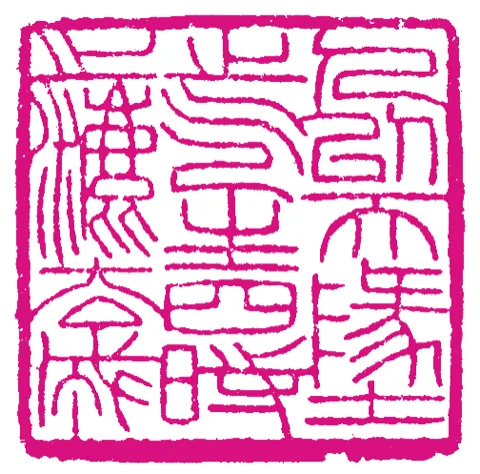
Heaven covers, Earth bears〔1〕; the ten thousand things are all in place, and none is more honored than the human. A human being arises from the qi of Heaven and Earth, and forms by the law of the four seasons.〔2〕 (Suwen · Discourse on Preserving Life in Fullness)
Notes: 【1】Heaven covers, Earth bears: "covers" is to contain; "bears" is to hold up. Heaven is hidden and Earth is shown; Heaven is empty and Earth is full. Heaven, hidden, covers; Earth, shown, bears. Heaven, empty, contains; Earth, full, holds up. Heaven and Earth, above and below, call to one another. Form and qi affect one another, and the ten thousand things are transformed and born. Heaven, by emptiness, covers and contains the ten thousand things; Earth, by fullness, holds up and bears the ten thousand things. 【2】A human being arises from the qi of Heaven and Earth, forms by the law of the four seasons: the Chinese Way of medicine presents the human being not only as an originally-one and intercommuning life-process, but also presents life and the spontaneous together as an originally-one and intercommuning movement-process. A person's life is brought into appearance by the movement-transformation of yin and yang in Heaven and Earth, and is shaped by the orderly succession of the four seasons. Which is to say: human and the spontaneous appear in the same operating process, and abide by the same space-time law. The deep insight that human and the spontaneous are originally one and intercommuning is the concentrated reflection of Chinese cultivation of root-and-origin understanding. It accomplished the unique structure of method and principle in the Chinese Way of medicine, and shows forth the singular brilliance of ancient Chinese culture.
Heaven, by emptiness, covers and contains; Earth, by fullness, holds up and bears. The ten thousand things flourish, all in place, and the most honored, most precious of them is the human. The human appears through the movement of yin-yang in Heaven and Earth, and is shaped by the law of the four seasons' transformations.
Whoever Can Measure the Transformations of Yin-Yang Will Not Lose the Four Seasons
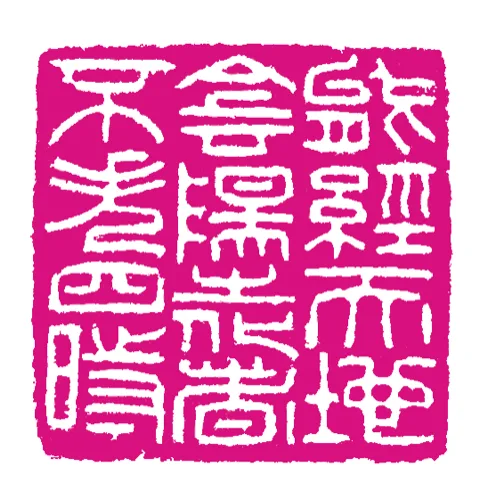
Heaven has yin and yang; the human has the twelve nodes〔1〕. Heaven has cold and heat; the human has empty and full. Whoever can measure the transformations of yin and yang in Heaven and Earth〔2〕 will not lose the four seasons; whoever knows the principle of the twelve nodes cannot be deceived even by the wisdom of the sage〔3〕. (Suwen · Discourse on Preserving Life in Fullness)
Notes: 【1】Twelve nodes (十二節): the twelve channels (經脈). Lingshu · Nine Needles, Twelve Origins: "The crossings of the nodes — three hundred and sixty-five meeting-points." Also: "What is called node is where the spirit-qi wanders out and in; it is not skin, flesh, sinew, or bone." The bronze-inscription form of 節 shows growing bamboo above and a vessel of use below — the root sense is the use of a bamboo joint, with the implied sense of constraint and regulation. The meridians-and-channels are the way that life's activity links itself; the channels themselves are where the life's spirit-qi wanders out and in. The meridians-and-channels are the net; the channels themselves are the lines. As bamboo grows joint by joint upward, the spirit-qi advances joint by joint. The motion of the channel is point-by-point ignition, point-by-point becoming a line, line-by-line returning to an aperture, with the master aperture at the heart. Suwen · Discourse on the Spirit-Orchid Secret Canon: "The lung is the official of the assistant-tutor; from it issues governance over the nodes." Govern means to lead; node means constraint. Govern means master; node means the channel. The channels begin at the lung; the lung holds court over the hundred channels. The Lingshujing speaks of "needling-the-nodes for the true-and-the-false," all of which discusses needling at the channels' opening-points. Past commentaries often gloss the twelve nodes as the upper-limb shoulder, elbow, wrist, and lower-limb hip, knee, ankle joints — left and right giving twelve in total. But that reading does not square with the next phrase "the principle of the twelve nodes," nor does it accord with the prior "yin and yang," nor does it match the following "wisdom of the sage." 【2】Measure (經): to gauge. Shijing · Lingtai: "He began to lay out the Spirit Terrace." Commentary: "Jing is to measure it." 【3】Sage and wise (聖智): sage — the sage. The cultivating of life takes place at different realms. Suwen · Discourse on the Heavenly Innateness of High Antiquity: "The sage abides in the harmony of Heaven and Earth and follows the principle of the eight winds." Wise — the highest wisdom. The realization of the Way takes place at different realms. Lingshu · The Root Spirit: "Considering and disposing of things is called wisdom."
Heaven has the four seasons of yin and yang; the human has the twelve channels. Heaven has cold and heat, warmth and cool; the human has emptiness and fullness, vigor and decline. One who can measure the transformations of yin and yang in Heaven and Earth will not transgress the rhythm of the four seasons' return. One who has grasped the relations of the twelve channels — even sage-wisdom itself cannot deceive him.
Patterned on Yin and Yang, in Tune with Method and Number
The people of high antiquity — those who knew the Way〔1〕 — patterned themselves on yin and yang〔2〕, were in tune with method and number〔3〕, ate and drank with measure, kept regular hours, and did not exhaust themselves with reckless labor〔4〕. So they could keep form and spirit together〔5〕, live out the years Heaven allotted〔6〕, and depart only after a hundred. (Suwen · Discourse on the Heavenly Innateness of High Antiquity)
Notes: 【1】The Way (道): the ancient Chinese insight into the origin of nature and of life. The pursuit of that origin is humanity's eternal, unceasing work. Western thought devotes itself to studying concrete matter; the Chinese honor the Way that stands above all. The Way is the mark of the spontaneous (自在) — self (自) is the root, being-in (在) is its function; self is the empty (空), being-in is the temporal (時) … The Way is so great there is nothing outside it, so small there is nothing within it, threading through being and non-being, encompassing the ten thousand images. It encloses the entire infinite spontaneous process. Within that process, the mutual interactions of various modes of motion are the root cause of every appearance and every transformation. So the Way also marks every relation and every interaction… 【2】Yin and yang belong to the number-Way (數道). They can be classified within every realm of the Way. In the realms of qi, of nature, and of image, they classify two kinds of opposed-and-paired modes of motion, together with their tendencies and their manifest forms. Yin and yang mark the most basic modes of operation in the spontaneous process — and so they are also the source of every process's arising, growth, and change. 【3】Method and number (術數): method is the law of the spontaneous, not the modern "technology." Number is a mode of operation, not the modern "mathematics." Here it points to the laws of change that emerge from different modes of operation in the spontaneous, and the application of those laws. May also read as number-method, in contrast with arithmetic. But because Western arithmetic was translated as "mathematics," confusion with the Westernized concept arises easily. Arithmetic describes concrete forms and quantitative relations of material structure; number-method shows the space-time modes and operational relations of the spontaneous process. The "number" here is the number of the spontaneous, not the number of quantity. The mutual interactions of motion modes in the spontaneous show the rhythms of number and sequence — yin-yang, three origins, four images, five phases, six qi, eight trigrams, nine palaces, and so on. Note: "in tune with method and number" is also cited as "knowing method and number" in the Lei Shuo, vol. 37. 【4】Did not exhaust themselves with reckless labor (不妄作勞): the Taisu reads "not reckless and not contriving"; the New Commentary takes Quan Yuanqi's text as the same. 作 communes with 詐 (deceit) — in the Qin and Han the two characters were both pronounced as the entering tone. The text Wang Bing relied on changed not contriving to reckless labor, treating 作 as "doing." That reading also makes sense. 【5】Form and spirit together (形與神俱): the modes of vital activity include form (形), qi (氣), spirit (神), and others. Form is the local mode of vital activity; qi is the universal mode; spirit is the directing mode. Form, qi, and spirit must be joined together if one is to live. 【6】Years Heaven allotted (天年): a person's Heaven-given lifespan. Far beyond a hundred years. Some hold that the highest measure is a hundred and twenty, the middle measure a hundred, the lower measure eighty.
Among the people of high antiquity there were those who knew the Way of the spontaneous: they followed the movements of yin and yang in Heaven and Earth, were in tune with the changes of cosmic method-and-number, took every meal with measure, lived in regular routine, and did not throw themselves into reckless overwork. Therefore they could keep form and spirit gathered together, live out their full Heaven-given span, and depart only after passing a hundred.
Holding the Fullness, Mastering the Spirit
The people of today are otherwise. They take wine for water〔1〕, take recklessness for the norm, in their drunkenness enter the chamber〔2〕, in their craving exhaust their essence〔3〕, in their wasting scatter their true qi〔4〕, do not know to hold the fullness, do not master their spirit at the right moments〔5〕 — devoting themselves to whatever pleases the heart, going against the joy of life, irregular in rest and rising. So they grow old at fifty. (Suwen · Discourse on the Heavenly Innateness of High Antiquity)
Notes: 【1】Water (漿): a kind of drink in antiquity. 【2】In drunkenness enter: should read with drunkenness enter. Enter the chamber (入房): chamber affairs, that is, sexual activity. 【3】Craving (欲): desire, greed. Essence (精): essential qi, pure qi — the most basic mode of vital activity related to birth, growth, maturity, and aging. To distinguish it from other modes of vital activity, essence and qi or essence-qi-spirit are sometimes named together. To distinguish their yin-yang properties, yin-essence and yang-qi are sometimes named in pair. Essence, qi, and spirit belong to the qi-Way. Yin and yang belong to the number-Way; the number-Way belongs to the harmony-Way. All these Ways thread up and down, and stand left and right in subordinate relation. 【4】Wasting (耗): to reduce, to lose. The New Commentary's citation from the Jiayi Jing gives 好 (love); Hu Shu agrees. Love there means desire — "loving to scatter the true" pairs with "in craving exhausting the essence." Shen Zumian gives 秏 (empty-out), with the sense of depleting. He also conjectures the line should read "scattering and depleting the true" — also in pair with "in craving exhausting the essence." True (真): the primal true qi — the earliest mode of vital activity. 【5】Master at the right moments (時御神): not at the right moments, not in step. Yu (御): to use. The New Commentary: "in another text 時 reads as 解." Solving (解) and knowing (知) parallel here.
The people of today are not so. They take wine as if it were water, treat wild and reckless behavior as the norm; in deep drunkenness they enter the bed-chamber, give the rein to desire and exhaust their yin-essence, let their primal true qi be used up and scattered. They do not know to keep the essential qi full; they do not measure the use of their own heart-spirit; they think only of pleasing the heart, run counter to the principle of preserving life, have no regular rhythm of rest or rising. So they are old at fifty.
The Yin-Yang of the Four Seasons Is the Root of the Ten Thousand Things
The yin and yang of the four seasons is the root of the ten thousand things〔1〕. Therefore the Sage cultivates yang in spring and summer, cultivates yin in autumn and winter,〔2〕 to follow that root, and so floats and sinks together with the ten thousand things through the gate of birth-and-growth〔3〕. To go against that root is to hew at the foundation, and to spoil the truth〔4〕. (Suwen · Great Treatise on Regulating the Spirit by the Four Qi)
Notes: 【1】Root (根本): the four seasons are spring, summer, autumn, winter; yin and yang thread through the four seasons. The four seasons are the change of time; that change in time has its origin in the motion of space. The motion-and-change of space-time is the root of the ten thousand things. If space did not move and time did not change, the ten thousand things would all perish. 【2】Cultivate yang in spring and summer, cultivate yin in autumn and winter: spring-summer are yang, autumn-winter are yin. Spring-birth, summer-growth, autumn-harvest, winter-storage. In spring-summer the yang qi is born and grows; in autumn-winter the yin qi is harvested and stored. Cultivating yang in spring-summer benefits the liver and heart; cultivating yin in autumn-winter benefits the lung and kidney. When spring-summer's birth-and-growth is at its full, to follow its current and yet not let it be over-used is to "cultivate yang"; when autumn-winter's harvest-and-storage is at hand, to follow its current and yet not let it be wantonly drained is to "cultivate yin." Past commentators differ. Wang Bing reads it as food temperature. Ma Shi and Zhang Zhicong read it as inner-outer waxing-waning of yin and yang. Gao Shishi reads it as birth-growth-harvest-storage. Li Shizhen reads it as drug appropriateness. 【3】Float and sink (沉浮): to sink is to descend; to float is to rise. Yang rises and yin descends; yin rises and yang descends. When yang rises and yin descends, there is birth-and-growth; when yin rises and yang descends, there is harvest-and-storage. Below, "birth-and-growth" stands implicitly for "birth-growth-harvest-storage." Gate (門): here, the gate of opening-closing exit-entry, the gate of birth-upon-birth and transformation-upon-transformation, the gate of motion-stillness-waxing-waning… Laozi: "The mystery of mysteries — the gate of all wonders." A gate must have a pivot, a pivot must have a spring; when the spring releases, transformation; when transformation reaches its limit, mutation. The ten thousand mutations issue from a single spring. The spring is the source of all transformation and mutation. 【4】True (真): the primal true qi. The earliest mode of vital motion. The source from which spirit-qi-form arise. Some read it as "body."
The motion-and-change, rise-and-fall, of yin and yang in the four seasons is the root of birth, growth, harvest, and storage of the ten thousand things. Therefore the Sage cultivates yang qi in spring and summer, cultivates yin qi in autumn and winter, in order to follow this root — and so floats and sinks together with the ten thousand things in the spring-released transformations of birth-growth-harvest-storage. To go against the root of yin-yang in the four seasons is to wound the foundation of life and to spoil one's primal true qi.
The Yin-Yang of the Four Seasons Is the End and the Beginning of the Ten Thousand Things
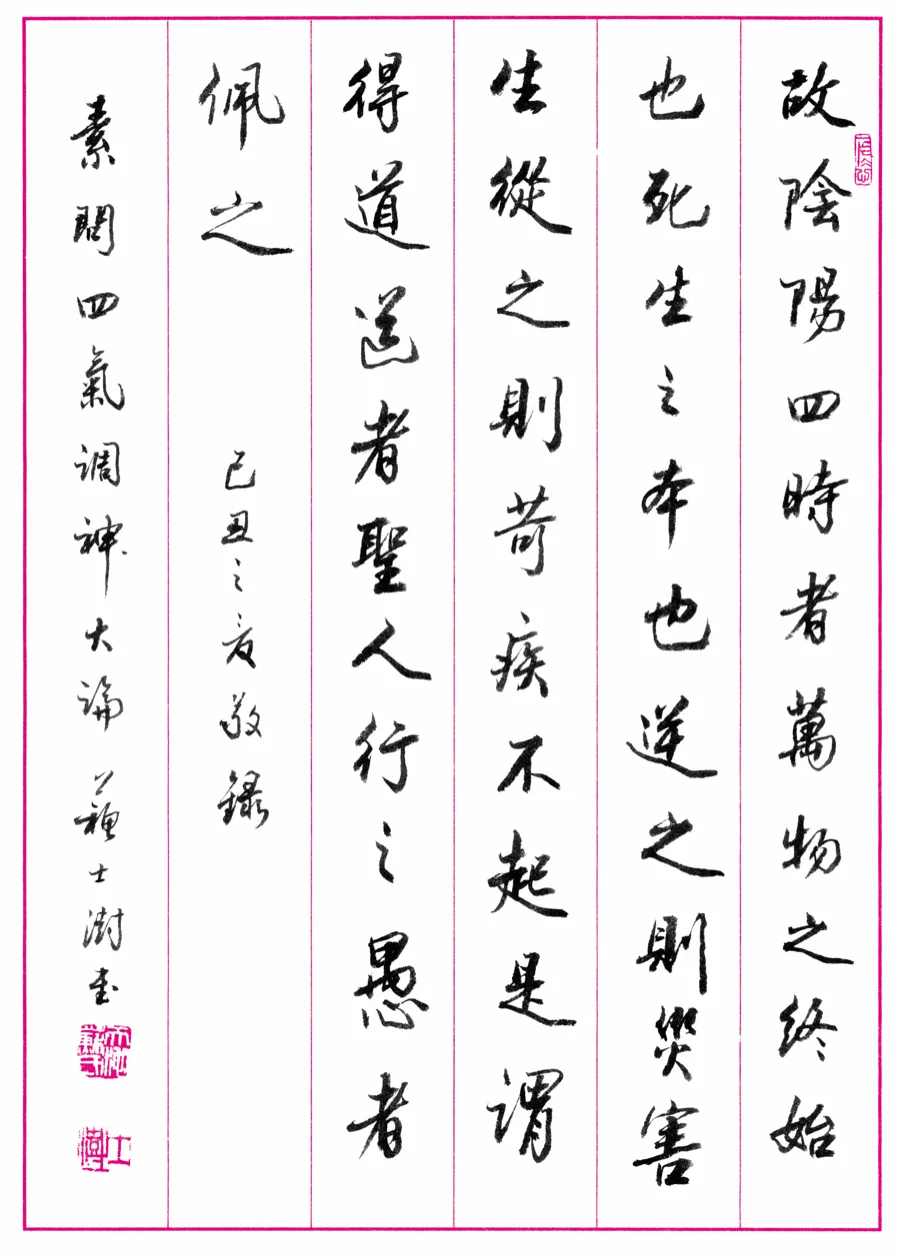
So yin-yang and the four seasons are the end and the beginning of the ten thousand things〔1〕, the root of death and life. Going against them, calamity arises; following them, no grave illness rises〔2〕 — this is what is called attaining the Way. The Way: the Sage practices it; the fool turns his back on it〔3〕. (Suwen · Great Treatise on Regulating the Spirit by the Four Qi)
Notes: 【1】End and beginning (終始): end is past, not future; beginning is future, not past. The future is non-being; the past is being. Non-being is hidden; being is shown. Non-being gives rise to being; being is born from non-being. End-before-and-beginning-after — said of things. A thing's end comes first; a thing's beginning comes after. Said of time: from before, then after. Self is beginning; thus is end. From beginning to end is an unbounded process. But what we call "process" today is mostly the narrow sense. Lingshu · End and Beginning: "All the Way of needling is summed up in end-and-beginning. Knowing end-and-beginning, with the five storehouses as ordering principle, yin and yang are settled." Daxue: "Things have root and tip, affairs have end and beginning. To know what comes first and what comes after is to come close to the Way." 【2】Grave (苛): heavy. The Taisu reads 奇 (odd, exceptional). Disease (疾): illness. Shiming · Diseases: "When alien qi strikes a person, ji is an acute, swift onset." The oracle-bone and bronze-inscription forms of ji are pictographs — a person struck by an arrow at the side. The seal-script form became a phono-semantic compound: 疒 (illness radical) + 矢 (arrow). The oracle-bone form of bing (病) is an associative compound: a person lying on a bed and sweating. It figures the whole course of pathological-pivot adjustment. The seal-script became phono-semantic: 疒 + 丙. In pre-Qin times ji and bing were distinguished: ji was the acute strike of evil qi; bing was ji accumulated over days. It also figures the standoff of evil and right qi: treatment should fortify the right and dispel the evil. Shuowen: "Bing is ji added to." Yupian: "Bing is ji intensified." The two characters used in succession mean illness intensifying. In the Neijing the two are mostly synonymous. 【3】Turn the back (佩): communes with 倍 (turn against). The original character is 倍. Shuowen: "Bei (倍) is to turn against." It carries the sense of going against. Before the Qin, 背 communed with 北 (north), without the sense of "to depart from, go against." By the Eastern Han, "departing from / going against" was basically expressed by 背 rather than 倍 — showing that the entering tone was passing into the falling tone. The Lei Shuo and the Jiazang Jiyao Fang cite the line with 背 — that is the post-Han usage. Wang Bing read 佩 as "wearing as ornament, taking to heart" — that is wrong.
The motion-and-change of yin and yang across the four seasons of spring, summer, autumn, winter is the end at which the ten thousand things go and the beginning at which they appear — the root by which life lives and dies. Going against it, calamity arises; following it, grave illness cannot take hold. This is what is called being one with the Way. The Way that one should be one with: the Sage follows it and walks with it; the fool goes against it and walks the other way.
The Sage Treats Not What Has Become Illness but What Has Not Yet
Following yin and yang one lives; going against them one dies. Following them, there is order; going against them〔1〕, there is disorder. To turn following into going-against is what is called internal blockage〔2〕. So it is said that the Sage does not treat what has already become illness, but what has not yet〔3〕; does not treat what has already become disorder, but what has not yet — this is what the saying means. To medicate after illness is fully formed, to govern after disorder is fully arrived, is like digging the well only when thirsty, like casting the weapon〔4〕 only after battle has begun — is that not too late? (Suwen · Great Treatise on Regulating the Spirit by the Four Qi)
Notes: 【1】Order (治): to lead, to guide. Used here as a noun meaning settled peace. The character 治 has a water radical on the left, 厶 above on the right, and a mouth-form below. The oracle-bone 厶 shows the form of a rope-loop, used for leading animals. The root sense of 治 is to guide. Floods overflowing are a Heaven-sent disaster; many mouths out of tune are a man-made calamity. Guide the water and the water comes to order; guide mouths and the people come to order; when water and people are in order, the realm is in order. Order (治) and disorder (亂) are paired. Where there is no disorder, there is order. Guoyu · Qi: "If teaching is bad, then governance does not come to order." Ma Shi: "If one follows yin and yang, the qi of this body comes to order, and being in order, will surely have life; if one goes against yin and yang, the qi of this body falls into disorder, and being in disorder, will surely come to death." This uses order-and-disorder to figure life-and-death, comparing social affairs to the life process — and so makes it clear that the Way of following-versus-going-against is the great Way of nature, of society, and of human life. Following, there is order; going against, there is disorder. Following, there is life; going against, there is death. 【2】Internal blockage (內格): an illness name, also called 關格 (gate-blockage). Caused by internal closure and obstruction. 格 communes with 閣. Guangya: "Ge (閣) is to stop." Extended to mean obstruction. Wang Bing glosses ge as "to oppose." 【3】Treating what has not yet become illness (治未病): not yet means future, not "absent." Illness (病) means pathological pivot (病機), not "disease." Most ancient illness names took their name from the pivot or the manifest sign, and are not the same as today's "diseases." Treating what has not yet become illness is guiding the pivot of future illness, not "treating a disease that has not yet occurred." 【4】Weapon (錐): the Taisu (vol. 2, Shun Yang) reads 兵 (weapon). Ma Shi, Wu, Zhang Zhicong agree. Bing — implements, here meaning weapons of all kinds.
Following yin and yang one can live; going against them one dies. Following them brings order; going against them brings disorder. When following is turned into going-against, this is what is called "internal blockage." So it is said: the Sage does not treat what has already become illness but what has not yet — does not govern what has already become disorder but what has not yet. That is the meaning. To take medicine only after the illness is already formed, to govern only after disorder has already arrived — is like digging a well only when one is already thirsty, like forging the weapons only when battle has been joined. Is that not too late?
The Essential of Yin and Yang: When the Yang Is Tight, It Is Firm
In all the workings of yin and yang, the essential is this: when the yang is tight, it is firm〔1〕. When the two are not in harmony, it is as though spring without autumn, winter without summer. To bring them into harmony is what is called the Sage's measure. So when the yang is overactive and cannot be tight, the yin qi falls away. When the yin is at peace and the yang is tightly held〔2〕, the essence and spirit are in order; when yin and yang split apart and decide on parting, the essence-qi falls away. (Suwen · Discourse on the Communing of Living Qi with Heaven)
Notes: 【1】When the yang is tight, it is firm: the yang qi must be tight in order to guard firmly without. Because the prior text already said the yin "stores essence and rises in answer," the parallel "when the yin is at peace, it stores" is omitted here. Below, the abridged forms about "what each season injures" follow the same pattern. The Taisu · Regulating Yin and Yang reads "when the yin is tight, the yang is firm." Yang Shangshan: "Tightness within is the strength of the yin; firmness without is the strength of the yang." 【2】Yin at peace, yang tightly held (陰平陽秘): peace (平) — harmony. Not the modern sense of "balance." "Balance" is a concept of the chemical level within the substance domain. In the realms above form-and-vessel, there is no equal-quantity balance. In the realm of spirit-qi, harmonized union is called peace; in the realm of transformation-and-change, coordinated tuning is called peace. Ancient Chinese mostly used one character for one name; concept is a thing made by translating from the West and borrowing into Chinese. The phrase "yin-yang balance" is a distorted construction. Yin at peace, yang tight really means yin and yang harmonized and joined. Tight (秘) — closely held. Yin qi at peace, guarded within; yang qi tightly held, firm without.
In all the workings of yin and yang, the heart of it is this: only when the yang is tightly held can it guard firmly without; only when the yin is at peace can it store and hold within. When the qi of yin and yang is not in harmony, it is as if there were spring without autumn, winter without summer. So the harmonization of yin and yang is named the Sage's measure. When the yang is over-used and cannot be tightly held, the yin qi will gradually be exhausted. When the yin is at peace and the yang is tightly held, the essence and the spirit are in coordinated order; when yin and yang lose harmony and break apart in decision, the essence-qi will follow them in falling away.
Do Not Disturb the Sinews and Bones; Do Not Show Yourself to Mist and Dew
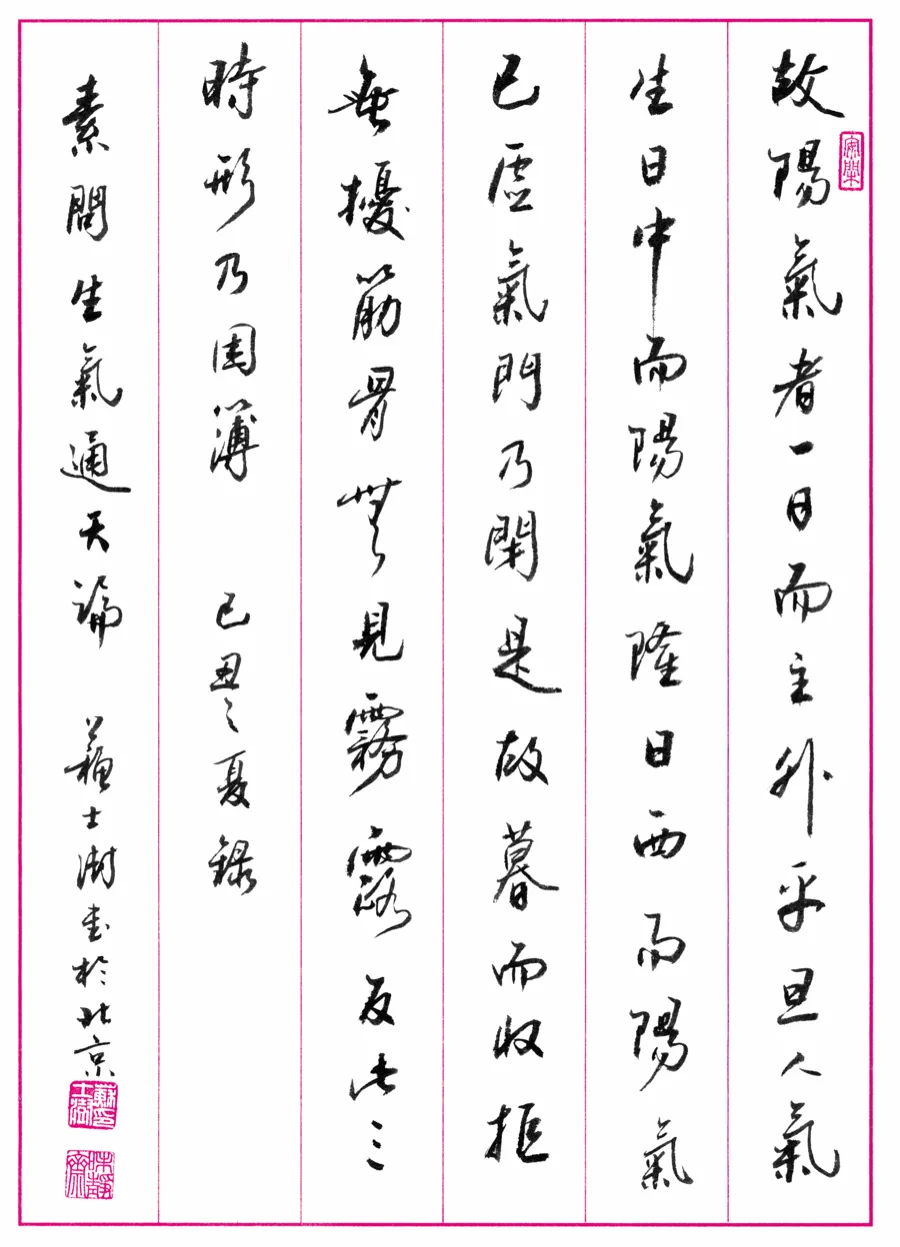
Therefore the yang qi rules outside through the day〔1〕. At dawn the human qi is born〔2〕; at noon the yang qi is at its height〔3〕; at the day's western turn the yang qi is already drawn in〔4〕, and the qi-gates close〔5〕. So at dusk one gathers in and warns off, does not disturb the sinews and bones, does not show oneself to mist and dew. To go against these three times is to make the body fall under siege. (Suwen · Discourse on the Communing of Living Qi with Heaven)
Notes: 【1】Rules outside through the day: in the relations between the qi-Way and the number-Way, yin-qi and yang-qi are the number of qi — that is, the yin-yang attribution of qi. With respect to being and non-being, yang is non-being, yin is being; with respect to motion and stillness, yang governs motion, yin governs stillness; with respect to inner and outer, yang governs the outer, yin governs the inner; with respect to day and night, yang governs the day, yin governs the night… Suwen · Discourse on the Communing of Living Qi with Heaven: "Yin: stores the essence and rises in answer; yang: guards what is outside and is the firmness." 【2】Dawn (平旦): the time at which the sun rises in the morning. Human qi (人氣): here, the person's yang qi. 【3】Noon (日中): midday. Height (隆): the image of the yang qi at the full of its growth. 【4】Day's west (日西): dusk. Drawn in (虛): the image of the yang qi being gathered back, not the yang qi being exhausted. Born-grown-drawn-in — the birth, growth, and harvest of the yang qi. The rhythm of three times across the day's transformations. At nightfall it is stored — just as in the four seasons. 【5】Qi-gates (氣門): the gates by which the yang qi diffuses. All the openings and pathways through which the human and the spontaneous communicate — not only the so-called sweat glands of the skin. Huainanzi · Heavenly Designs: "The pores, openings, and limbs all commune with Heaven."
In the life process the yang qi rules outside throughout the day. At dawn the yang qi begins to rise; at noon the yang qi reaches its full height; at dusk the yang qi has already drawn in, and the qi-gates close in answer. So at dusk the yang qi gathers in, guarding off evil qi from outside; do not disturb the sinews and bones; do not expose yourself to mist and dew. To go against the rhythm of yang activity in these three times is to leave the body under siege, pressed by evil qi.
Yin and Yang Are the Way of Heaven and Earth
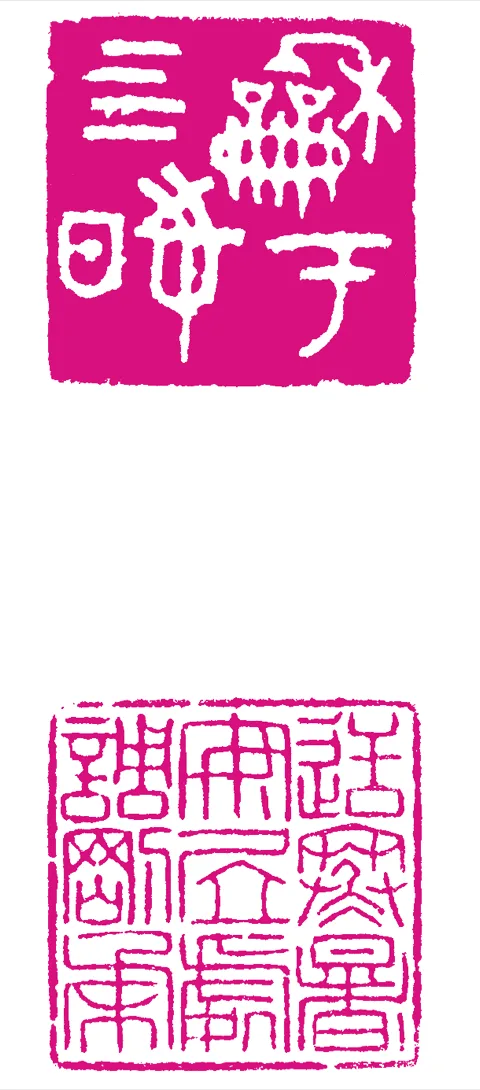
The Yellow Emperor said: Yin and yang are the Way of Heaven and Earth〔1〕, the great pattern of the ten thousand things〔2〕, the father and mother of mutation and transformation〔3〕, the root and beginning of life and death, the storehouse of the spirit and the bright〔4〕. Treating illness must seek the root〔5〕. (Suwen · Great Treatise on the Correspondence of Yin and Yang)
Notes: 【1】The Way of Heaven and Earth: here the great Way of the space-time motion-and-change of Heaven and Earth. Yin and yang belong to the number-Way; the number-Way belongs to the harmony-Way; the harmony-Way belongs to the time-Way. So yin and yang belong to the Way of Heaven and Earth. The Way of Heaven and Earth, in the realm of open-space, includes what we today call the mutual interactions of two kinds of natural force — the physical effects of mutually-interacting different phase-states of quantized curved space. And yin and yang can without question stand as marks for two kinds of mutually-interacting natural force. The Way of Heaven and Earth manifests itself as the yin and yang of the number-Way. Yin and yang can show the utter simplicity and ease of the Way. Only what is utterly simple and easy can be of universal use; therefore yin-yang and its derived sequences — the five phases and so on — became the Way's basic ordering principle. 【2】Pattern (綱紀): the gathering rope is gang, the dividing thread is ji. Here it figures how the ten thousand things come to be — from non-being to being, from hidden to shown, from the macroscopic to the subtle, from one to ten thousand — all proceed by yin and yang in pair as their pattern. 【3】Father and mother of mutation and transformation (變化之父母): father and mother carry the implied sense of source and origin. Suwen · Great Treatise on the Original Catalog of Heaven: "When a thing arises, this is called transformation; when a thing reaches its limit, this is called mutation." The source of transformation and mutation lies in the mutual interaction of yin and yang — and so yin and yang are the father and mother of every spring-released change. 【4】Storehouse of the spirit and the bright (神明之府): storehouse — Shuowen: "The place where documents are stored." Extended to mean gathering place, with the implied sense of fountainhead. "Yin and yang that cannot be measured is called spirit; yin and yang that are clearly evident is called bright." So yin and yang are the storehouse of the spirit and the bright. 【5】Treating illness must seek the root: yin and yang can stand as marks for two opposed-and-paired modes of vital activity. The mutual interaction of yin and yang is the source of the arising and developing of the life process. To seek yin and yang as the root in treating illness is to seek the root of the life process — not the "essence" of substantive structure-and-function. The space-time of life has three brightnesses: empty, joined, open. The life process has three boundaries: birth, qi, harmony. Vital activity has three origins: spirit, qi, essence. The three brightnesses are root; the three boundaries are tip. Root and tip cover all realms. In the realms of spirit, qi, and essence, they reflect the master-servant, inner-outer, hidden-shown relations among modes of activity in the life process — as well as the priority of the heavy versus the light, the master versus the subordinate in clinical observation; the urgent versus the slow, the prior versus the latter in regulating-treating prescription. Extending widely: between a person's life process and pathological process, the person is root and the illness is tip; between a sick person and a physician, the illness is root and the physician is tip; between the four seasons and the five storehouses on one hand and the four limbs and the hundred bones on the other, the four seasons and five storehouses are root and the four limbs and hundred bones are tip. Xue Ji: "Treating illness, seek the root — the root is the four seasons and the five storehouses." The root of the storehouses is in the spleen and kidney. Li Zhongzi: "The roots of the human body are two: one is pre-Heaven, one is post-Heaven. The pre-Heaven root is in the kidney; the post-Heaven root is in the spleen." Between pathological pivot and pathological sign, the pivot is root and the sign is tip. The root of the pathological pivot lies in cause, attribution, and tendency. Chinese-medicine pathological-pivot reasoning is not about locating, characterizing, or quantifying — it seeks cause, attribution, and tendency. Zhang Zhicong: "Seek whether the root of the illness lies in yang-evil or yin-evil." This is seeking the cause. "Seek whether the illness is in the yang-portion, the yin-portion, the qi-portion, the blood-portion." This is seeking the attribution. Zhang Jiebin: "The root of all illness is just these six: surface and inner, cold and heat, empty and full." This is seeking the tendency. Empty-full and cold-heat are local tendency; surface-inner is broad tendency. All can be marked by the yin-yang of the number-Way.
The Yellow Emperor said: Yin and yang belong to the great Way of the space-time motion-and-change of Heaven and Earth, the ordering pattern by which the ten thousand things come to be, the source of every change, the first cause of growth and dissolution, the place where the spirit-pivot is bright. To treat illness one must seek the root.
Adapt to Cold and Heat, Settle the Dwelling, Tune the Hard and the Soft
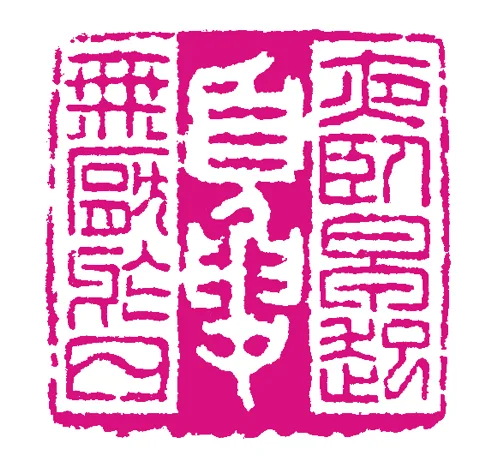
So the wise one's cultivation of life〔1〕 must follow the four seasons in adapting to cold and heat, harmonize joy and anger in settling the dwelling〔2〕, and moderate yin and yang in tuning the hard and the soft〔3〕 — and so slanting evils〔4〕 do not come; life is long, and the gaze endures. (Lingshu · The Root of the Spirit)
Notes: 【1】Wise one (智者): one who has attained a higher realm of awakening to the Way — not what is now called "clever and intelligent." Thought leads to reflection, reflection to wisdom. Lingshu · The Root of the Spirit: "What the heart holds in memory is called will; where the will dwells is called resolve; what changes from the resolve is called thought; what thought longs after from afar is called reflection; what reflection settles among things is called wisdom." The eight great realms of awakening to the Way: Way, Virtue, Art, Principle, Wisdom, Reflection, Learning, Skill — the Great Way, highest Virtue, hidden Art, manifest Principle, supreme Wisdom, deep Reflection, subtle Learning, last Skill. Wisdom is among the higher realms. 【2】Settle (安): the realm near the Way. Halt, fix, still, settle, reflect, attain — only then can one come near the Way. Daxue: "Knowing where to halt, then there is fixity; in fixity, one can be still; in stillness, one can be settled; settled, one can reflect; reflecting, one can attain." 【3】Tune (節): harmonize. Lüshi Chunqiu · Valuing the Self: "Tune to one's nature." Commentary: "Tune is the same as harmonize." Hard and soft (剛柔): here, the natures of yin and yang. Yang is hard, yin soft; yang strong, yin weak. Lingshu · Lifespan, Hard-and-Soft: "I have heard that in a person's life there are the hard and the soft, the weak and the strong, the short and the long, the yin and the yang." 【4】Slanting (僻): off-line, slanted. Slanting evils — evil qi that has lost its rightness.
The wise person, having attained the higher reach, cultivates life by following the motion-and-change of the four seasons and adapting to the shifting of cold and heat, by harmonizing the seven feelings of joy and anger and settling the dwelling in clear stillness, by harmonizing yin-yang's transformations and bringing the natures of hard-and-soft into accord. So evil qi cannot strike, and life endures.
Spring: Lie Late and Rise Early, Walk Broadly in the Courtyard
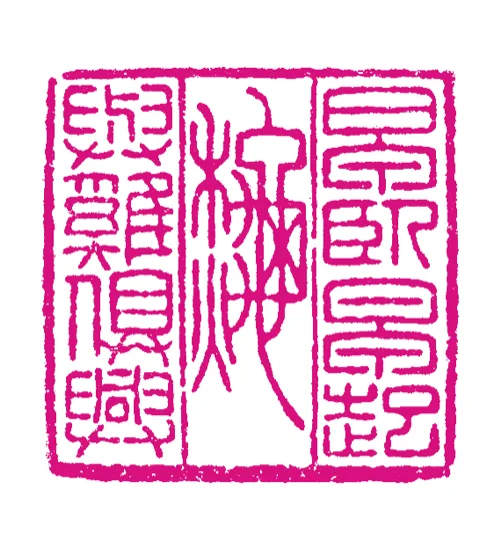
The three months of spring〔1〕 are called bringing-forth-the-old〔2〕. Heaven and Earth give birth together; the ten thousand things flourish. Lie down at night and rise early; walk broadly in the courtyard〔3〕; loose the hair and slacken the body〔4〕, that the will may arise. Bring it to birth, do not slay it; give to it, do not take from it; reward it, do not punish it. This is the answer to the spring qi, the Way of cultivating life〔5〕. To go against it injures the liver〔6〕; in summer it turns into cold-illness〔7〕, and the strength to meet the growing-qi is little〔8〕. (Suwen · Great Treatise on Regulating the Spirit by the Four Qi)
Notes: 【1】Three months of spring: the first, second, and third lunar months — by solar terms, from Beginning of Spring to Beginning of Summer. 【2】Bringing-forth-the-old (發陳): fa — to set forth; chen — long-standing. Here it figures the pushing-out of the old and the issuing-forth of the new. Wang Bing also reads it as "displaying one's bearing." 【3】Walk broadly (廣步): guang — wide, broad. Here, strolling at ease. It also carries the hidden sense of strolling under Heaven's open court. The Zhubing Yuanhou Lun writes "step widely in the courtyard" — to avoid the taboo on Emperor Yang's name. 【4】Loose the hair, slacken the body (被髮緩形): bei communes with pi (to drape, to put off). Pi carries the sense of letting fall. Hair may figure miscellaneous thoughts and vexations. Slacken — loosen. Ma Shi: "Loose the hair so nothing binds it; slacken the body so nothing constrains it — let the will arise here." Zhang Jiebin: "Move gently in answer to spring qi; the spirit settles and the will rises — this is the meaning of let arise." Yang Shangshan: "Walk broadly in the courtyard — use motion to let the will arise; loose the hair, slacken the body — use rest to let the will arise." The kidney stores the will; the heart stores the spirit. The hidden sense is loose stillness and open emptiness, so the will may arise and the spirit be bright — not loose-and-careless lack of restraint. 【5】Arising (生): the rising-and-issuing qi of springtime. The spring's Way of cultivating life lies in nurturing the arising qi. Spring's arising-qi and summer's growing-qi are yang; autumn's gathering-qi and winter's storing-qi are yin — hence the saying below: "in spring and summer nourish the yang; in autumn and winter nourish the yin." 【6】Injures the liver: in five-storehouse classification the liver, and in four-season classification the spring, both belong to the wood phase. The liver answers to spring; going against spring's arising qi injures the liver. 【7】Cold-illness (寒變): an illness name. Most commentators have read it as a pathological-pivot description — Ma Shi: "transformed by cold"; Zhang Jiebin: "heat changing into cold." But the parallel terms below — malaria, undigested-food diarrhea, flaccidity-with-coldness — are all illness names. When liver-wood is injured, it cannot generate heart-fire; with heart-fire deficient, cold-illness easily arises in transformation — hence the name. 【8】Strength to meet the growing-qi is little (奉長者少): feng — to supply, extended to mean adapt to. Zhang — summer's growing-qi. Little — insufficient strength to adapt to it. The phrases that follow — strength to meet the gathering / the storing / the arising is little — all carry the same sense.
Springtime's three months are the time of pushing out the old and issuing forth the new. Heaven and Earth are full of life-qi; the ten thousand things move and grow because of it. In this season one should sleep late and rise early, let the spirit qi roam in Heaven's open court, loose the hair and slacken the body in stillness and emptiness, so the kidney's will arises and the spirit is bright of itself. Bring it forth — do not destroy it; give to it — do not take from it; reward it — do not punish it. This is the way to be in answer to spring qi, and so to nurture the arising qi. Going against this rule injures the liver qi; in summer one may suffer cold-illness, and the strength to meet the growing qi will diminish.
Summer: Lie Late and Rise Early, Do Not Tire of the Day
The three months of summer〔1〕 are called flourish-and-show. The qi of Heaven and Earth meet; the ten thousand things bear flower and fruit〔2〕. Lie down at night and rise early; do not tire of the day〔3〕; let the will be without anger; let the flower-bright〔4〕 reach its full clarity; let the qi vent itself, as if what one loves were outside. This is the answer to the summer qi, the Way of nurturing the growing-qi. To go against it injures the heart; in autumn it turns into malaria〔5〕, and the strength to meet the gathering-qi is little. When winter comes, grave illness follows. (Suwen · Great Treatise on Regulating the Spirit by the Four Qi)
Notes: 【1】Three months of summer: the fourth, fifth, and sixth lunar months — by solar terms, from Beginning of Summer to Beginning of Autumn. 【2】Flower (華): the old form of 花. The oracle-bone graph for 華 shows blossoms opening on a tree. The blossom-time is the zhang (growing-and-transforming) of birth-grow-transform-gather-store. Zhang leads to transform, made manifest in use. Flower may figure the becoming-manifest of use. Summer is the time of growing-and-transforming, hence the saying that the ten thousand things "bear flower and fruit." Fruit (實): used here as a verb. 【3】Tire (厭): grow weary. Also communes with 饜 (sated). Shuowen: "Yan (饜) is to be sated." Duan Yucai: "When the belly is full the will tires — extended therefore to mean weariness, distaste." 【4】Flower-bright (華英): blossoms used as a figure for the spirit-light, meaning the spirit-light is bright as blossoms and leaves. Zhang Jiebin: "It speaks of the spirit qi." 【5】Malaria (痎瘧): an illness name, the general term for malarial fevers. Shiming · Diseases: "Nüe — cruel and tormenting. Most diseases are either cold or hot; this one is first cold and then hot — two diseases together, like cruelty doubled."
Summer's three months are the time of flourishing and showing forth in beauty. The qi of Heaven and Earth meet above and below; every plant blooms and fruits. In this season one should sleep late and rise early; do not weary of the long day; let the will be settled and free of anger; let the spirit-light be full and clear; let the yang qi flow open and outward, as if what one loved were outside. This is the way to be in answer to summer qi, and so to nurture the growing qi. Going against this rule injures the heart qi; in autumn malaria may follow, and the strength to meet the gathering qi will diminish. When winter comes, grave illness will follow.
Autumn: Lie Early and Rise Early, Get Up with the Cock
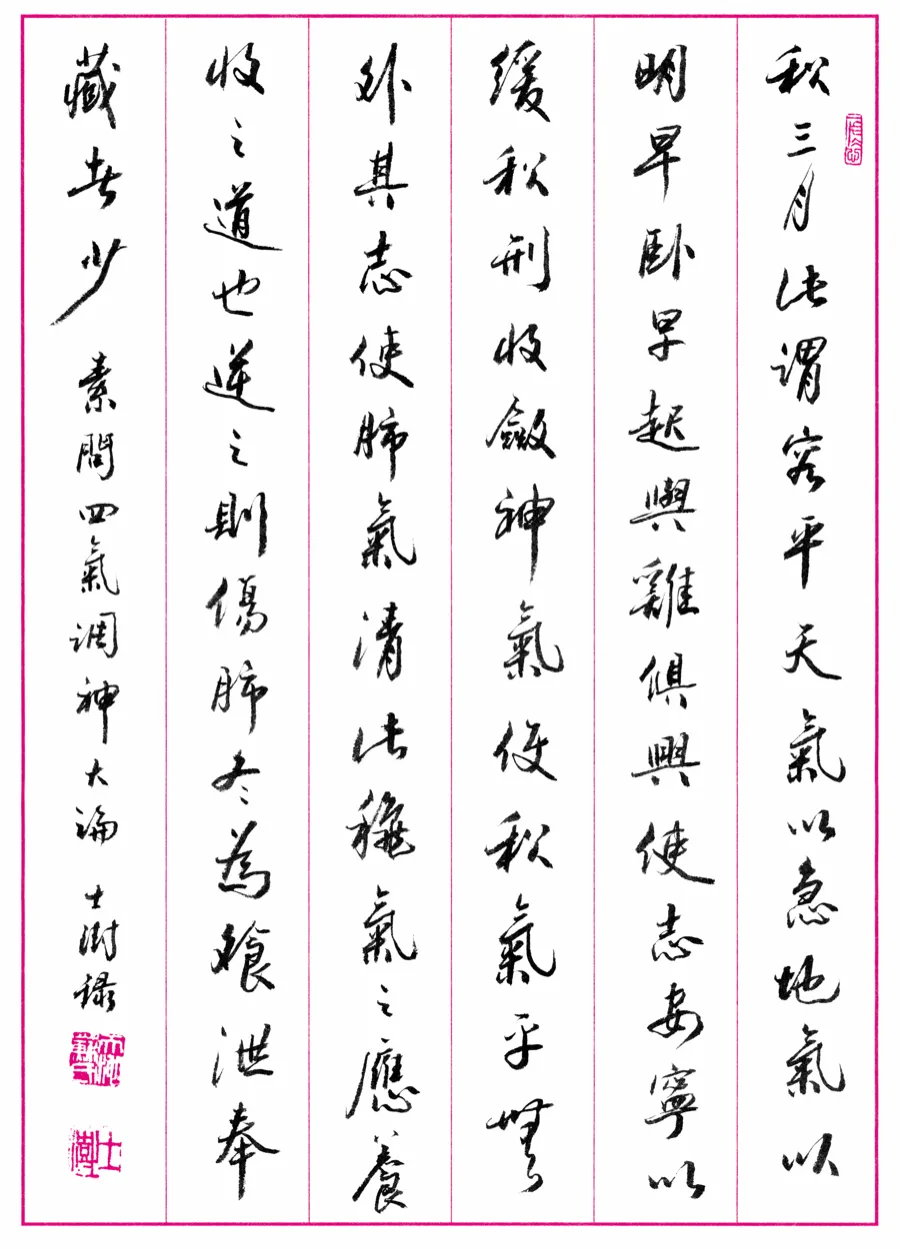
The three months of autumn〔1〕 are called holding-at-the-level〔2〕. Heaven's qi grows urgent; Earth's qi grows clear. Lie down early and rise early; rise with the cock〔3〕; let the will be at peace and quiet, to soften autumn's punishment〔4〕; gather in the spirit qi, and let the autumn qi be levelled; do not turn the will outward; let the lung qi be clear. This is the answer to the autumn qi, the Way of nurturing the gathering-qi. To go against it injures the lung; in winter it turns into undigested-food diarrhea〔5〕, and the strength to meet the storing-qi is little. (Suwen · Great Treatise on Regulating the Spirit by the Four Qi)
Notes: 【1】Three months of autumn: the seventh, eighth, and ninth lunar months — by solar terms, from Beginning of Autumn to Beginning of Winter. 【2】Holding-at-the-level (容平): rong — to hold, to receive (in the sense of containing, not of being filled to substance). Ping — even, with no leaning. What summer transformed, autumn now holds; what summer brought to abundance, autumn now levels. Wang Bing reads it as "demeanor" and "settled level." 【3】Cock (雞): the same as 鸡. Xing — to rise; here, to rise early. 【4】Autumn punishment (秋刑): autumn qi cuts and stills; grass and trees wither — like punishments inflicted. Hence "autumn punishment." 【5】Undigested-food diarrhea (飧洩): an illness name. Also called cave-diarrhea (洞洩). Later ages call it water-passage (水利). Undigested food appears in the discharge. The Neijing also distinguishes other diarrheas: damp-flooding, gushing, soft-stool, duck-stool, and so on.
Autumn's three months are the time of holding-and-levelling-and-receiving. The air turns cool and the wind grows urgent; the earth grows still and bare, all things stand sober and clear. In this season one should sleep early and rise early, getting up with the cock at first light; let the will be quiet, settled, and at peace, to soften autumn's punishing qi; gather in the spirit qi which would otherwise float outward; bring the person into level harmony with autumn's qi; do not turn the will outward; keep the lung qi clean and clear. This is the way to be in answer to autumn qi, and so to nurture the gathering qi. Going against this rule injures the lung qi; in winter undigested-food diarrhea may follow, and the strength to meet the storing qi will diminish.
Winter: Lie Early and Rise Late, Wait for the Sunlight
The three months of winter〔1〕 are called closure-and-storing. Water freezes and the earth cracks〔2〕; do not disturb the yang〔3〕. Lie down early and rise late; one must wait for the sunlight; let the will lie hidden as if buried, as if holding a private thought, as if having already attained; flee the cold and approach the warm; do not let the skin vent, for the qi will quickly be lost〔4〕. This is the answer to the winter qi, the Way of nurturing the storing-qi. To go against it injures the kidney; in spring it turns into flaccidity-with-coldness〔5〕, and the strength to meet the arising-qi is little. (Suwen · Great Treatise on Regulating the Spirit by the Four Qi)
Notes: 【1】Three months of winter: the tenth, eleventh, and twelfth lunar months — by solar terms, from Beginning of Winter to Beginning of Spring. 【2】Crack (坼): pronounced chè, "to split open." 【3】Do not disturb the yang: the yang qi closes-and-stores in winter and should not be disturbed. Lie early and rise late — the dwelling-and-rising should store; as if buried, as if hidden — the spirit should not race outward; as if holding a private thought — the spirit qi guards within; do not let the skin vent — the yang does not leak outward. 【4】Quickly lost (亟奪): ji communes with ji 急 (urgent), and also with ji 極 (utmost). Shuowen: "Ji (極) is swift." Lost — to lose hold of. Winter is the season for the yang qi to be guarded; it should not be over-spent and dispersed. Shen Zumian suspects the two characters are reversed. Ji, ni, de rhyme in the old poetic finals. The Taisu reads "not at the utmost." 【5】Flaccidity-with-coldness (痿厥): an illness name. The principal sign is hand-and-foot flaccidity, weakness, and coldness.
Winter's three months are the time of closing and hiding-away. Rivers freeze and the earth cracks; movement should not disturb the yang qi. In this season one should sleep early and rise late, and must wait for the sunrise; let the will lie hidden as if covered over, as if holding something secret, as if already in keeping with what was sought; avoid the yin-cold and approach the yang-warm; do not let the openings of the skin lie open, lest the yang qi swiftly disperse. This is the way to be in answer to winter qi, and so to nurture the storing qi. Going against this rule injures the kidney qi; in spring flaccidity-with-coldness may follow, and the strength to meet the arising qi will diminish.
Do Not Go Against the Four Seasons
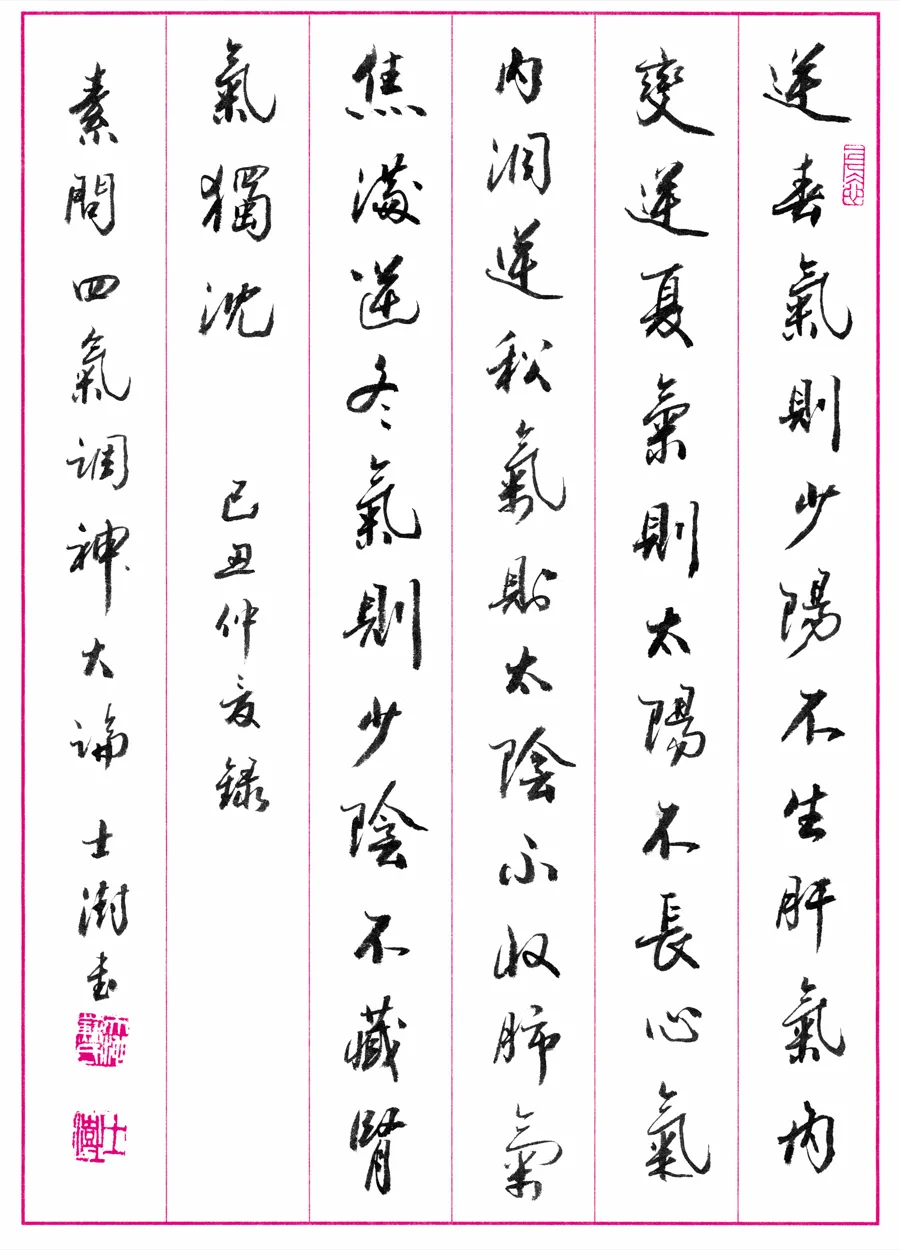
To go against the spring qi: the lesser yang does not arise〔1〕, and the liver qi changes within. To go against the summer qi: the greater yang does not grow, and the heart qi is hollowed out〔2〕. To go against the autumn qi: the greater yin does not gather〔3〕, and the lung qi parches and is full〔4〕. To go against the winter qi: the lesser yin does not store, and the kidney qi sinks alone〔5〕. (Suwen · Great Treatise on Regulating the Spirit by the Four Qi)
Notes: 【1】Lesser yang: spring answers to lesser yang; lesser yang answers to the arising qi; the arising qi answers to the liver. Summer answers to greater yang; greater yang answers to the growing qi; the growing qi answers to the heart. Autumn answers to greater yin; greater yin answers to the gathering qi; the gathering qi answers to the lung. Winter answers to lesser yin; lesser yin answers to the storing qi; the storing qi answers to the kidney. 【2】Hollowed out (洞): here, hollow-within. The Taiping Shenghui Fang cites it as 動 (moved). It has also been read as 痛 (pained). 【3】Greater yin: Shen Zumian — "lesser yin and greater yin in this passage should be interchanged." Greater yin belongs to the north and answers winter; lesser yin to the west and answers autumn. Worth considering. 【4】Parches and is full (焦滿): jiao — scorched. The same as Discourse on Flaccidity's "lung-heat scorching the leaves." Man — same as 懣, sound and sense as 悶 (oppressed). 【5】Sinks alone (獨沈): du communes with 濁 (turbid). Shen same as 沉. The Jiayi Jing reads 濁沉 (turbid-sunken); the Taisu, 沉濁 (sunken-turbid). Sunken — submerged. Here it means kidney qi heavy-and-turbid, sunken, unable to perform its proper work. The kidney qi in the eight trigrams is qian; the qian principle holds the great line and gathers all the yangs. Turbid kidney qi is not bright; sunken kidney qi cannot gather. Wu Kun: "The kidney qi sinking alone makes a person's knees feel heavy."
To go against spring qi: the lesser yang cannot arise and issue forth; the liver qi closes within and brings on disorder. To go against summer qi: the greater yang cannot grow to its fullness; the heart qi spends itself and is left hollow. To go against autumn qi: the greater yin cannot gather; the lung scorches and grows oppressed. To go against winter qi: the lesser yin cannot close-and-store; the kidney qi grows turbid and sinks down.
Contented Tranquility, Empty Non-Being — and the True Qi Follows
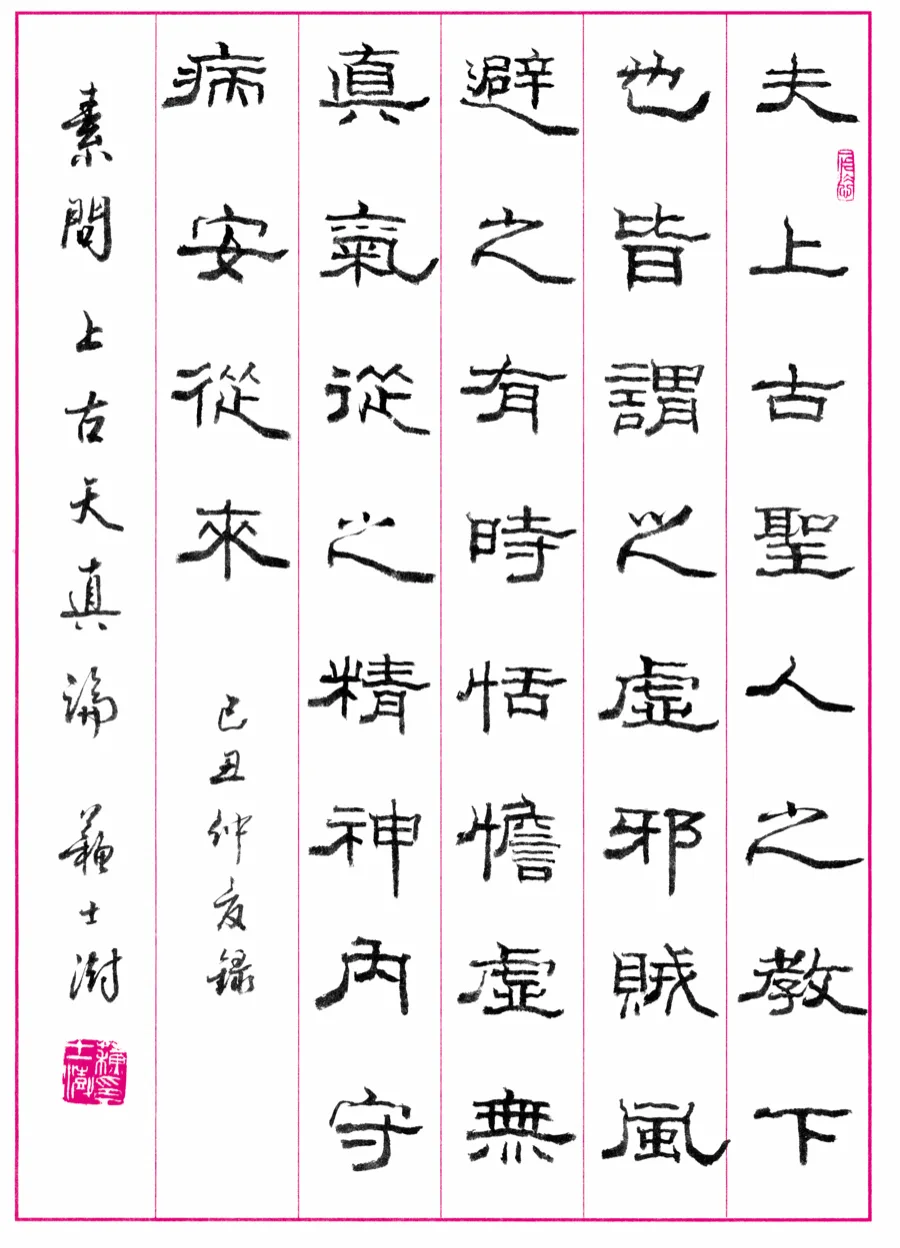
Now the Sages of high antiquity, in teaching those below them, all said: 〔1〕empty evils and bandit winds〔2〕, avoid them in their season; contented tranquility, empty non-being〔3〕 — and the true qi follows〔4〕; the essence and spirit are held within — from where, then, should illness come?〔5〕 (Suwen · Discourse on the Heavenly Innateness of High Antiquity)
Notes: 【1】Now the Sages of high antiquity, in teaching those below them, all said: Sage — here, one of high refinement in the Way of cultivating life. Below — the common people. The Xinjiaozheng cites the Quan Yuanqi recension: "The Sages of high antiquity taught — and those below all practiced." The Taisu and Qianjin read the same. 【2】Empty evils and bandit winds (虛邪賊風): empty — out of place: out-of-season evil qi falling on a person; evil — askew, the loss of harmony among the six qi turning into excess; bandit — sneak attack: pernicious qi that catches a person unprepared; wind — moving, swift and piercing pernicious qi. Together it names every out-of-season, askew qi that strikes a person where the body is empty. 【3】Contented tranquility, empty non-being (恬憺虛無): tian — still; dan — settled. The two old characters share the ding initial and the dan rhyme — a doubled-sound, doubled-rhyme compound. Tian-dan — clear stillness, settled and free of attachment toward the outside; empty-non-being — open emptiness, circling motion, alone-guarded within. The cultivation of life lies in clear stillness and open emptiness. Only when one enters the realm of empty-non-being does one attain the true sense of cultivating life. From essence transform into qi; from qi transform into spirit; from spirit return to emptiness; from emptiness return to its source; from source return to non-being — the highest realm of cultivating life. Laozi: "Reach the utmost in emptiness; hold to stillness with all earnestness." Emptiness at the utmost — return. Stillness in earnest — non-being. By way of returning to space-time one returns to non-being — the final return-to-the-root. 【4】True qi (真氣): the primal qi. The first beginning of life-qi. It comes from before-Heaven and decides the arising and developing of life. Lingshu · Cutting the Joint, the True Evil: "True qi is what is received from Heaven, joined with the qi of grain to fill the body." 【5】Illness (病): here, all the modes of life-activity that have lost their harmony, which can stir abnormal change in form, qi, and spirit. Illness is a process — the pathological process. The cause of the loss of harmony is called illness-cause (病因); the disordered mode of activity is called illness-qi (病氣); the trend of the disorder is called illness-tendency (病勢); the disordered state appearing is called illness-image (病象).
The Sages of high antiquity taught the people in this way: pernicious qi that strikes a person where the body is empty, in good season turn aside and avoid; settle in clear stillness and open-circling emptiness — and the true qi accords with you and follows; the essence and spirit are held within and do not race outward — from where, then, should illness come?
Putting the Spirit to Use
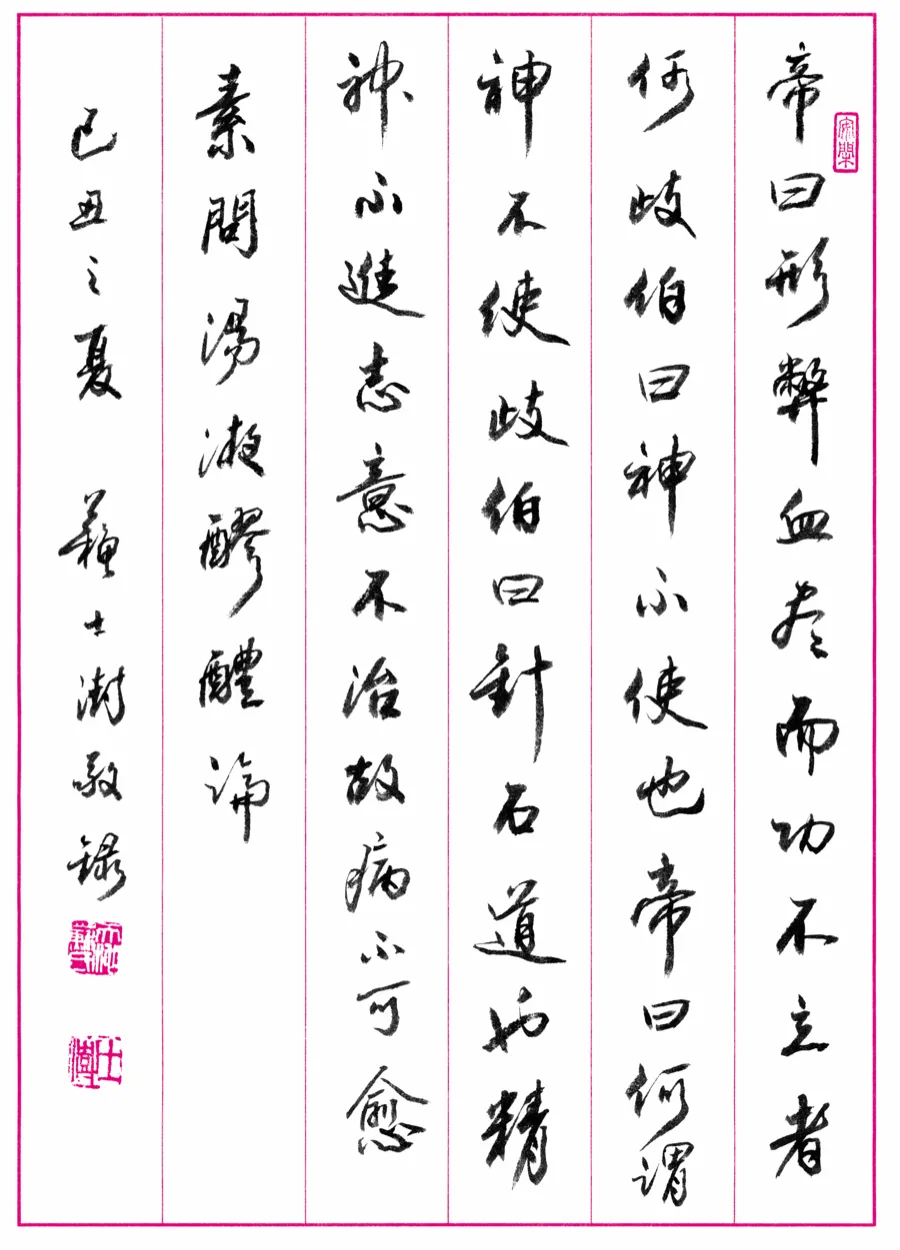
The Yellow Emperor said: when the body is worn and the blood spent, why does the working still not stand?〔1〕 Qi Bo answered: the spirit is not put to use〔2〕. The Yellow Emperor said: what is meant by the spirit not put to use? Qi Bo answered: needles and stones are tools; the Way is something else〔3〕. The essence-and-spirit does not enter〔4〕; the will-and-resolve is not in order〔5〕 — therefore the illness cannot be cured. (Suwen · Discourse on Decoctions and Wines)
Notes: 【1】Worn (形弊): the body grown decrepit. Bi — broken, wearied. 【2】Spirit not put to use (神不使): shi — to use, to set to work. Here it means the spirit cannot perform its function. The physician's spirit-treatment cannot meet the patient's spirit. Hence the line that follows: "Needles and stones are tools; the spirit moves between them." This corresponds to Suwen · Yi Jing Bian Qi Lun: "Treatment is brought to perfection in oneness." Whoever attains the spirit flourishes; whoever loses the spirit dies. When tip and root do not meet, the evil qi is not subdued. 【3】Needles and stones are tools; the Way is something else: needles and stones are merely a kind of implement; their use as tools is the Way. The Way of needle-and-stone tuning lies in the harmonious passage of the spirit qi. Their action upon a person must be moved by the spirit. When the spirit moves, the person regulates of himself. When the spirit does not move, the needle-and-stone work goes wild. To get qi is to receive the arrival of spirit qi; to fail to get qi is the spirit qi not arriving. The Way of the needle takes the spirit as its mover. The spirit takes the hun and po as its movers. The heart takes the heart-envelope as its mover… Lingshu · Heavenly Years: "The Way of using runs deep and long" — yet later commentators down to today have read the Way of using (使道) as "the nostrils" or "the philtrum." 【4】The essence-and-spirit does not enter (精神不進): jing-shen — essence-qi and heart-spirit, not what is now called "essence-and-spirit" (i.e. mental state). The spirit of life, classified by the five storehouses, is hun, shen, yi, po, zhi. What the heart stores is spirit in the narrow sense. The essence is fit to be stored; the spirit is fit to be guarded. Not enter means not enter into; if it does not enter, it floats away. 【5】The will-and-resolve is not in order (志意不治): zhi-yi — the kidney's will and the spleen's resolve, not what is now called will-consciousness. The will is fit to be stored; the resolve is fit to be still. Not in order means not regulated; if not regulated, they scatter and run wild.
The Yellow Emperor asked: when the body is worn down and the qi-and-blood are exhausted, why does treatment have no effect? Qi Bo answered: because the spirit cannot perform its work. The Yellow Emperor asked: what is meant by the spirit not performing its work? Qi Bo answered: needles and stones are no more than tools that act on a person; only through the spirit can one harmonize the various modes of life-activity. If the essence-qi and the heart-spirit have already floated away, and the kidney-will and the spleen-resolve have already scattered, the illness cannot be cured.
Ordering the Spirit
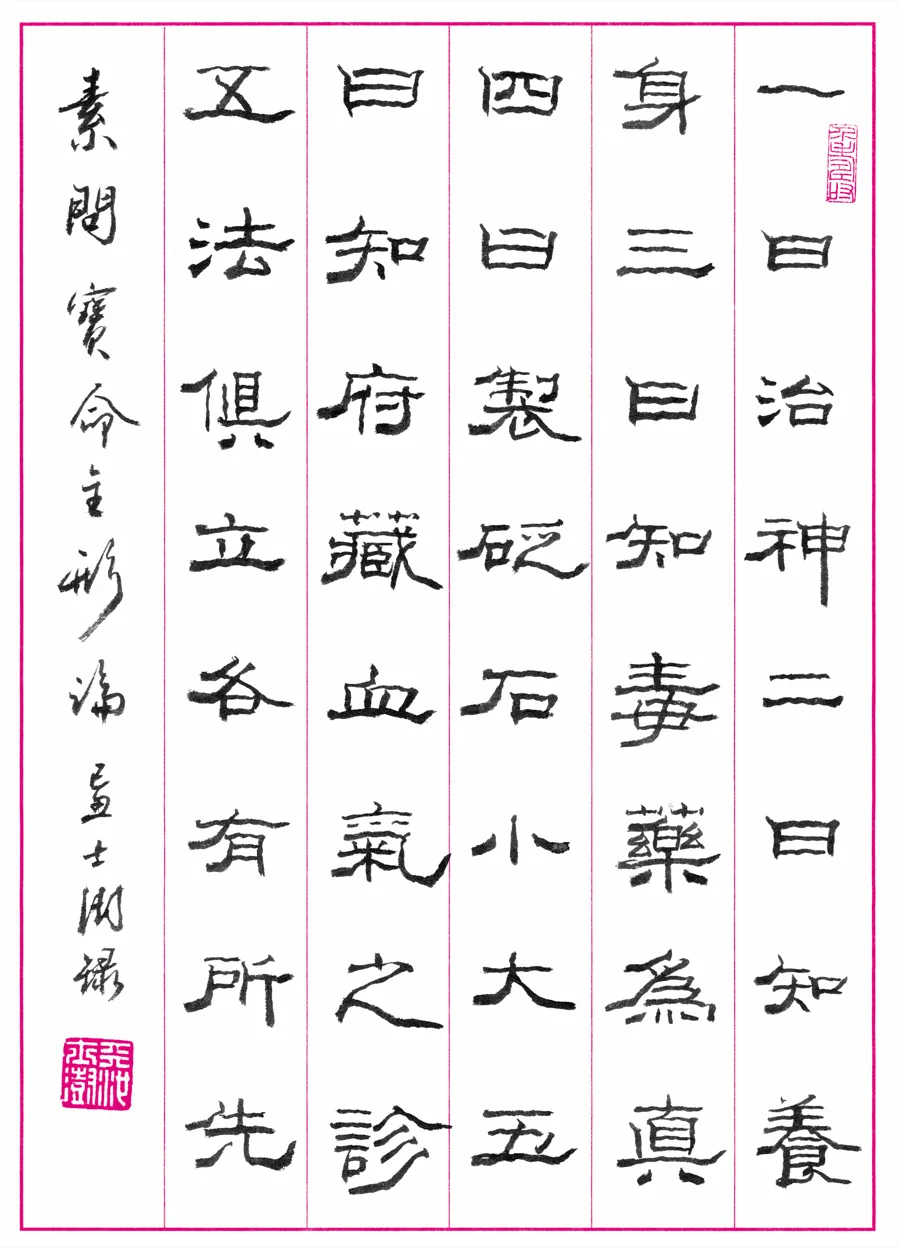
The first is to order the spirit〔1〕; the second is to know how to nourish the body〔2〕; the third is to know the true natures of medicines〔3〕; the fourth is to make the size of the stone-needle right; the fifth is to know how to read the blood-and-qi of the bowels and storehouses. The five rules are all set, and each has its order of precedence. (Suwen · Discourse on the Treasure of the Mandate and the Wholeness of the Form)
Notes: 【1】Order the spirit (治神): the spirit is the mode of life-activity that leads; ordering the spirit is the highest realm in the Way of treatment. Here, that the physician should first order the spirit. He must still the will and forget the thought, settle the heart and guard within, refine essence into qi and qi into spirit. To forget form is to attain meaning; to forget meaning is to bring forth spirit; to bring forth spirit is to enter transformation. Spirit — that life-spirit which "patterns Heaven and emulates Earth, comes and goes alone." Later in this same chapter: "In all that is true of needling, one must first order the spirit; the five storehouses fixed, the nine pulses ready, then one takes the needle…" — that is, first order one's own spirit, then the patient's. Suwen · Yi Jing Bian Qi Lun: "Whoever attains the spirit flourishes; whoever loses it dies" — meaning that when the physician's spirit and the patient's spirit accord as tip and root, treatment succeeds; when they do not accord, it fails. Hence: "When tip and root meet, the evil qi is subdued"; "when tip and root do not meet, the spirit is lost and the kingdom falls." 【2】Nourish the body: besides ordering the spirit, the physician must cultivate his own body, and only then can he treat others. Suwen · Discourse on Pulses of the Healthy: "Always use one who is not sick to regulate the sick — the physician unsick, hence taking the patient's even breath as his rule." 【3】Medicines have their true natures (毒藥為真): du-yao — herbs of strong, sharp character. Here, herbs in general. Wei — particle, equivalent to zhi (of). True — natural inborn property. Here it refers to the proper-and-strong nature of each medicine.
First, regulate one's own heart-spirit; second, nourish one's own body; third, know the proper natures of the medicines; fourth, be able to make and to use stone-needles of every size; fifth, be able to read the blood-and-qi of the bowels and storehouses by inspection. The five disciplines of self-cultivation having been set in place, in practice each precedes or accompanies the others according to its place.
When Essence and Spirit Are Held Within, From Where Should Illness Come?
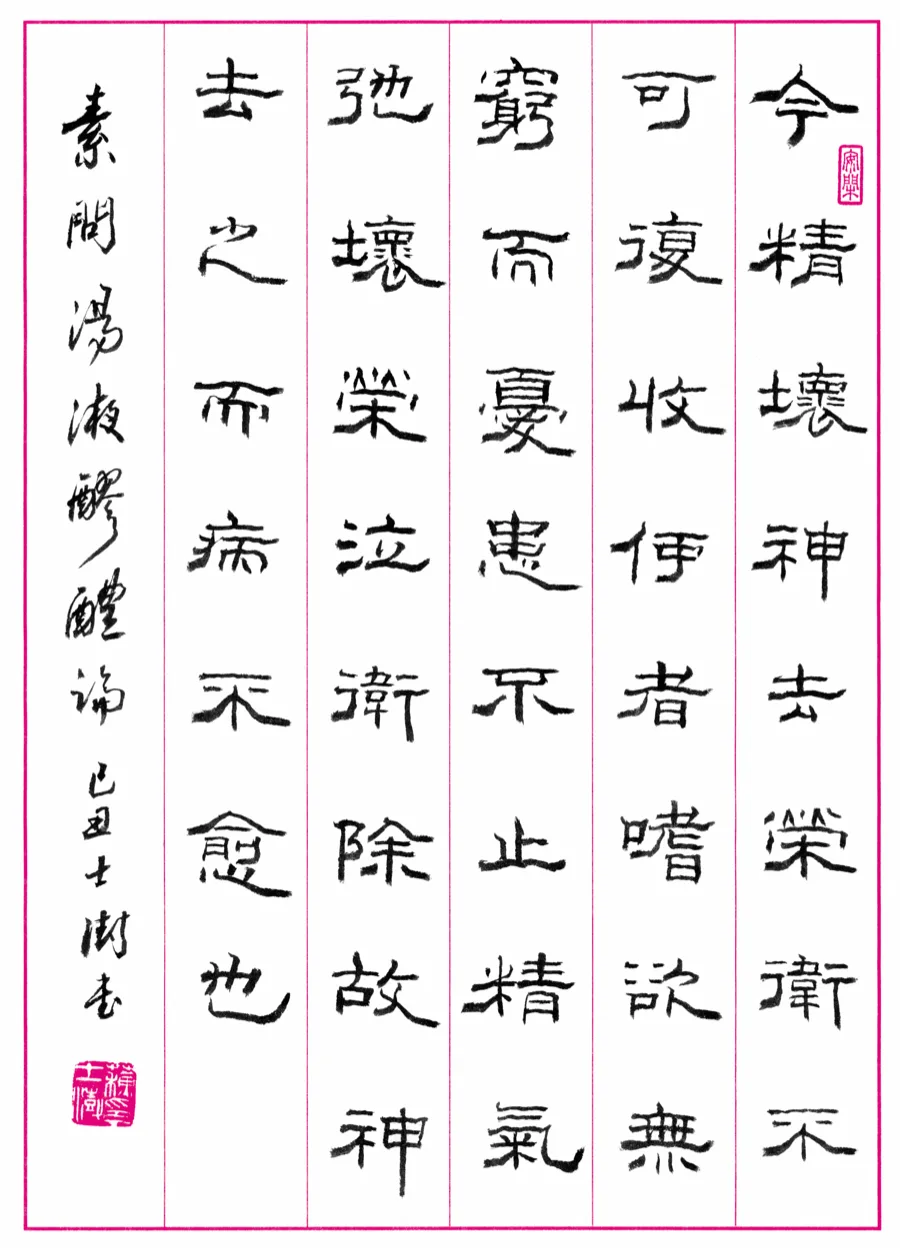
Now the essence is broken and the spirit gone〔1〕, the ying and wei cannot be drawn in again〔2〕 — why? Because cravings and desires are without end, and grief and worry do not stop. The essence-qi slackens and breaks; the ying clogs and the wei is taken away〔3〕 — therefore the spirit departs and the illness is not cured. (Suwen · Discourse on Decoctions and Wines)
Notes: 【1】Essence broken, spirit gone (精壞神去): essence — the essence-qi; spirit — the heart-spirit. The five qi-storehouses all store essence, but the primal essence is stored in the kidney. Of the five spirit-storehouses, the heart stores the spirit. Endless craving injures the essence; ceaseless grief injures the spirit. When essence is injured, it is broken; when spirit is injured, it departs. With essence broken and spirit gone, ying and wei cannot be drawn in. 【2】Ying and wei (榮衛): ying — the construction qi; wei — the defense qi. Ying and wei are paired: ying belongs to yin, wei to yang. Ying is the essence-qi from grain and water — every mode of life-activity that secretes fluids, transforms qi into blood, runs to the four extremities, and pierces and links the bowels and storehouses, can be classed under ying-qi. Wei is the fierce qi of grain and water — every mode of activity that warms the skin, defends and firms the surface, exchanges air, opens-and-closes the pores, can be classed under wei-qi. 【3】Ying clogs, wei is taken away (榮泣衛除): qi — to stop, to clog. Chu — to disperse. Here, the construction-blood withers and clogs, the defense-qi disperses, losing the work of guarding within and defending without.
When the essence-qi has broken and the heart-spirit has gone, why can the ying and wei qi no longer be drawn in? Because cravings and desires have no end, and worry and grief no stopping; the essence-qi grows weak and broken, the ying-blood freezes and clogs, the wei-qi disperses — therefore the heart-spirit departs and the illness cannot be cured.
Find the Food Sweet, Wear the Clothing Easily, Take Joy in One's Customs
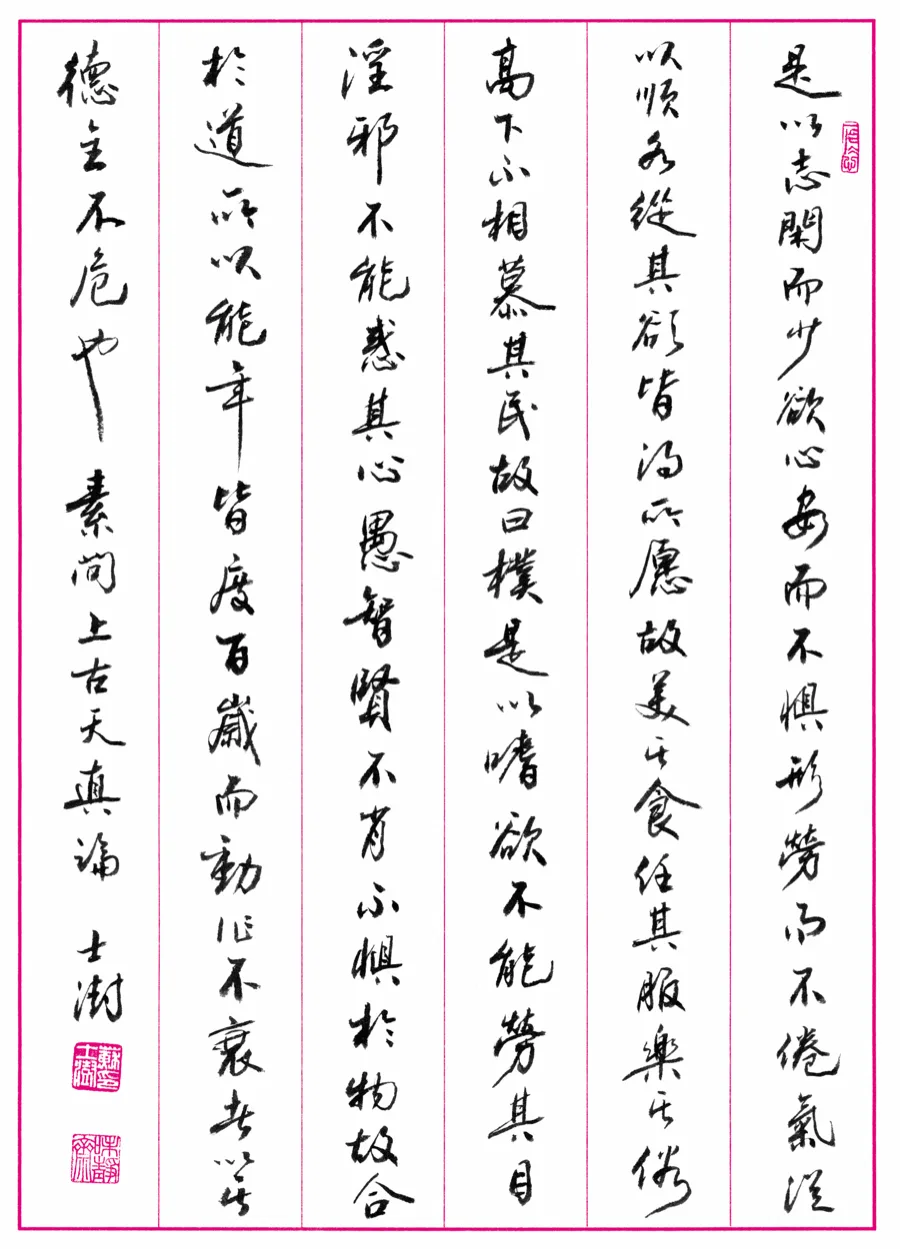
Therefore the will is quiet and desires are few〔1〕; the heart is at peace and does not fear; the body labors but does not weary; the qi accords and follows〔2〕; each follows what is proper to him, and all attain what they wish. So they find their food sweet, wear their clothing with ease, take joy in their customs; high and low do not envy one another — and so it was said of those people: they were plain〔3〕. Therefore cravings and desires could not weary their eyes; lewd and crooked things could not deceive their hearts. Foolish, wise, worthy, unworthy〔4〕 — none feared the things of the world; therefore they were one with the Way. So they could all live past a hundred years, and their movements never failed — for their virtue was whole and they stood in no danger. (Suwen · Discourse on the Heavenly Innateness of High Antiquity)
Notes: 【1】Quiet (閒): still. Also, Shuowen: "From gate with wood in the middle." Guangyun: "To bar; to make small." Extended to mean limit, restraint. 【2】Qi: in the oracle-bone graph, three horizontals — top, middle, bottom; in the bronze graph the top horizontal curves up at right and down at left. The seal-script form has all three curving thus. The root sense is unbounded motion, and motion that is curving. Hence it can figure every mode of self-arising motion. Here, the qi of life, made manifest in the life-process. The qi of life includes every mode of life-activity. Shiming · Heaven: "Qi — kai (great anger). Kai-ran, with sound and without form." Qi has image but no form; one should call it a mode of motion, not a bodily structure. To define qi as "the basic substance composing the human body" is a distortion. 【3】Plain (樸): pure, true. Laozi: "See the simple, embrace the plain; be little of self, slight of desire." Here, simple, honest folk-custom. 【4】Foolish, wise, worthy, unworthy: people of every kind — the foolish, the clever, the worthy, and the ordinary. Bu-xiao — not worthy.
The will is at peace and free of much craving; the heart is at peace and without fear; the body labors but does not tire; qi accords with the spirit and goes smoothly; each one follows what he rightly desires, and what he undertakes succeeds. He finds the food he eats sweet, the clothing he wears comfortable, the customs he sees a joy; no one envies another for his rank, and the manners of the people may be called natural and plain. Sights, sounds, cravings cannot weary their eyes and ears; obscenity and crooked things cannot mislead their hearts; whether foolish or clever, worthy or ordinary, none fears the things outside — and so they live in accord with the Way of cultivating life. They can pass a hundred years and their bodies do not fail, because their virtue is full and they stand in no place of danger.
Quiet the Will, Few Desires
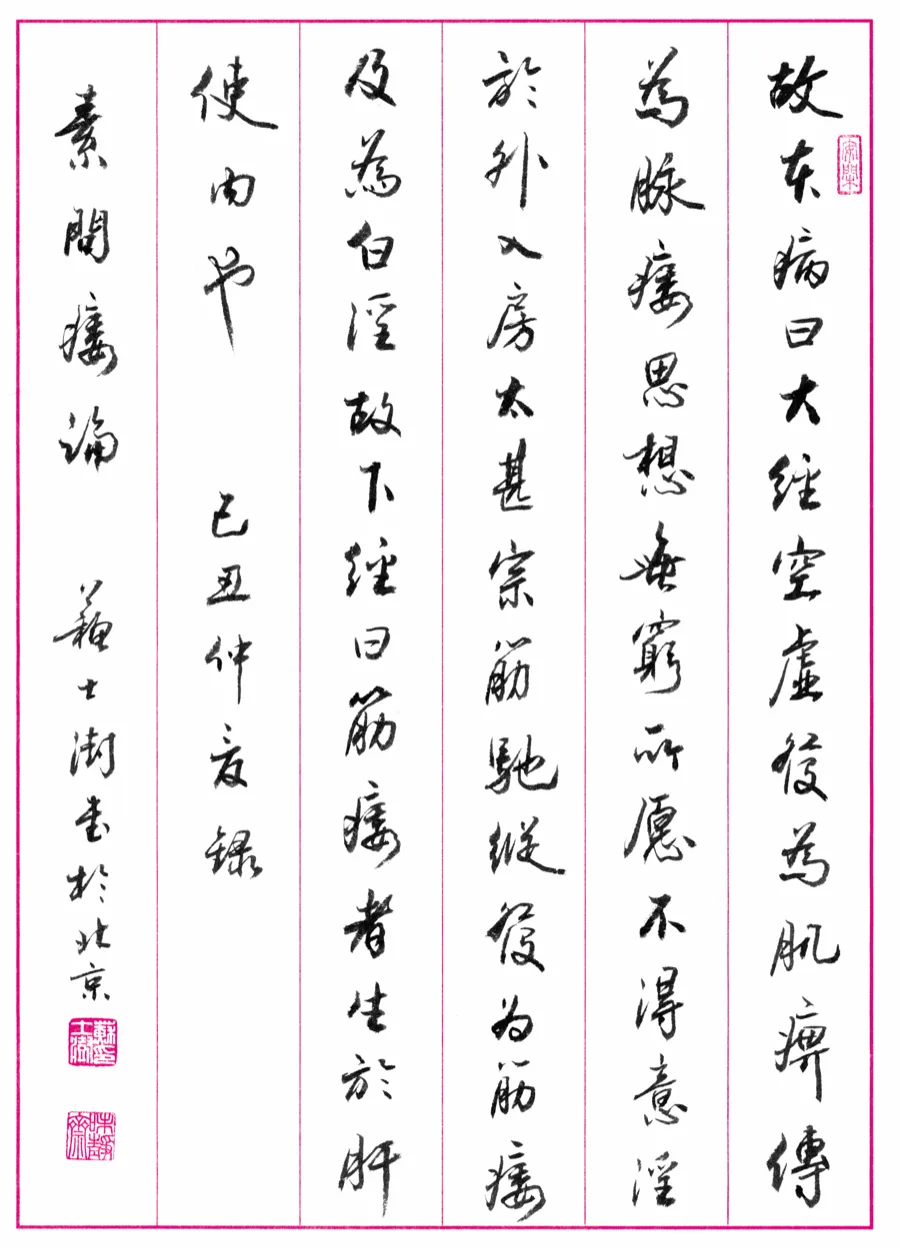
So the Benbing says〔1〕: the great channels are empty, and muscle-bi arises〔2〕, passing on into vessel-flaccidity〔3〕. Thoughts are without end, and what is wished cannot be gained; the mind goes wantoning outside; bedchamber matters are excessive; the gathered sinews〔4〕 slacken and grow loose; sinew-flaccidity〔5〕 arises, leading on to white-discharge〔6〕. So the Xiajing says〔7〕: sinew-flaccidity is born of the liver and brought on by the inner act. (Suwen · Discourse on Flaccidity)
Notes: 【1】Benbing: an old medical-classic chapter name. Lost. 【2】Muscle-bi (肌痺): an illness name. Also called flesh-bi. A bi condition whose chief sign is full-body skin pain, accompanied by withering weakness, sweating, and numbness. Suwen · Discourse on the Long Needling: "Disease in the skin and muscle, with all the skin in pain, is called muscle-bi." Here, muscle-bi from emptied great-channel qi; treat by tonifying qi, nourishing blood, fortifying the spleen, and draining damp. From cold-damp, warm the yang and dispel damp. The Taisu · Five Storehouse Flaccidity reads "vessel-bi." 【3】Vessel-flaccidity (脈痿): an illness name. Also called heart-flaccidity. A flaccidity whose chief sign is weakness in foot and shin, with joints feeling broken and unable to move. Here, vessel-flaccidity from emptied great-channel qi; treat by augmenting qi, nourishing the heart, supplying blood, and quickening it. With heart-qi heat, clear the heart and drain fire. 【4】Gathered sinews (宗筋): zong — many. Guangya · Shigu: "Zong — many." Some hold it means the male genital organ, citing Discourse on Reversal: "Qianyin (front-yin) is the place where the gathered sinews gather." But gathering-place does not mean that gathered sinews equals front-yin or yin-instrument. The Jiayi Jing writes 眾 (many) for 宗. 【5】Sinew-flaccidity (筋痿): an illness name. Also called liver-flaccidity. A flaccidity whose chief sign is the slackening of all the sinews. Early signs include cramping sinews, bitter mouth, blood-withering. Here, brought on by exhaustion of body and heart; treat by supplementing blood, nourishing the liver, and benefiting the kidney. 【6】White-discharge (白淫): turbid white in the urine. Ma Shi: "In a man, slipping of essence; in a woman, white-leukorrhea." 【7】Xiajing: an old medical-classic name.
The Benbing records: when the great vessels are empty, muscle-bi arises and passes on to become vessel-flaccidity. When desire and thought have no end and what is wished cannot be had, the mind runs wanton outside and the bedchamber act injures within; the gathered sinews slacken into weakness — and sinew-flaccidity takes form, with white-discharge and leukorrhea following. The Xiajing records: sinew-flaccidity arises from emptiness of the liver, brought on by injury through the inner act.
Heart at Peace, Qi Following Smoothly
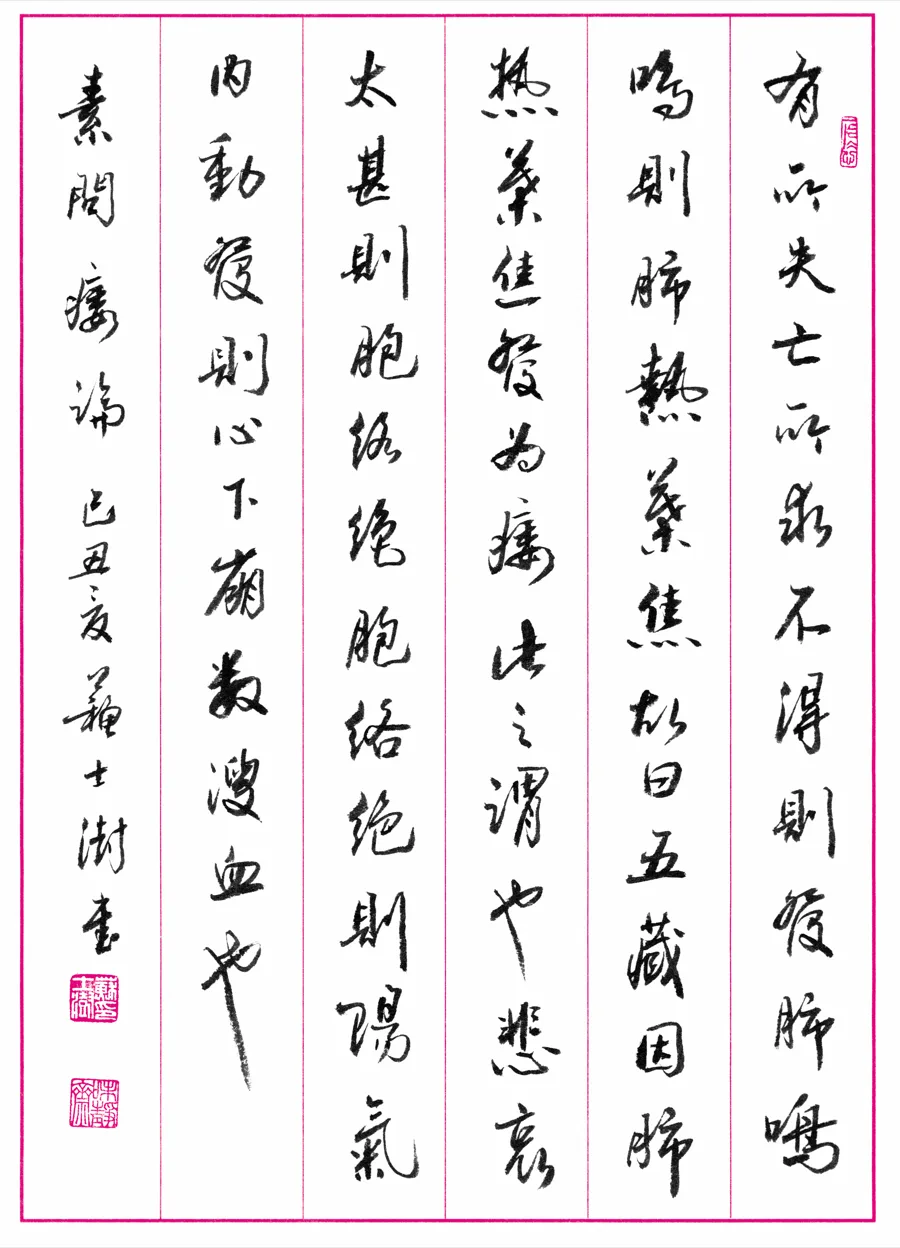
When there has been loss or absence, when what one sought is not had, lung-cry arises〔1〕, and with the cry the lung grows hot and its leaves scorch. So it is said: the five storehouses, by reason of the lung's heat scorching its leaves, give rise to flaccidity. That is the meaning〔2〕. When grief is too heavy, the bao-luo breaks〔3〕; when the bao-luo breaks, the yang qi stirs within, and there arises heart-collapse〔4〕 — frequent passing of blood in the urine. (Suwen · Discourse on Flaccidity)
Notes: 【1】Lung-cry (肺鳴): the lung governs breath; when the lung is sick the breath is heavy with sound — this is lung-cry. 【2】That is the meaning: the Jiayi Jing, scroll 10 chapter 4, omits these four characters. 【3】Bao-luo (胞絡): the heart-envelope-network. The envelope is also called danzhong. Suwen · Discourse on the Hidden Pivot of the Numinous Orchid: "The danzhong is the office of envoy; from it joy comes forth." Lingshu · Discourse on Distention: "The danzhong is the inner palace of the heart." It carries out orders for the heart, takes blame for it. The heart guards within; the envelope-network moves outside. The envelope-network runs lengthwise; the five storehouses crosswise. The envelope-network is the heart's envoy, and is connected to all the four other storehouses. The heart-envelope-network is wholly other than what is now called the "pericardial membrane." 【4】Heart-collapse (心下崩): when the envelope-network is blocked, upper and lower do not pass; the heart qi stirs within, and the heart-blood collapses below.
When a person has lost what mattered or cannot have what was sought, the lung pants and cries; from this the lung breeds bad heat, and its leaves are scorched dry. So it is said: when the five storehouses suffer because the lung has heat that scorches its leaves, flaccidity arises — that is the meaning. When grief is excessive, the envelope-network is injured; once the envelope-network is sealed off, the yang qi races wildly within, and the heart-blood collapses below — there is frequent blood in the urine.
Heart Levelled, Qi at Harmony
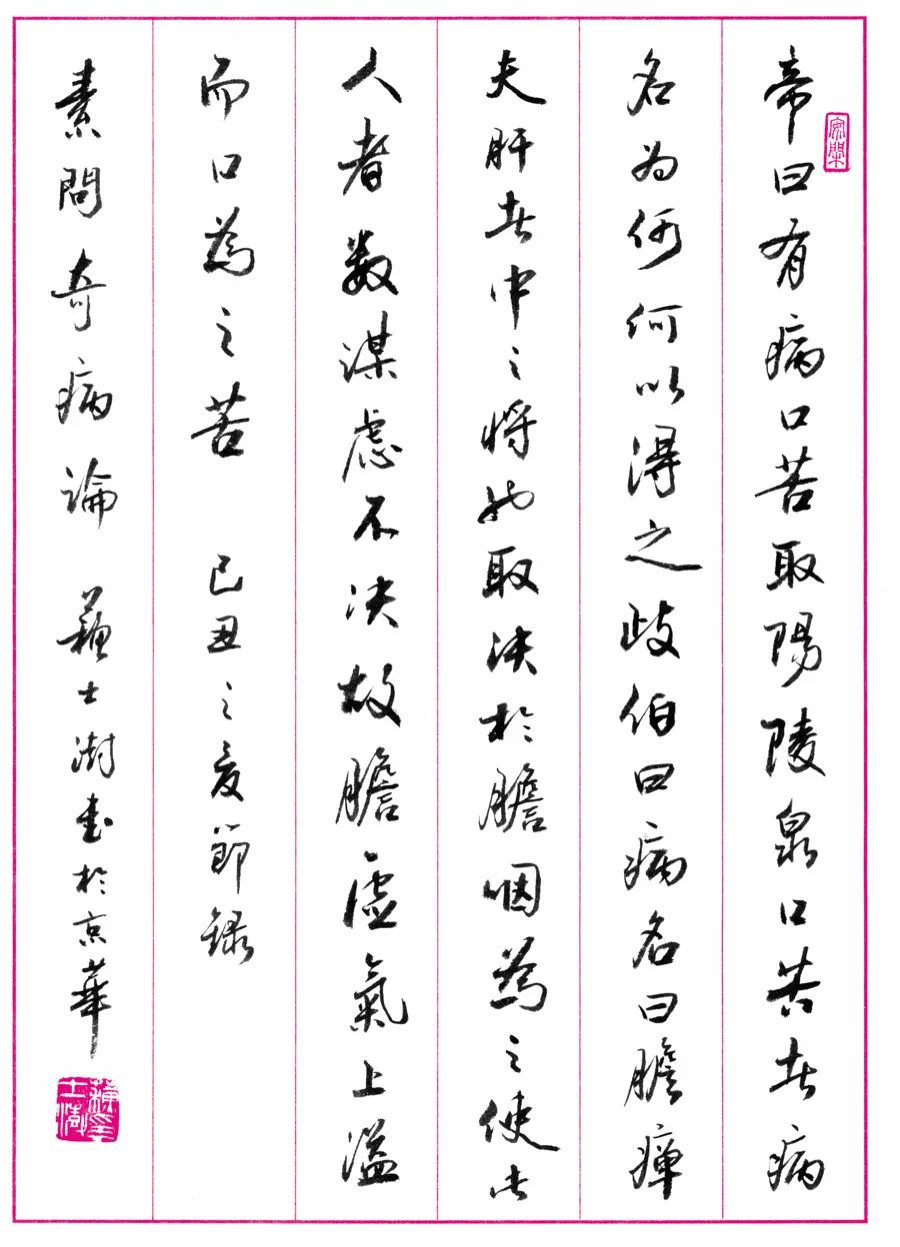
The Yellow Emperor said: there is an illness in which the mouth tastes bitter; one needles yanglingquan; the mouth-bitter remains〔1〕 — what is the illness called? How is it gotten? Qi Bo answered: it is called gall-heat〔2〕. The liver is the general at the centre〔3〕, taking its decision from the gall〔4〕; the throat is its envoy〔5〕. In such people, planning is repeatedly undecided; therefore the gall is empty, its qi rises and overflows, and the mouth turns bitter〔6〕. (Suwen · Discourse on Strange Diseases)
Notes: 【1】Needles yanglingquan; the mouth is still bitter: yanglingquan is the he-point of the foot-shaoyang gallbladder channel; if needling it does not relieve mouth-bitter, that is gall-heat, and below it says one ought to treat with the gall mu and shu points. Many commentators suspect these characters are interpolated commentary in the text. Xinjiaozheng: "By the Quan Yuanqi recension and the Taisu, the six characters 'needles yanglingquan; mouth-bitter' are absent." Zhang Qi: "Six interpolated characters." Wu Kun simply deletes them. 【2】Gall-heat (膽癉): an illness name — gall-heat. From planning that does not come to decision, the gall fails to discharge; gall has stagnant heat; its qi rises and overflows — hence mouth-bitter and the like. 【3】General at the centre (中之將): zhong — central, upright; jiang — general. Suwen · Discourse on the Hidden Pivot of the Numinous Orchid: "The liver is the office of the general, and from it planning comes forth." The liver is like the upright central general — the modes of activity that govern defense, planning, and coordination are classed under the liver. The liver and what is now called the "liver organ" are wholly different at root. 【4】Decision from the gall: Suwen · Discourse on the Hidden Pivot of the Numinous Orchid: "The gall is the office of central uprightness, and from it decision comes forth." The gall is upright by nature; the modes of activity that decide accurately, leaning to no side, are classed under the gall. The gall and what is now called the "gallbladder" are worlds apart. 【5】The throat is its envoy: the foot-jueyin and foot-shaoyang channels meet at the throat; diseases of liver and gall often show in the throat. Zhang Jiebin: "The foot-shaoyang vessel runs up alongside the throat; the foot-jueyin vessel follows the back of the windpipe and rises into the upper jaw. The vessels of liver and gall meet in the throat — therefore the throat is their envoy." 【6】Empty (虛): empty in place — not in its station. Here, unable to perform its work. Where evil gathers, qi must be empty — same idea. The gall qi should descend; when planning fails, its qi loses its station and instead surges upward.
The Yellow Emperor asked: there is one whose mouth is bitter; needling yanglingquan does not cure it. What is the disease called, and what brings it on? Qi Bo answered: it is called gall-heat. The liver is like the upright central general; it takes its decisions from the gall, with which it stands paired; the channels of liver and gall pass through the throat, which is like their outer envoy. Such people are forever planning and never deciding; the gall qi loses its station, surges and overflows, and the mouth tastes bitter.
The Flavors Have Their Storehouses, Nourishing the Five Qi
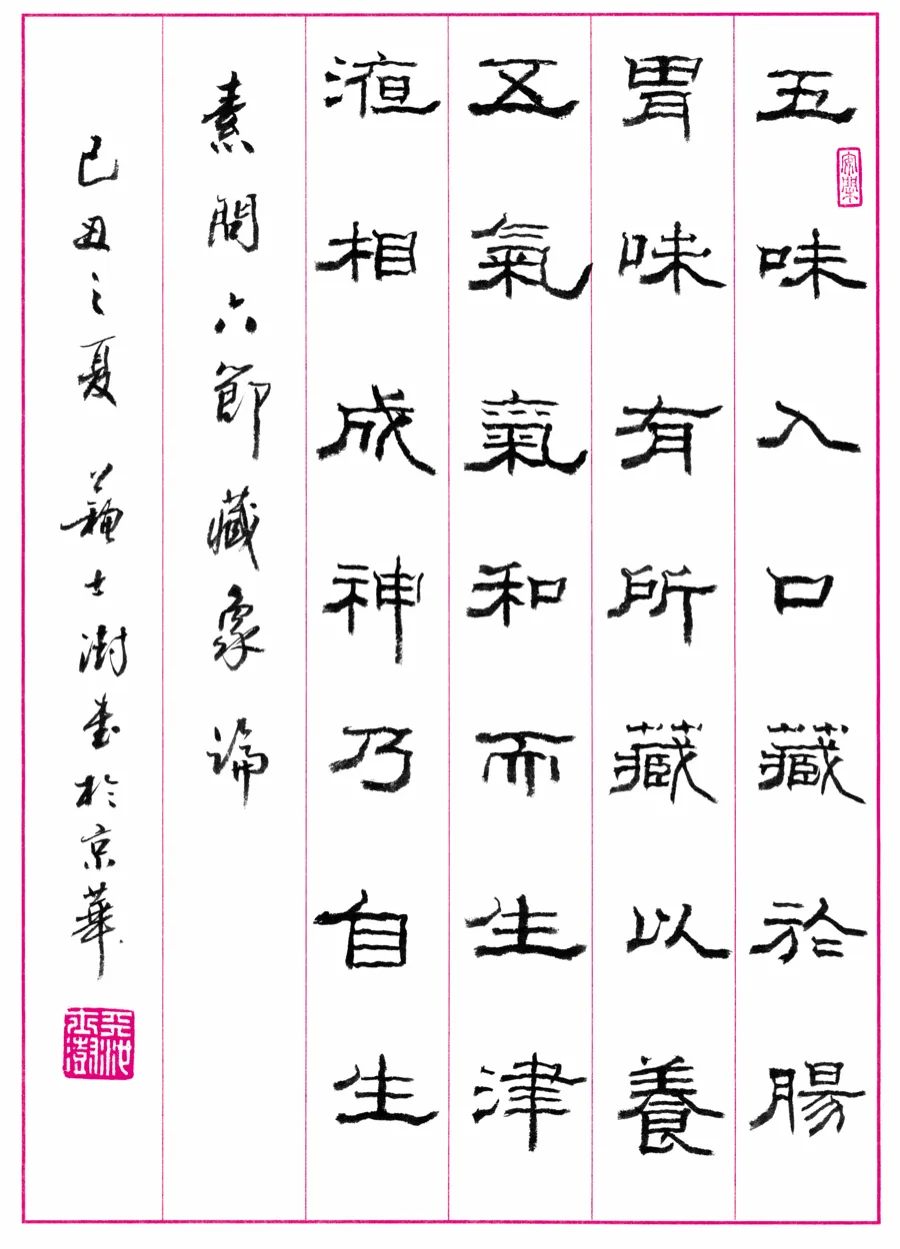
The five flavors〔1〕 enter the mouth and are stored in the bowels and stomach〔2〕. Each flavor has its storehouse〔3〕, and so they nourish the five qi〔4〕. The qi being in harmony, life appears; the fluids in answer come into being; the spirit then arises of itself〔5〕. (Suwen · Discourse on the Six Sections and the Image of the Storehouses)
Notes: 【1】Five flavors: sour, bitter, sweet, pungent, salty. Both food and bencao (herbal materia) have five flavors. Here, the five flavors of food. Five classes of motion-mode, not five tastes of five foods. 【2】Store (藏): to hide. The oracle-bone graph for zang shows a weapon thrust at an eye — the root sense is to strike the eye, with the implied sense of what cannot be seen. 【3】The flavors have their storehouses: each flavor has its own storehouse to which it returns. Sour enters the liver; bitter enters the heart; sweet enters the spleen; pungent enters the lung; salty enters the kidney. 【4】Five qi: the qi of the five storehouses — liver-qi, heart-qi, spleen-qi, lung-qi, kidney-qi. Five classes of life-activity, not "the function of organs." The five storehouses belong to the five phases; the five phases belong to the number-Way. Above and below, left and right, all the Ways are crossed and joined. So there are time-storehouse, spirit-storehouse, qi-storehouse, number-storehouse, order-storehouse, kind-storehouse… pivot-storehouse, transformation-storehouse, change-storehouse, state-storehouse, tendency-storehouse… form-storehouse, vessel-storehouse, thing-storehouse, body-storehouse… The substantive-component storehouse is the last of all the storehouses. What today's TCM calls the "tissues and organs" of zang is its distorted sense. To translate Western anatomy by borrowing the Chinese name zang is its westernized sense. 【5】Spirit (神): here, the spirit of the five storehouses. The liver stores hun; the heart stores spirit (in the narrow sense); the spleen stores yi; the lung stores po; the kidney stores zhi. This is the five-storehouse classification of the spirit of life — not what is now called the "thinking consciousness." The kidney's zhi is the root of the heart's spirit; the heart's spirit is the use of the kidney's zhi; the spleen's yi makes the heart's spirit manifest; the liver's hun and the lung's po are its envoys. Zhi lies in empty space; spirit lies in joined space; yi lies in open space; hun and po go in and out, between empty-and-full, open-and-closed.
The five flavors enter through the mouth and are first stored in the bowels and stomach. Each flavor has the storehouse to which it goes, and from there nourishes its corresponding qi. The five qi being in harmony, they perform their normal work; the fluids accompany them; and the five spirits then appear of themselves.
The Yin Arises With Its Root in the Five Flavors
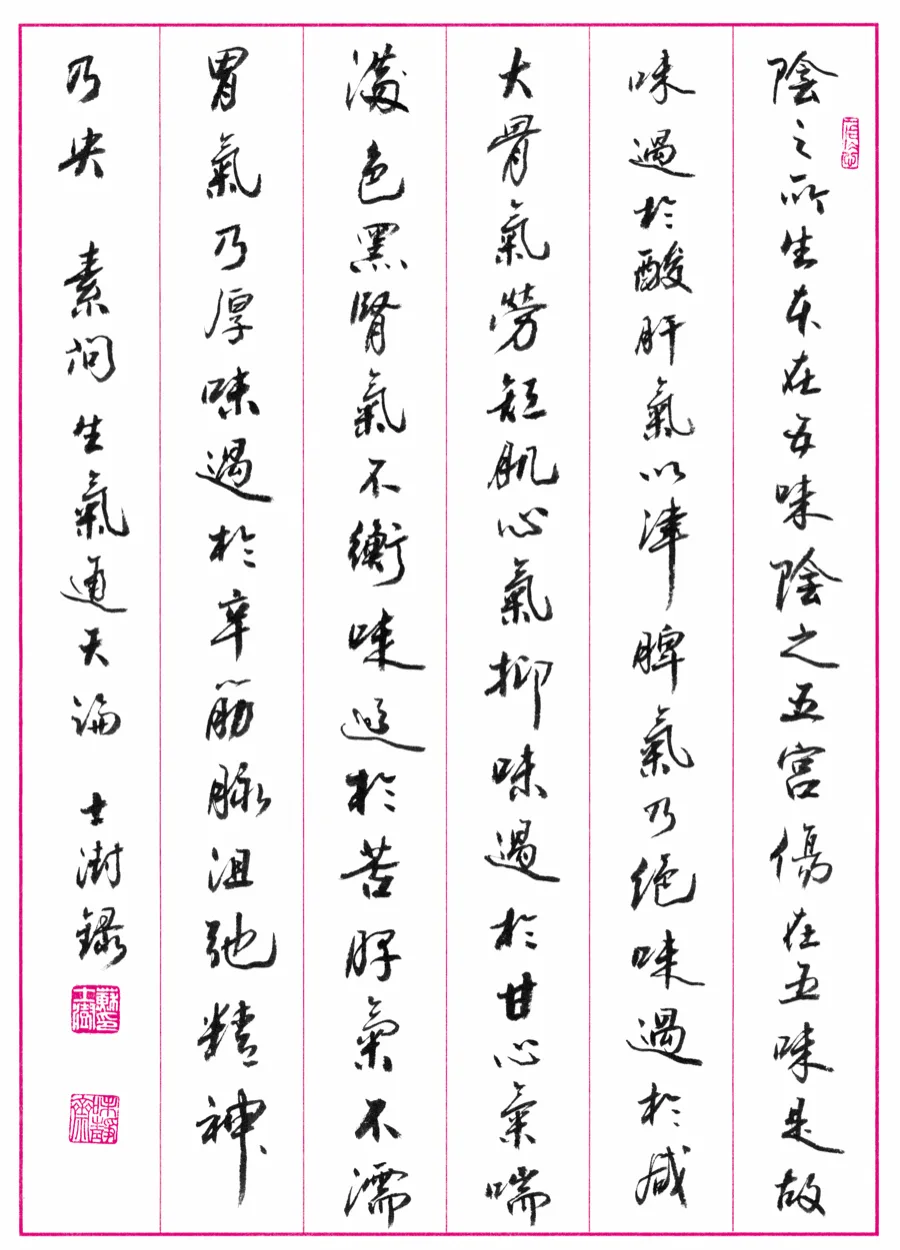
The yin arises with its root in the five flavors〔1〕; the five palaces of yin〔2〕 are injured by the five flavors. So when the flavor is too sour, the liver qi overflows〔3〕, and the spleen qi is cut off. When the flavor is too salty, the great bones are wearied〔4〕, the muscles shrink, the heart qi is depressed. When the flavor is too sweet, the heart qi pants and is full, the colour blackens, the kidney qi loses harmony. When the flavor is too bitter, the spleen qi is not moistened; the stomach qi grows thick〔5〕. When the flavor is too pungent, the sinew-vessels are blocked and slacken〔6〕; the essence-and-spirit is then ruined〔7〕. (Suwen · Discourse on the Communing of Living Qi with Heaven)
Notes: 【1】Root in the five flavors: the five-phase classification of flavor — sour belongs to wood, bitter to fire, sweet to earth, pungent to metal, salty to water. The five-storehouse classification of flavor — the liver's flavor is sour, the heart's bitter, the spleen's sweet, the lung's pungent, the kidney's salty. The five flavors return to the five storehouses; the yin essence is stored in the five storehouses; therefore the root of its arising lies in the five flavors. 【2】Five palaces: the five storehouses. Because the five storehouses are the place where essence is stored, they are called the five palaces. 【3】Overflow (津): to overflow. Here, in excess. Sour enters the liver; when liver qi is too full, it injures spleen-earth. The same below. 【4】Great bones (大骨): the high bones. Not only the bone "above the mingmen point." The kidney governs the bones; here it also stands for the kidney. 【5】Thick (厚): too much accumulation; thickness will not move. The stomach qi is fit to be dispersed; when thick, it clogs. Some read it the opposite way as "thin." But the surrounding lines all describe excess and evil-fullness — the reverse reading is doubtful. 【6】Block (沮): communes with 阻 (block). Erya · Shiqiu: "When water comes out behind it, jǔqiū." Shiming · Shiqiu writes jǔqiū as zǔqiū. Mengzi · King Hui of Liang II: "The favorite Zang Cang blocked the prince." Yinyi: "Ju is the original character for 阻." 【7】Yang (央): communes with 殃 (calamity). Yu Yue reads it as jin (exhausted). Worth considering. Wang Bing reads yang as 久 (long-lasting) — doubtful.
The yin essence comes to manifestation with its root in the harmony of the five flavors; but the five storehouses that store the yin essence are also injured by the five flavors. So eating too much of the sour overfills the liver qi, and the spleen qi grows weak. Eating too much of the salty wears the great bones, shortens the muscles in flaccidity, and depresses the heart qi. Eating too much of the sweet makes the heart qi pant and fill; the colour of skin turns black; the kidney qi loses harmony. Eating too much of the bitter, the spleen qi cannot transform; the stomach qi clogs. Eating too much of the pungent, the sinew-vessels are blocked from their motion, slack and unable to flex; the essence-and-spirit is then injured.
Carefully Harmonize the Five Flavors, Long Hold the Heavenly Mandate
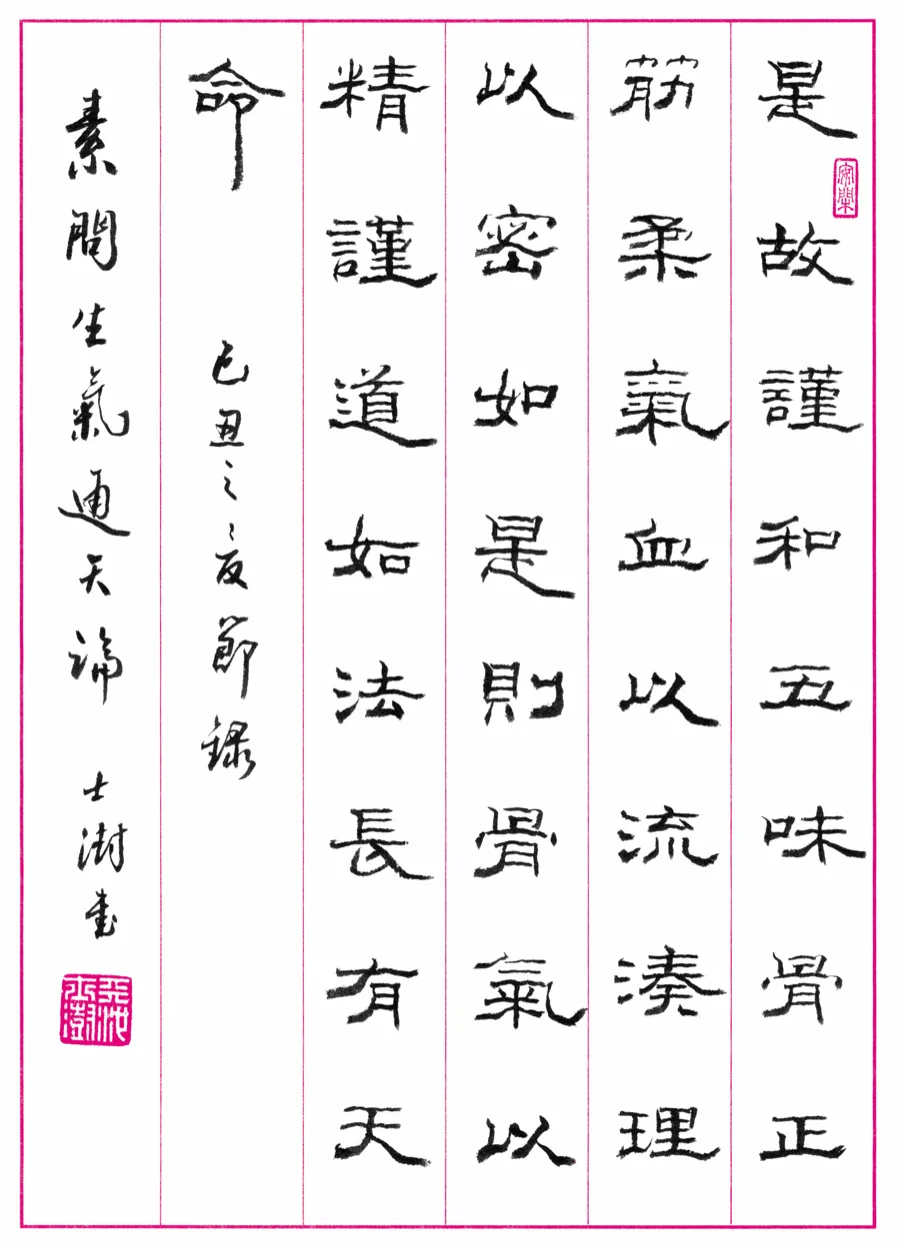
So when one is careful in harmonizing the five flavors, the bones stand straight and the sinews are pliant; the qi-and-blood flow; the coucouli close〔1〕; thus is the bone qi made fine〔2〕. Be careful in following the Way and the law, and you will long hold the Heavenly mandate. (Suwen · Discourse on the Communing of Living Qi with Heaven)
Notes: 【1】Coucouli (湊理): cou communes with 腠. Couli — the place where the primal-and-true qi of the storehouses-and-bowels passes through, and where qi between body-form and outside flows in transit; the gates by which a person and the spontaneous open-and-close their qi. They also include what is now called the boundary of matter, energy, and information exchange between human and nature. Couli is not "subcutaneous tissue"; couli is everywhere. Jinkui Yaolüe: "Cou is the place where the sanjiao gathers and meets the primal-and-true; where blood-and-qi flow in. Li is the patterned grain of skin, storehouses, and bowels." The sanjiao runs lengthwise; the five storehouses and five bowels run crosswise; the sanjiao can pierce all of them. Tong — to penetrate-and-harmonize; hui — to meet. Yuan — primal qi; zhen — true qi. The place where the sanjiao gathers and meets the primal-and-true is by no means a substantive tissue. The oracle-bone graph for wen (文) shows a female animal in heat, which can figure life about to arise. Wen is image. The oracle-bone graph for li (理) shows the form of the earth divided up, by which the relations are clarified for the management of cultivation. Wenli — the image of mutual relation, also not a substantive part. 【2】Bone qi (骨氣): the modes of life-activity related to bone — not just the bone or the function of bone.
Therefore, by carefully harmonizing the five flavors, the bones stand straight and the sinews are pliant; the qi-and-blood pass freely; the couli close firmly; and the bone qi is fine and strong. Carefully obey the Way and follow the law, and one can enjoy the lifespan Heaven gave.
Pungent, Sour, Sweet, Bitter — Each Has Its Use
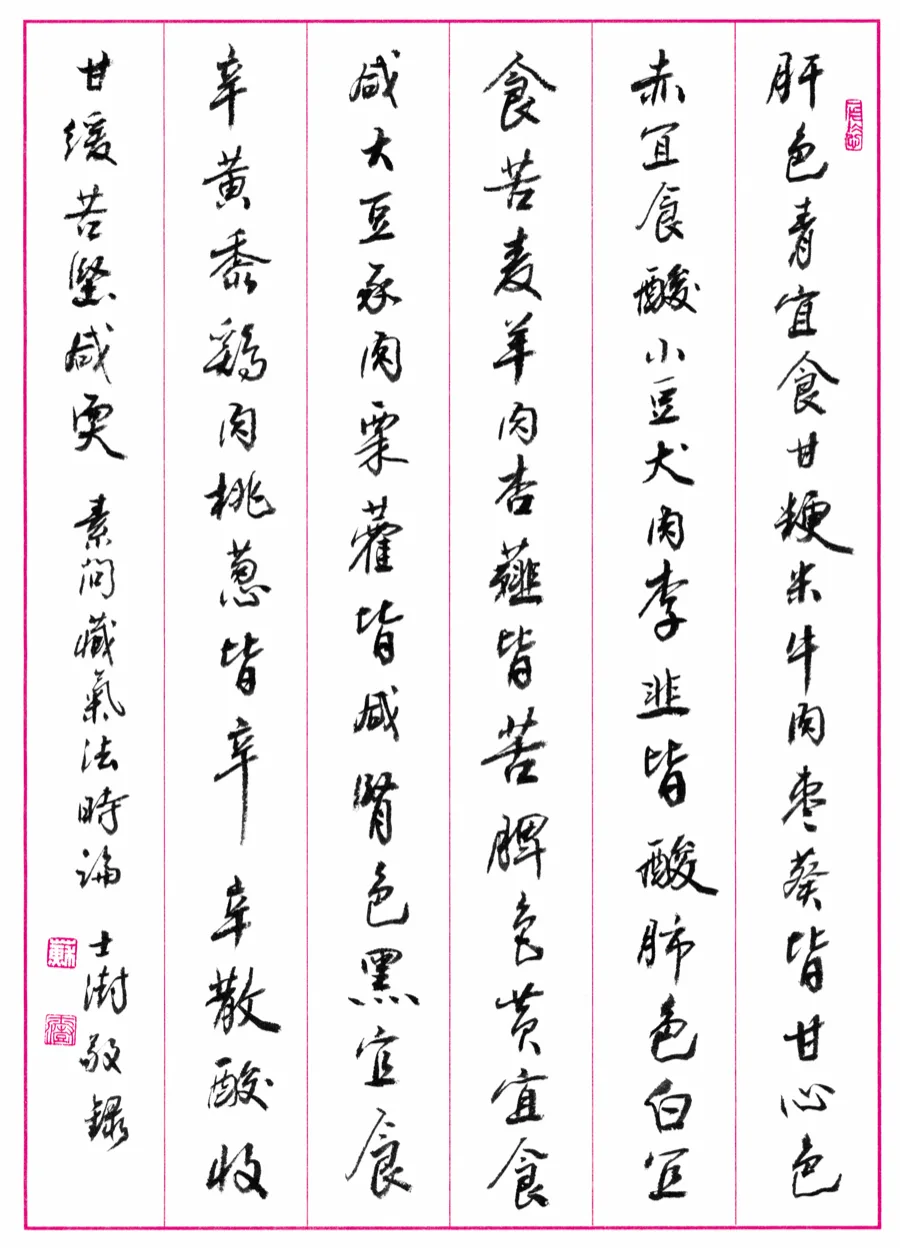
The colour of the liver is green〔1〕; it is fitting to eat the sweet〔2〕 — non-glutinous rice, beef, jujube, mallow are all sweet〔3〕. The colour of the heart is red; it is fitting to eat the sour — small bean, dog meat, plum, jiu-onion are all sour. The colour of the lung is white; it is fitting to eat the bitter — wheat, mutton, apricot, xie-onion are all bitter. The colour of the spleen is yellow; it is fitting to eat the salty — soybean, pork, chestnut, bean-leaf are all salty〔4〕. The colour of the kidney is black; it is fitting to eat the pungent — millet, chicken, peach, scallion are all pungent〔5〕. Pungent disperses; sour gathers; sweet softens; bitter firms; salty moistens-and-softens. (Suwen · Discourse on the Time-Method of the Storehouses' Qi)
Notes: 【1】Liver green: the five phases belong to the number-Way; the five storehouses, five colours, and five flavors belong to the kind-Way. The five-phase classification of colours — green is wood, red is fire, yellow is earth, white is metal, black is water. The five-storehouse classification of colours — liver green, heart red, spleen yellow, lung white, kidney black. 【2】It is fitting to eat the sweet: what is fitting differs by season and pivot. One may take by phase or by tendency; by flavor or by nature; by generation-restraint or by carrying-transformation — not bound to one rule. Too little is empty; too much harms. This corresponds to the line above — what each storehouse suffers, what is fitting to take: "When the liver suffers acuteness, swiftly take the sweet to slacken it"; "when the heart suffers slackness, swiftly take the sour to gather it"; "when the spleen suffers damp, swiftly take the bitter (suspected to be a slip for salty) to dry it"; "when the lung suffers qi rising counter, swiftly take the bitter to vent it"; "when the kidney suffers dryness, swiftly take the pungent to moisten it." 【3】Mallow (葵): Nongshu: "Kui is a yang-grass, the chief of the hundred greens." 【4】Bean-leaf (藿): the leaf of the bean. 【5】Yellow millet (黃黍): foxtail millet.
The liver answers green; sweet is fitting — non-glutinous rice, beef, jujube, mallow are all of the sweet flavor. The heart answers red; sour is fitting — small bean, dog meat, plum, jiu-onion are all of the sour flavor. The lung answers white; bitter is fitting — wheat, mutton, apricot, xie-onion are all of the bitter flavor. The spleen answers yellow; salty is fitting — soybean, pork, chestnut, bean-leaf are all of the salty flavor. The kidney answers black; pungent is fitting — yellow millet, chicken, peach, scallion are all of the pungent flavor. Pungent flavor disperses; sour gathers; sweet slackens; bitter firms; salty softens-and-moistens.
Five Grains for Nourishment, Five Fruits for Aid, Five Beasts for Benefit, Five Vegetables for Filling
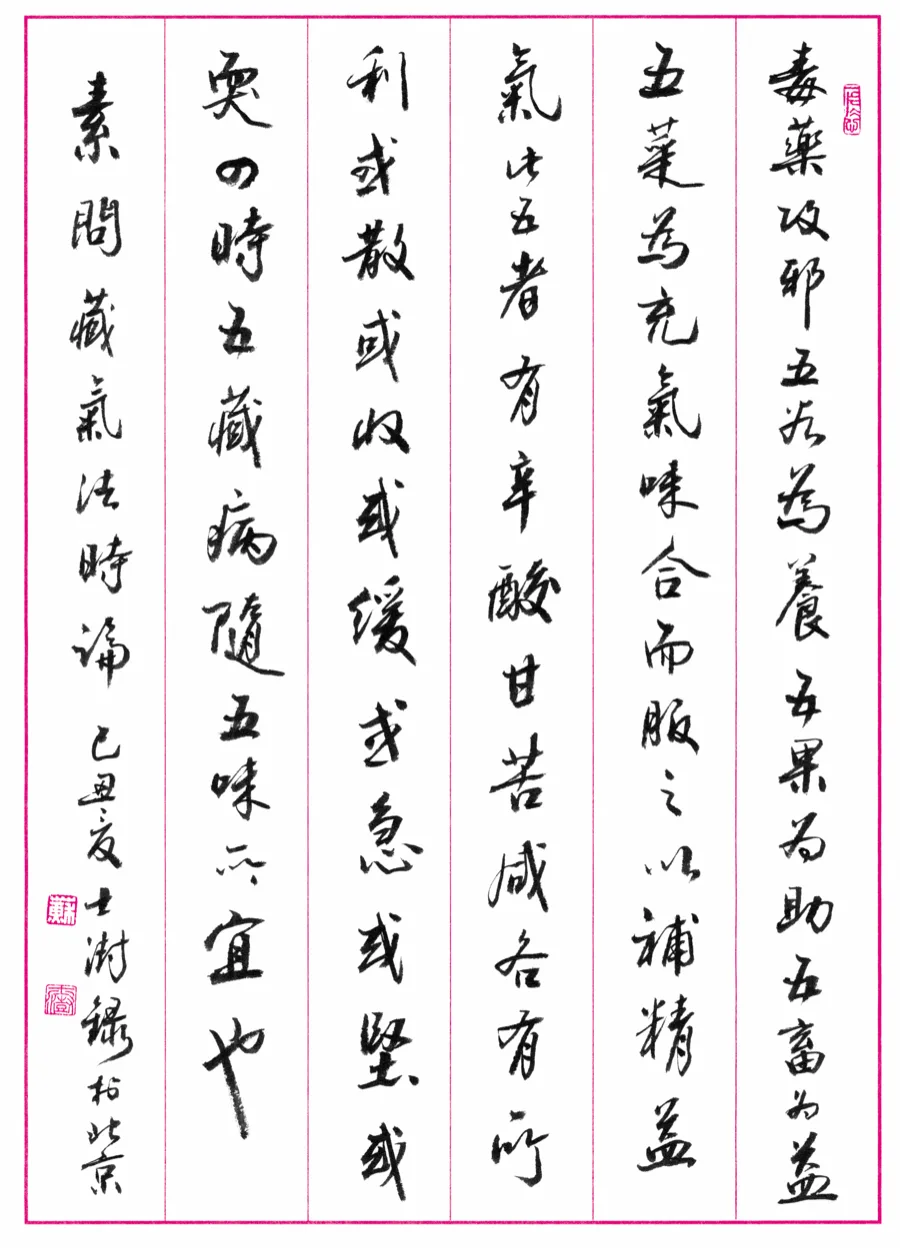
Strong-natured medicines〔1〕 attack what is evil; the five grains nourish〔2〕; the five fruits aid〔3〕; the five beasts benefit〔4〕; the five vegetables fill〔5〕. The qi-and-flavor combined and taken supplement essence and benefit qi. These five — pungent, sour, sweet, bitter, salty — each has what it brings to use: now dispersing, now gathering, now slackening, now urging〔6〕, now firming, now softening. Across the four seasons and the five storehouses, treatment follows the flavor that is fitting to the illness. (Suwen · Discourse on the Time-Method of the Storehouses' Qi)
Notes: 【1】Strong-natured medicines attack what is evil (毒藥攻邪): an herb's qi-and-flavor lean one way; the more pronounced ones are called du-yao. By the leaning of an herb one corrects the leaning of a person. Herbs whose leaning is strong are used to attack what is evil. Evil is a mode of life-activity that has lost harmony — not what is now called a "material disease-cause." Right is a mode of life-activity in harmony — not what is now called the "immune function." When qi loses its harmony, it is evil qi; when qi is in harmony, it is right qi. 【2】Five grains: non-glutinous rice, small bean, wheat, soybean, yellow millet. 【3】Five fruits: peach, plum, apricot, chestnut, jujube. 【4】Five beasts: ox, sheep, pig, dog, chicken. 【5】Five vegetables: mallow, bean-leaf, xie-onion, scallion, jiu-onion. Fill (充): to fill out. Guangya · Shigu: "Chong is yang (to nourish)." 【6】Or urging (或急): Tanba Genkan suspects this is interpolated. Disperse, gather, slacken, firm, soften answer to the line above — pungent, sour, sweet, bitter, salty — and urging is one too many.
Strong herbs are used to attack what is evil; the five grains nourish; the five fruits aid; the five beasts benefit; the five vegetables fill. Combining qi-and-flavor in food, one can supplement essence and benefit qi. These five all have the five flavors — pungent, sour, sweet, bitter, salty — each with its own usefulness: dispersing or gathering, slackening or quickening, firming or softening. The Way of treatment must accord with the four seasons and the five storehouses, and follow the flavor fitting to the kind of illness.
Grain, Meat, Fruit, Vegetables — Food's Nurture Completes It
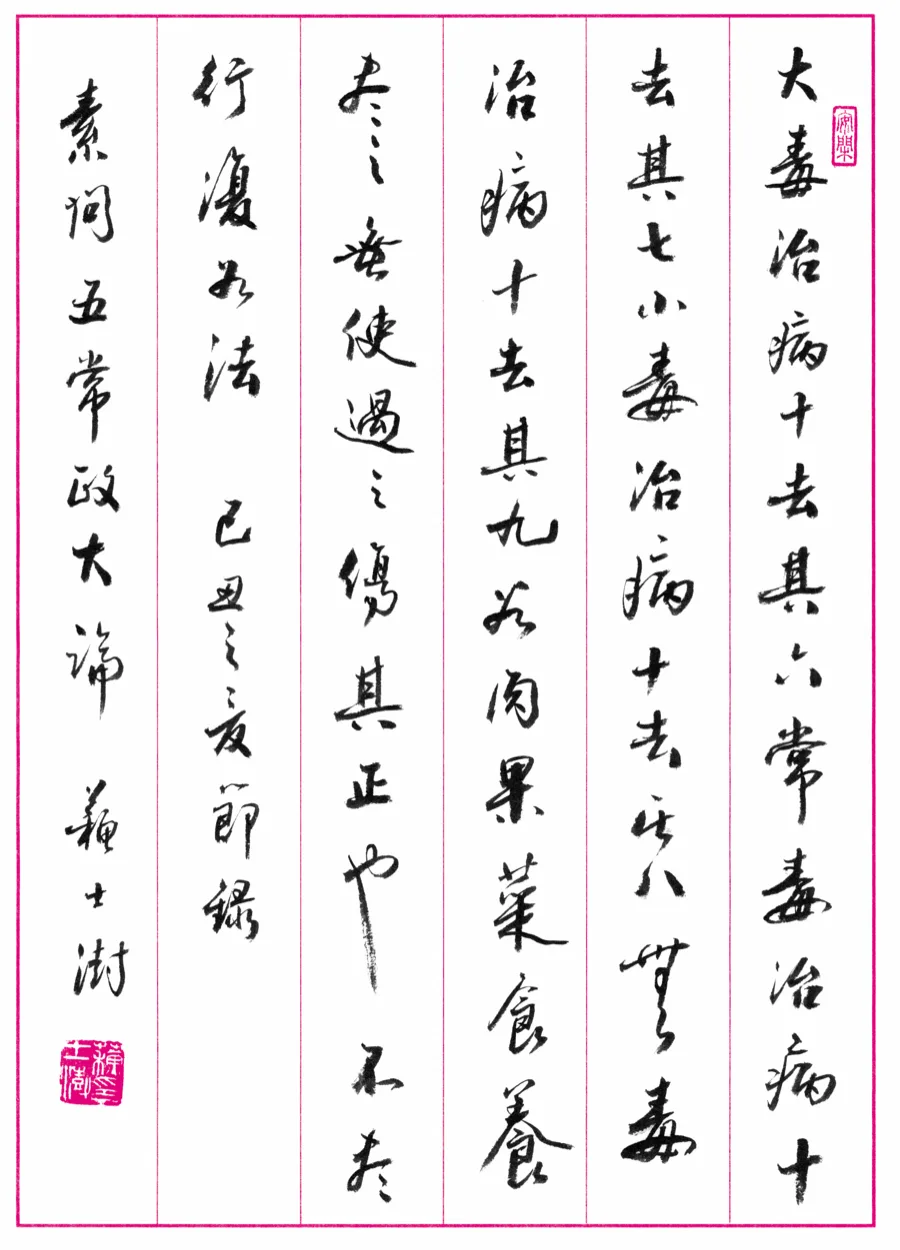
In treating illness with great-strong medicines〔1〕, take away six parts in ten and stop. With ordinary-strong medicines, seven in ten. With small-strong medicines, eight in ten. With non-strong medicines, nine in ten. Then with grain, meat, fruit, vegetables — let food's nurture complete the rest〔2〕. Do not exceed, lest the right qi be injured. If the work is not finished, follow the rule again. (Suwen · Discourse on the Five Constants and Their Government)
Notes: 【1】Great-strong (大毒): herbs of pronounced qi-and-flavor — not "toxicity" in the modern sense. Flavor belongs to qi; nature belongs to tendency. Qi is a mode of motion, not what is today called a "function." Tendency is a direction of change, not what is now called a "property." Yao-wei (medicinal flavor) belongs to bencao (herbal materia), not what is now called "drugs." 【2】Food's nurture completes it: meaning that, with medicines, one should stop in good time, then nourish with food to drive out remaining evil. Jin — completely removed. Corresponding to the lines above — take six in ten… take nine in ten. Erya: "To stop." Extended to mean to remove. Suwen · Discourse on the Time-Method of the Storehouses' Qi: "Strong medicines attack what is evil; the five grains nourish, the five fruits aid, the five beasts benefit, the five vegetables fill — combining qi-and-flavor in their use to supplement essence-qi." Suwen · Great Treatise on the Six Primal Standard: "Great accumulations and great clusterings — they may be approached, but stop when more than half is gone; to go further is death." Hanshu · Yiwenzhi: "An untreated illness — the steady middle physician." All warn that medication should not exceed; rather, the rest should be cleared by food. This is what fully calls forth a person's life-self: the process by which it self-regulates, self-stabilizes, self-orders, self-arises, self-transforms, self-harmonizes.
In treating with sharp-natured medicines, stop the medicine when six-tenths of the illness is gone. With moderately-natured medicines, stop at seven-tenths. With slightly-natured medicines, stop at eight-tenths. With non-strong medicines, stop at nine-tenths. Then turn to grain, meat, fruit, and vegetables; let food's nurture clear out the remaining evil qi. Neither medicine nor food should be over-used, or the right qi will be injured. If evil qi still cannot be fully cleared, follow the same method again.
Avoid Damp
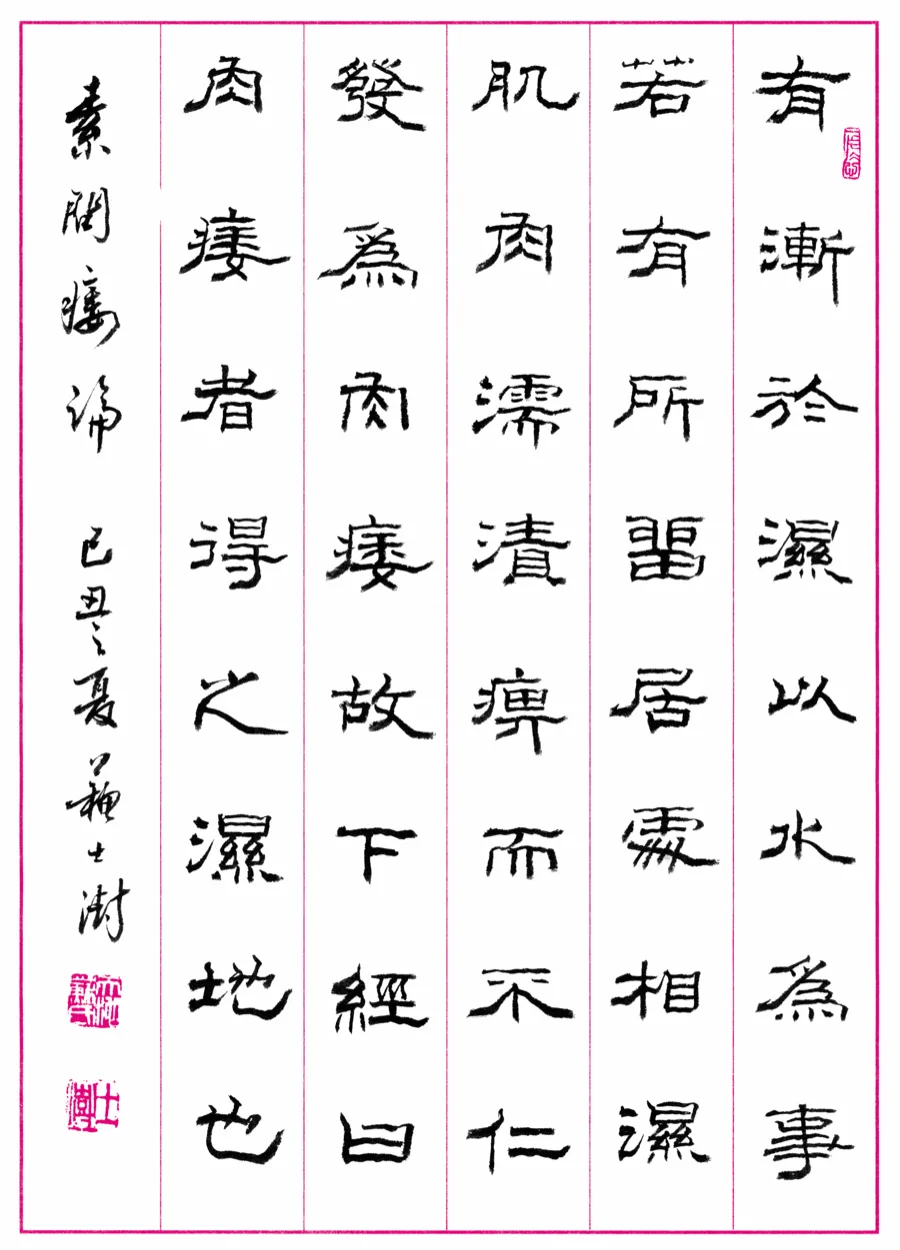
Where there is gradual soaking by damp〔1〕, where one is at work in water〔2〕, if water lingers, if the dwelling is also damp, the muscle and flesh are soaked through; bi arises with numbness; this gives rise to flesh-flaccidity〔3〕. So the Xiajing says: flesh-flaccidity is gotten from a damp place. (Suwen · Discourse on Flaccidity)
Notes: 【1】Gradual soaking by damp (有漸於溼): jian — to soak; damp — damp evil. The six qi — wind, cold, summer-heat, damp, dryness, fire — when out of season, in excess, off-and-not-right, become evils. Damp evil clogs and stagnates; striking a person, it most often leads to stagnation, blockage, numbness, and the like. 【2】At work in water: refers to those whose activity often brings them in contact with water and damp, so they take in damp evil. Living on damp ground, working in water, drenched in rain or frost, exposed to cold and to damp, and so on. 【3】Flesh-flaccidity (肉痿): an illness name. Also called spleen-flaccidity. A flaccidity whose chief sign is numbness, with severe cases unable to lift the four limbs. This is damp evil injuring the muscle. Treat by fortifying the spleen and draining damp. With heat, also clear heat; with cold, also warm the yang.
When one is gradually soaked by damp evil — often near water, with damp lingering, dwelling in damp places — the muscle and flesh are soaked through, and bi and numbness take hold; flesh-flaccidity takes form. The Xiajing records: this disease, flesh-flaccidity, is gotten by long living in a damp place.
Keep Away from Great Heat
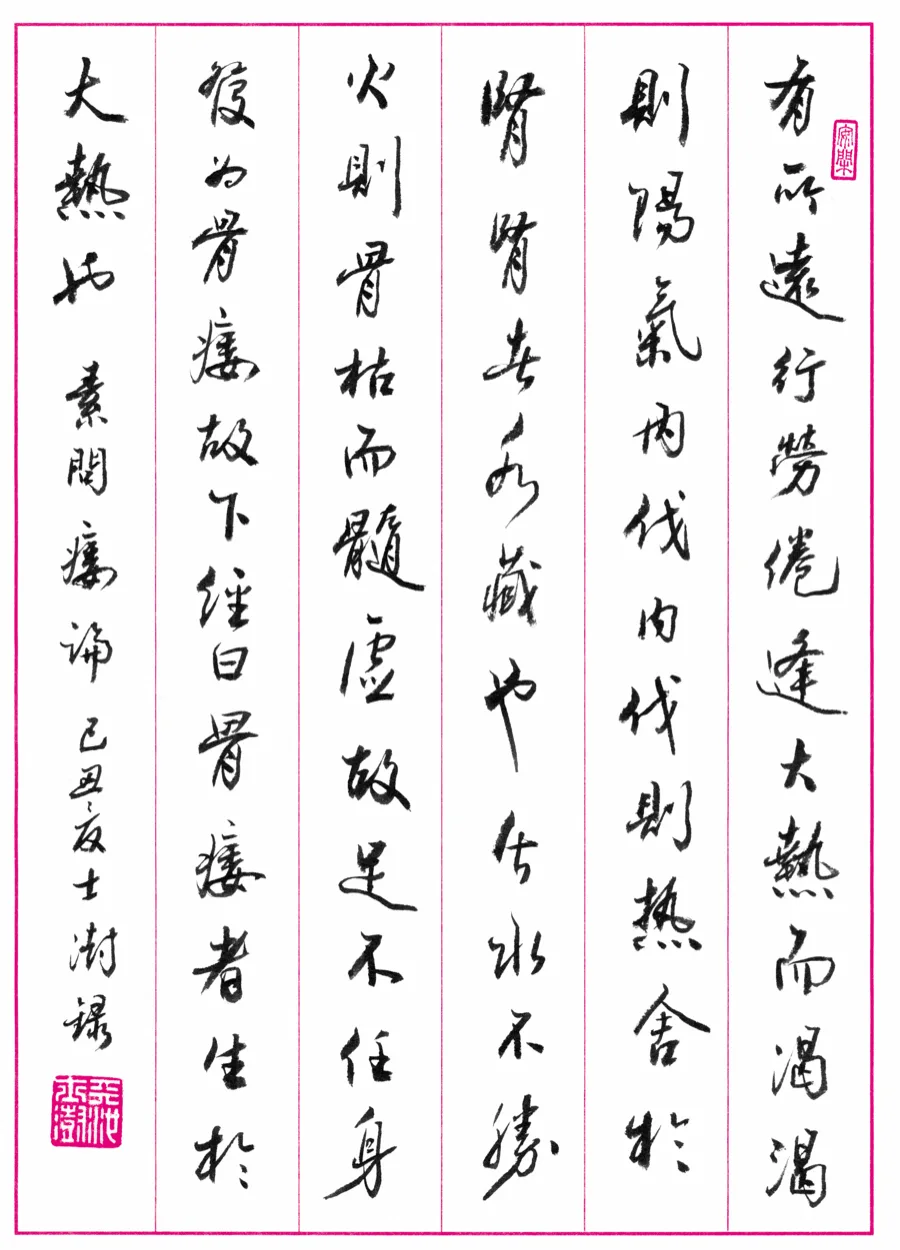
If there has been distant travel and bodily exhaustion, met by great heat and bringing on thirst, then thirst makes the yang qi attack within〔1〕; attacking within, heat lodges in the kidney; the kidney is the water-storehouse〔2〕; if water cannot prevail over fire〔3〕, the bone withers and the marrow is empty — therefore the foot can no longer carry the body; bone-flaccidity arises〔4〕. So the Xiajing says: bone-flaccidity is born of great heat. (Suwen · Discourse on Flaccidity)
Notes: 【1】Yang qi attacks within (陽氣內伐): too-great yang heat scorches the yin-fluids. Fa — to attack, to injure. 【2】Kidney is the water-storehouse: in five-phase classification of the five storehouses, the kidney belongs to water. So it is called the water-storehouse. 【3】Water cannot prevail over fire: when heat-evil strikes the kidney, kidney-water cannot prevail over the evil fire; thus the bone withers and the marrow is empty — for the kidney governs the bones and generates the marrow. 【4】Bone-flaccidity (骨痿): an illness name. Also called kidney-flaccidity. A flaccidity whose chief sign is the foot's inability to bear the body. With it: aching, weak lower back; inability to extend or lift; dark face; teeth dried-out; and so on. From heat-evil injuring the kidney, the yin-essence wasted, the bone withered and the marrow empty. Treat by enriching the yin and clearing heat, supplementing the kidney and benefiting the essence, strengthening the bones and filling the marrow.
If long travel has brought bodily exhaustion, and one then meets hot weather and grows thirsty, the yang qi is stirred within and heat-evil enters the kidney; the kidney is the water-storehouse; if water cannot prevail over fire, the bone withers and the marrow is empty, the foot cannot support the body — and bone-flaccidity arises. The Xiajing records: this disease, bone-flaccidity, is born of suffering great heat.
Live in Ease
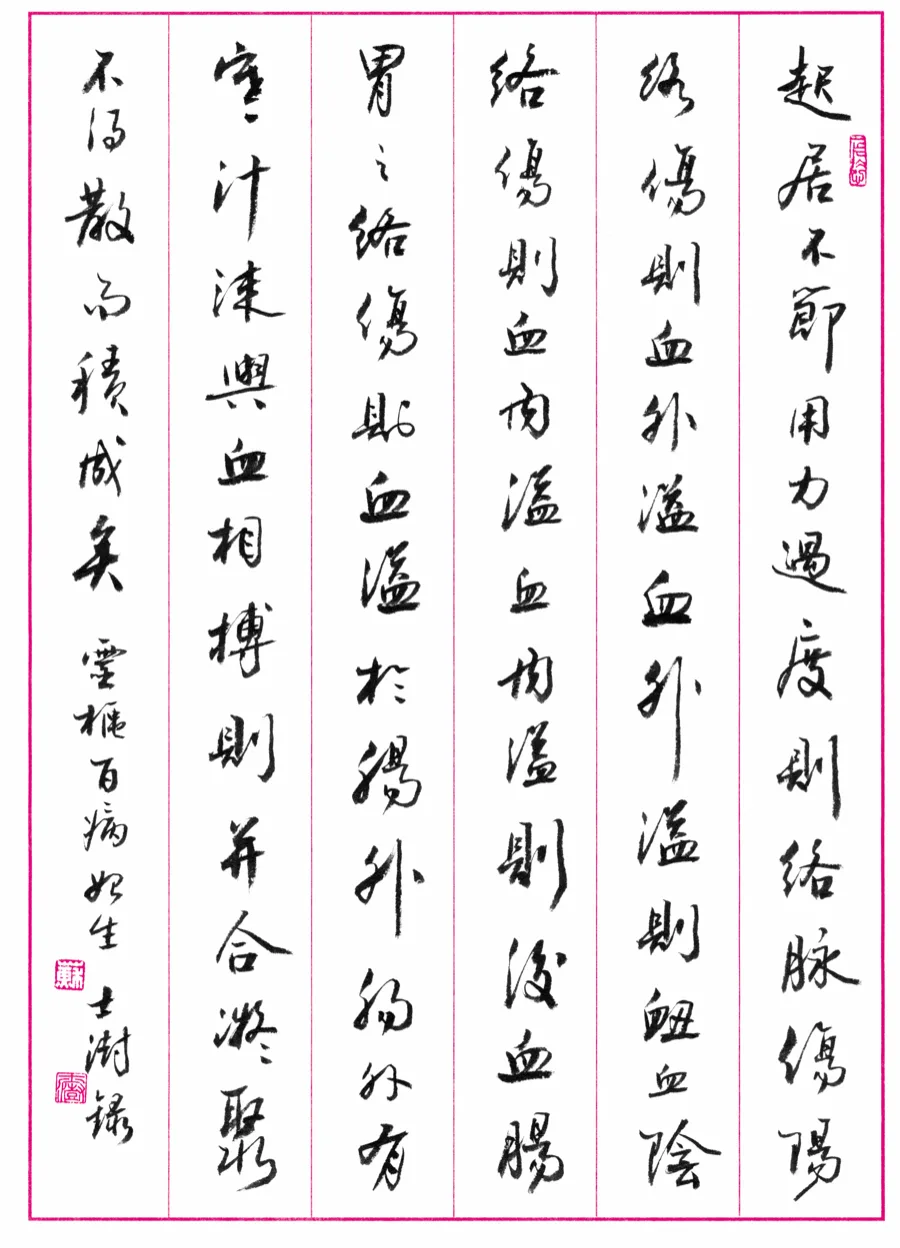
When dwelling-and-rising are not measured, and use of strength is excessive, the luo-vessels are injured〔1〕. When the yang-luo is injured, blood spills outward〔2〕; spilling outward, there is nosebleed. When the yin-luo is injured, blood spills inward; spilling inward, there is blood in the stool. When the luo of bowels and stomach are injured, blood spills outside the bowels. Outside the bowels, cold-fluid foam meets the blood and joins with it — congealing, gathering, not dispersing — and accumulations form. (Lingshu · The Beginnings of the Hundred Diseases)
Notes: 【1】Luo-vessels (絡脈): vessel — net. Here, the net of relations, the net of being-with — the net of mutual relations, of mutual interactions — not a substantive tissue. Every mode by which life-activity links can be classed under jing-luo. Every spirit-qi of life that goes in and out can be classed under jing-mai. Not what is called "the channel through which the human body's qi-blood runs." (If "qi is the basic substance composing the body" and "blood is the red liquid running in the blood vessels," what could the channel through which they run be, other than the blood vessels?) Laozi: "The net of Heaven is wide; coarse, yet nothing is lost." The unbounded interconnection of self-arising motion looks like a sparse net, but in fact has no gap. Luo — the small of the jing. Luo has fifteen great luo, bie-luo, fu-luo. Lingshu · Nine Needles and Twelve Origins: "Twelve jing-mai; fifteen luo-mai." Luo-mai mostly refers to the great-luo. Lingshu · Jingmai: "What is seen of the mai is all luo-mai"; "what floats and is constantly seen is luo-mai." Jing hidden, luo shown; jing inner, luo outer; jing closed, luo open; jing entering, luo coming forth… 【2】Yang-luo: luo has yin and yang — yang outer, yin inner; yang surface, yin lining. Inner-outer, surface-lining are tendencies of life-activity, not "tissue regions of the body." What tends outward, when injured, sends blood out. The blood here is the narrow sense. In the broad sense, blood spilling out, qi dispersing out, spirit racing out — all answer the same.
When the dwelling-and-rising have lost their rule, and one labors and uses strength to excess, all this injures the luo-vessels. When the yang-luo is injured, blood spills outward; from this comes nosebleed. When the yin-luo is injured, blood spills inward; from this comes blood in the stool. When the luo outside the bowels are injured, the bowels also bleed; if outside the bowels there is also a cold thin fluid in foam, joining with the blood, the two combine and clot, do not disperse — and so a clot forms.
Guard Against Wind
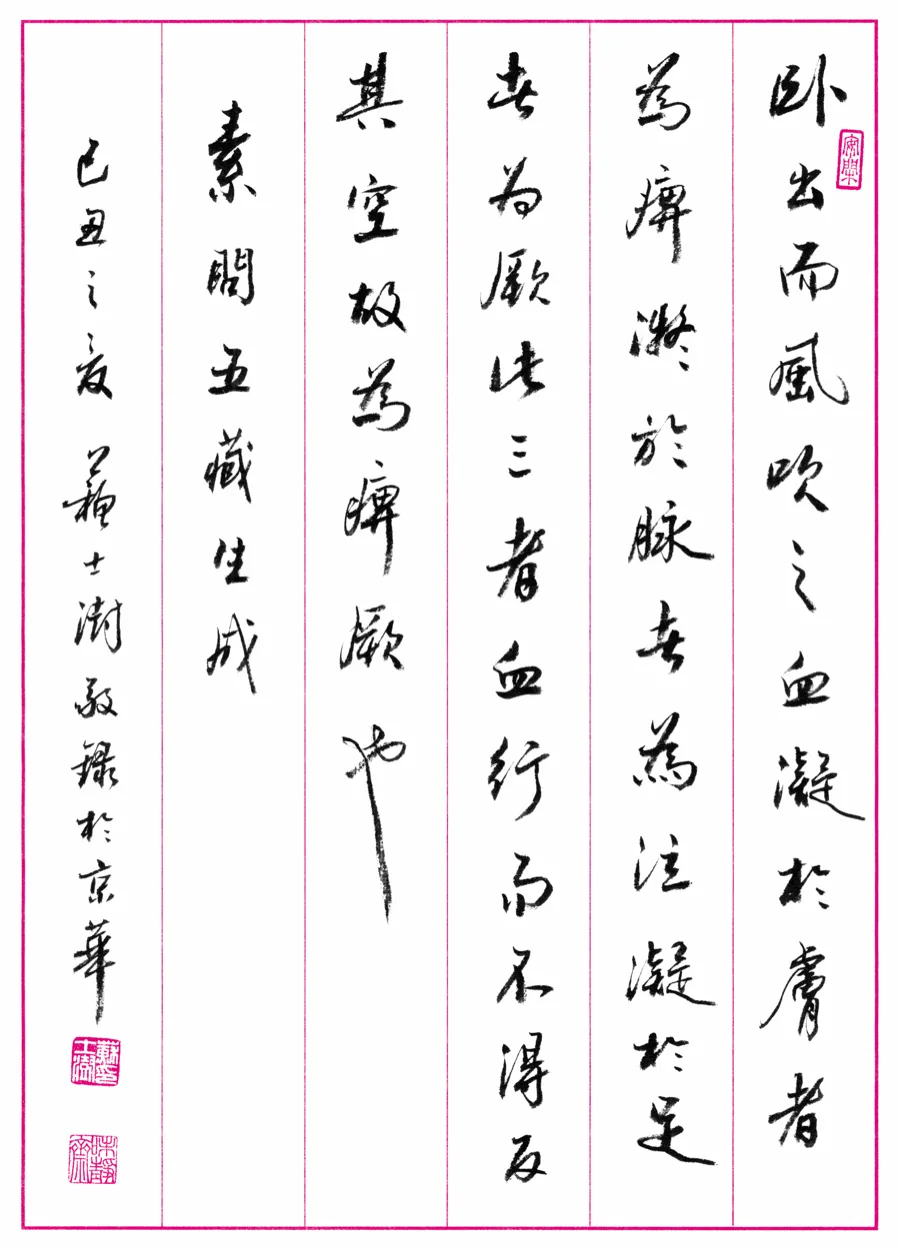
When one rises from sleep and is struck by wind: blood that congeals in the skin becomes bi〔1〕; congealing in the vessels, qi-clogging〔2〕; congealing in the foot, jue (reverse-cold)〔3〕. In all three, the blood runs but cannot return to its hollow〔4〕; therefore bi and jue arise. (Suwen · The Five Storehouses' Generation)
Notes: 【1】Bi (痺): numbness without feeling. Wind, cold, and damp qi making trouble; when blood receives the evil, it congeals. In the skin, it is bi-block; in the channels, bi-stasis; in the foot, jue-reverse. 【2】Qi-clogging (泣): movement slowed-and-stopped. 【3】Jue (厥): the lower limbs cold to reversal. 【4】Hollow (空): communes with 孔, opening. Here, the hollows of valley and stream — openings everywhere in the body, all empty. Lingshu · Nine Needles and Twelve Origins: "The Skilled guards the pivot; the Coarse guards the gate." "The pivot's stirring does not leave the hollow." The motion of the spirit-pivot of life can never leave the space-of-life. Hollow is not what today is called an acupoint; an acupoint is also not a "body region." The jing-mai are the going and coming of spirit-qi; the openings are the relays where spirit-qi gathers. When blood-and-qi clot, the spirit-qi loses passage; what cannot return to its hollow is the spirit-qi. Hence the line that follows: "A person has twelve great valleys, three hundred and fifty-three small streams, less twelve shu points. These are all where the wei-qi pauses, and where evil qi guests. The needle and stone follow them and drive it out."
If one has just risen from sleep and goes out where wind-evil strikes: if the blood congeals in the skin, bi-block arises; if the blood congeals in the channels, qi-stasis arises; if the blood congeals in the foot, jue-reverse arises. In all three of these, blood does not flow freely, and the spirit-qi cannot pass to and fro through the openings of the valley and stream — and so bi, jue, and the like, take form.
Postscript
What this small book offers is not the arts of cultivating life but its Way. From Fuxi's invention of the nine needles, Shennong's tasting of the hundred herbs, and the Yellow Emperor's composing of the Neijing, our Chinese forebears — the Three Sovereigns — took human life as root, and through a millennial search created the Chinese Way of medicine.
Chinese medicine and pharmacy, with their long history, profound theory, and rich practice, are unmatched in the world. They have not only enriched our medical treasury but woven themselves into our Chinese culture. Under the shock of modern westward impact they have suffered blow after blow, yet in the cold they have held their own, meeting the era's ever more complex and troubling diseases with a distinctive stance and, again and again, with astonishing results.
During his tenure as Minister of Health, Cui Yueli traveled the country in investigation, steered by the views of the people and the condition of the nation, and led the revival of Chinese medicine. He devoted the whole of his later life's energy to the cause. His highest wish was to preserve and develop the distinctive character of Chinese medicine and pharmacy, to ensure successors, and to keep its world-leading position over the long term.
Carrying Cui Yueli's intent forward, we founded the Beijing Cui Yueli Center for Traditional Medicine and opened the Beijing Pingxintang TCM Clinic. Over ten years we have stood on honesty, followed a culture of harmony, gathered the senior masters of the capital, and borne the people's burden of illness. However high praise now stands, we dare not slacken a hair's breadth.
We offer this small book in memory of Mr Cui Yueli — whose bright, open-hearted generosity, whose plain, selfless conduct, whose meticulous and unyielding work, will always be what we pursue.
May all of us walk this road together and complete the great work of reviving Chinese medicine and pharmacy — offering a share of heart, a share of strength, a share of warmth, a share of light — for the country's strength, the nation's flourishing, and the health of all human beings.
Beijing Cui Yueli Center for Traditional Medicine
Beijing Pingxintang TCM Clinic
December 2009