[Memoir] Zhang Xiaoshan: In Deep Remembrance of an Idealist
In Deep Remembrance of an Idealist
By Zhang Xiaoshan
About the author: Zhang Xiaoshan, born 1947 in Shanghai, family from Qichun, Hubei. Attended Beijing No. 4 High School 1960–1968. In September 1968 sent down to Tumd Left Banner in Inner Mongolia. March 1978 undergraduate, Inner Mongolia Normal College Class of 1977; 1979 graduate student in agricultural economics at Renmin University of China. After graduation, spent his career at the Institute of Rural Development of the Chinese Academy of Social Sciences. Ph.D. in Management, researcher, doctoral supervisor, institute director, and an academician of CASS.
Zhang Xiaotong: born March 1948, died February 17, 2025, aged 76.
Xiaotong was at Beijing No. 4 High School — class of 1967, senior-second year. I was one year ahead, so his classmate and senior, but in school our paths never actually crossed.
I remember one evening a roommate of mine, who was in the same class as Xiaotong and had come back from a student-union meeting (Xiaotong was then its deputy head), saying: this kid is good. After the meeting everyone was heading back to the dormitory, but Xiaotong was heading for the track — he said his plan for the day wasn't done and he still had to run a few laps.
One of Xiaotong's dormmates — a junior-high schoolmate — told me of something that stayed with him. Sometimes on weekends Xiaotong wouldn't go home; he and another roommate would spend the whole day studying Mao's Selected Works in the school.
His classmate and close friend Wu Changsheng remembered the first winter vacation of senior-one year, when Xiaotong had organized a visit: they biked out to the farming village of Yongfeng Tun in the northwest suburbs of Beijing, where their class had done rural labor a few months before. Another cold day he organized a nightsoil-hauling work session in the city. He got in touch with the Shi Chuanxiang sanitation crew, and the students worked alongside the workers for half a day. Whatever the activity, Xiaotong was both its careful organizer and the first one to put his own hands in the work — and it earned him the classmates' respect.
In senior-two year he was already in the Party's candidate pool. Beijing No. 4 gathered the talent of Beijing; to stand out already as a senior-two means his standing was unusually strong.
Early in the Cultural Revolution, Xiaotong and two classmates put out a few big-character posters rallying their peers to take active part in the movement, signed with the pen name "Wu Haotong." The posters had some impact. But then the movement flipped like a pancake: his father Cui Yueli was denounced as a member of the "Peng Zhen black gang," and Xiaotong — now a child of a "black-gang element" — disappeared from sight. In 1968, when I was sent down to Inner Mongolia, I was surprised to spot the name Zhang Xiaotong on the commune's list of sent-down youth: we weren't only schoolmates — we'd become commune-mates.
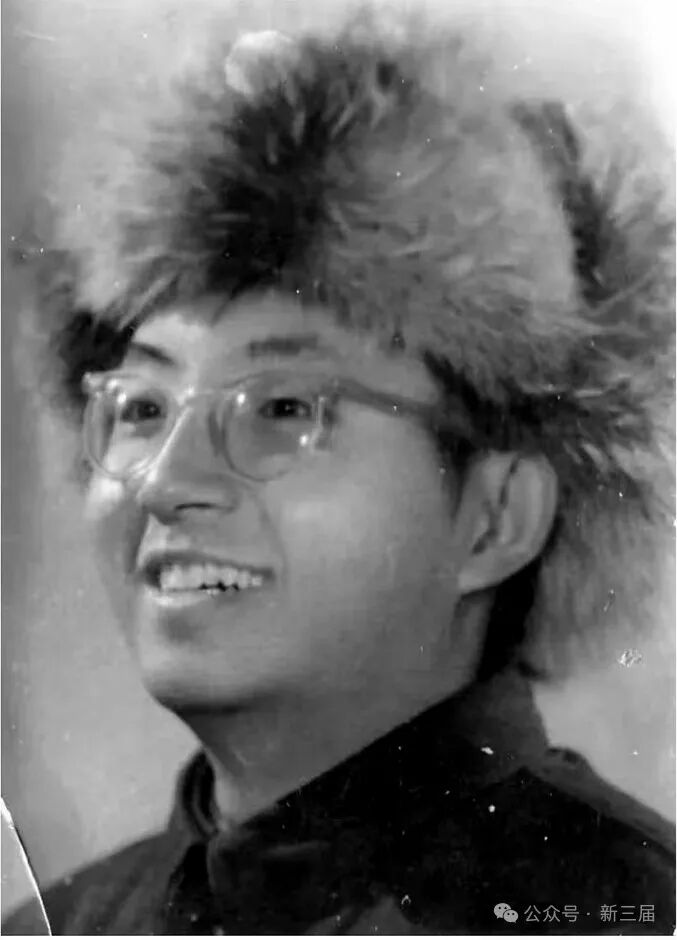
Zhang Xiaotong as a sent-down youth in Inner Mongolia
Soon after arriving, the commune called the sent-down youth together for a meeting. No farm work, and still you earned work-points — who wouldn't go? That day we were both over at the commune's boiler room getting hot water, and we ran into each other. He introduced himself and said with a smile: So I've finally found you. Zhang Xiaoshan. More than one person has thought I was either your older brother or your younger brother. I laughed too, and with that we were acquainted. We didn't have much contact in the next stretch, until both of us were assigned to the brigade's seed-breeding farm as peasant-technicians — then the technical conversations began.
And so the years went on, until the winter of 1974. I had been sent down more than six years now; by then each brigade had only a handful of Beijing youth left. The ones still there fell broadly into two camps. First, the root-down faction: from families with no political problem, or with parents already "liberated" or about to be, absolutely refusing to return to Beijing, and raising slogans like "Fight heaven, fight earth, learn from Dazhai, never shake in rooting down to the countryside." Second — the muddle-through faction, as I call it — the dregs washed up by the great wave: families with something "not clean" made their children harder to send back, and since by now they had years in the countryside and some literacy and ability, a few had worked up to minor posts (accountant, storehouse keeper, league branch secretary, etc.) and had a little say in the brigade.
Around then someone raised the idea of consolidating all the Beijing sent-down youth of the area into a Beijing Youth Farm — rumor had it the higher-ups were considering the same. We were young men, in our prime, full-blooded — muddling through, yes, but unwilling to truly waste the days. Someone pronounced, with feeling: "…A person needs a little bit of spirit… A life is what it is; may as well break it all open and do something big…" That was the origin of the push for the Youth Farm.
On the afternoon of December 19, a Beijing youth from a neighboring brigade called me: the Beijing youth at Zhangfang Brigade had slaughtered a pig and wanted to eat pork and discuss the Youth Farm; I had to come. In all, eight people came to this "Pork-Meat Meeting" (from Tabusai Commune: two from Tabusai Brigade — Gao Tianhong and Li Gang; two from Yushigeqi Brigade — Zhang Xiaoshan and Deng Liyang; one from Beiyuanzi Brigade — Zhang Xiaotong; three from Zhangfang Brigade — Li Jiandong, Sun Qirong, Bai Guanyun).
Xiaotong came prepared. He laid out the three advantages and three disadvantages of the Beijing Youth Farm, and the three conditions that must be in place for it to succeed. (What follows is mostly quoted from my own diary at the time.) (1) There must be Party leadership; the higher-ups must post a capable, upright, enthusiastic cadre the sent-down youth would accept. (2) At least a third of the members must be poor and lower-middle peasants. Don't forget, we all have a tendency to waver; we need poor and lower-middle peasants as the backbone — "if the hide is gone, where does the hair attach?" (3) There must be a core of die-hards. This must succeed or not be attempted. If those three conditions were met, he said, he would join — and he would be die-hard.
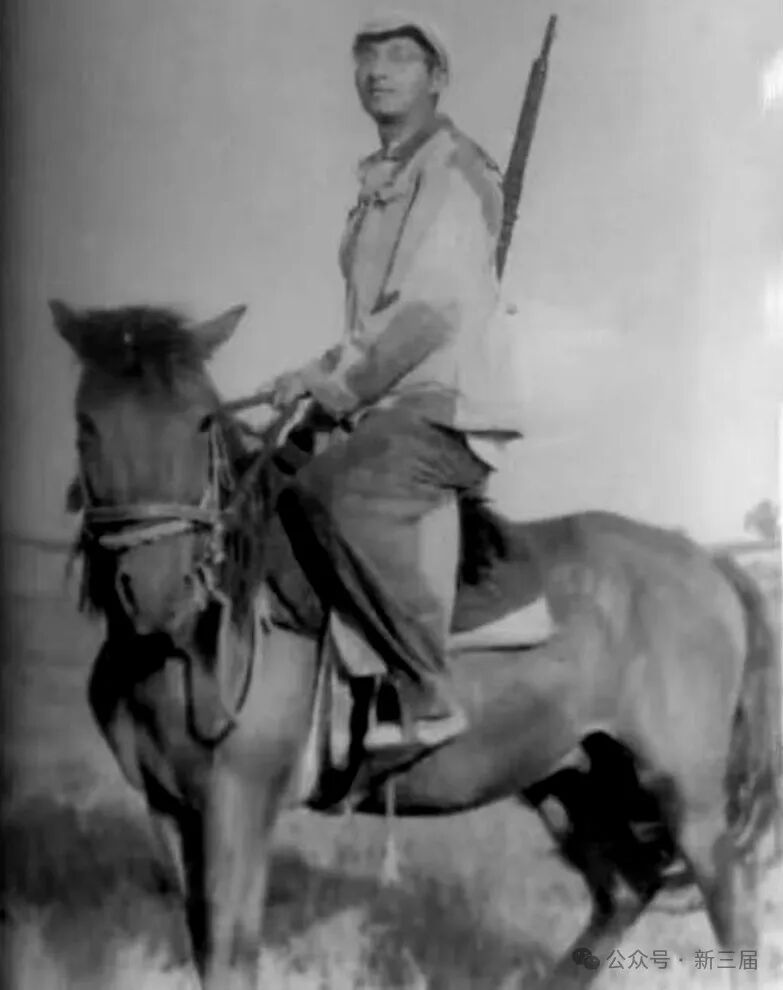
Zhang Xiaotong "on horse, rifle at the ready, riding the border"
At this, everyone's spirits fell — those three conditions were not going to be met. Someone raised that the sent-down youth today were isolated, a single hand can't clap. Xiaotong replied: the key is whether the sent-down youth can root themselves in the masses of poor and lower-middle peasants, can throw themselves into the fiery struggle; whether they pick up the heavy load or the light. "Educated youth sticking with the countryside have a thousand roads, ten thousand roads — why insist on the one dead road?" They should be thinking about how to make a greater contribution to the Chinese revolution, to the world revolution. Turning suddenly personal, he spoke of himself: "My mother gave me eight characters: proud, arrogant, cynical about the world. I said — I admit it; but I won't change. 'Proud, arrogant' — people look down on sent-down youth now, so we can't also look down on ourselves. We have to be arrogant, we have to be proud, have to hold our heads high. 'Cynical about the world' — well, life is what it is. I don't take anything in life too seriously; don't weight it too much; don't collapse at failure, don't bounce up wildly at success. I'm willing to be a jester in the communist enterprise."
The discussion about the Youth Farm was unusually heated, with every person putting in their view. Xiaotong may have had a drink or two, and he spoke of his own ideals and ambitions. He had resolved to root himself at Beiyuanzi — build up strength, gather a crew, start with a visible achievement in the squad, then sharpen his elbows to drill up into the brigade and win a little power. He said: "My ambition is to change the backward face of Beiyuanzi… It may take eight or ten years, twenty or thirty, even generations. If I can't do it, the younger knowledge-youth will carry on from there…"
The "Pork-Meat Meeting" turned into an all-gods-in-one-temple kind of meeting, with no conclusion in the end — we scattered like birds and beasts and went back to our own brigades. It may have been the last "leap" of the Beijing sent-down youth who remained in Tumd Left Banner; after that, the once-roaring Beijing youth tide in Tumd Left went to its end.
A few days after the "Pork-Meat Meeting," one morning I was walking alone on a country path. In the distance I saw a figure moving slowly forward. As I drew near I saw it was Xiaotong, riding a bicycle into the banner town to buy things. He wore a big fur hat, a set of blue cadre clothes washed to pale, and turned-wool leather boots. I asked if he would go home for New Year. With great spirit he said to me: "After the fifth day of the year — start work on the well!" He waved at me and kept going. I stood and watched his retreating figure for a long, long time.
After that I heard news of Beiyuanzi and Xiaotong here and there. I heard that — at great effort — he managed to join the Party while his father was still not rehabilitated; I heard that he became the brigade Party secretary, and then deputy secretary of the commune Party committee. I remembered his ambition and said quietly in my heart: Xiaotong, now you can really show what you can do!
The great tide of history rolls on. Who could have foreseen that history would play a small joke on Xiaotong and his kind: halfway along, the current took a bend. Bends are ordinary enough — but this small bend changed the trajectory of how many lives.
Some lucky ones rode the historical current and caught the last train; even a muddled-through person like me did. I wouldn't claim I "chose the right direction of history's forward march" or "joined the great current of the age" — I simply wanted change; any change was better than staying put. "The proletariat has nothing to lose but their chains, and they will gain the whole world." But Xiaotong's kind kept to their ideals; they could not figure out how the policy had changed. The policy hadn't, in fact — only the direction of the wind had shifted, silently, slowly. The "root-down faction" was no longer the focus of policy, no longer the media's darling; the hot words had become going to university, graduate school, studying abroad, realize the four modernizations…
Xiaotong returned to Beijing very late. One step behind was every step behind.
Right after he returned, the sent-down-youth classmates liked to gather, and at those gatherings I saw Xiaotong and could keep up with his situation. Later, as everyone got busy, the gatherings thinned out, and I saw less of him. I heard only that he had rented some space at the Chinese People's Association for Friendship with Foreign Countries and opened a Chinese-medicine clinic.
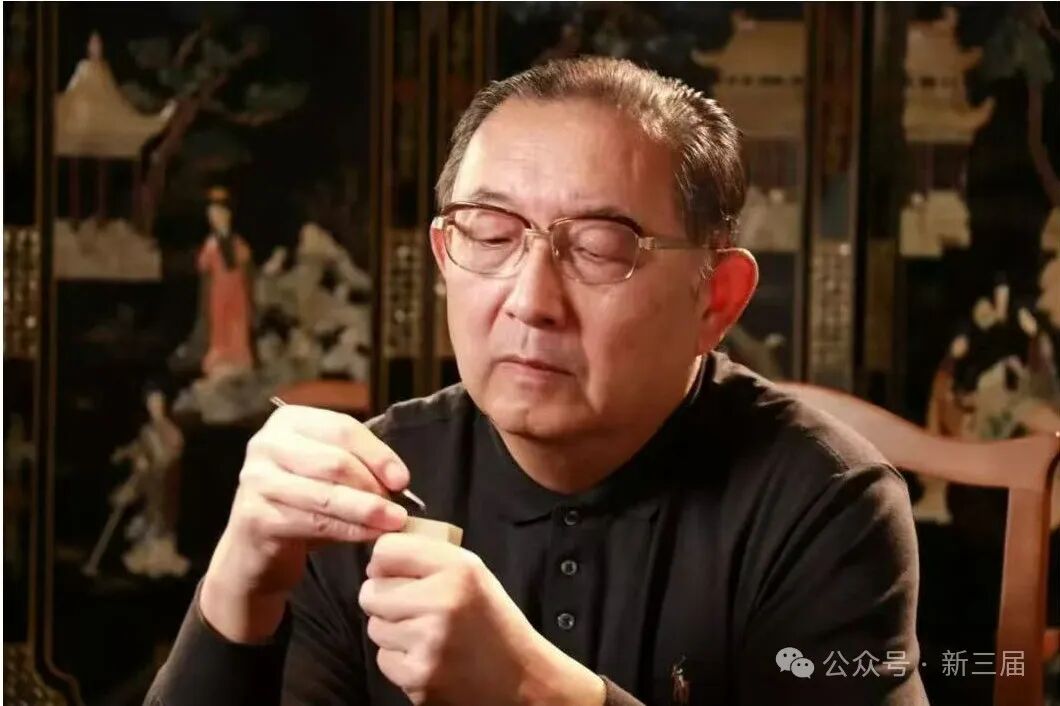
Zhang Xiaotong carving a seal
After the pandemic, I fell ill with something strange. My nervous system was damaged; my coordination failed; my cerebellum began to atrophy; I couldn't move freely. In September 2021 I was hospitalized for half a month at Beijing Hospital. A round of tests suggested multi-system atrophy or a peripheral-nerve-root lesion. First — not confirmed, so no prescription. Second — even if confirmed, there is no cure. If Western medicine couldn't help, I turned my eyes toward Chinese medicine. I reached Xiaotong on WeChat: his TCM clinic was still open, and he invited me over — he would find a doctor to see me.
On the appointed day I arrived at his office, and I was startled. A few years apart, and now he spoke through a Japanese-made voice aid, with a sound like the cross-talk actor Li Wenhua after his illness. The hospital had diagnosed him with throat cancer and removed the whole larynx and vocal cords. With compromised immunity, he could only stay in a temperature-and-humidity-controlled room, like a flower in a greenhouse. He had to give up the swimming he loved, and the flute he had played at performance level. Eating used to be a gulping affair; now, without saliva, chewing and swallowing were hard; each meal took more than an hour.
In his own words: the hospital "saved a life and ruined the second half of it." Compared with the illness he carried and the suffering he took — what I had was nothing. Xiaotong probably saw it the same way. He called over a senior Chinese-medicine doctor, who took my pulse, asked questions, and said I had a liver-kidney deficiency — a few doses would fix it. A few doses later, no effect. Xiaotong grew concerned and tried every angle. From there began my nearly two-year (2022–2023) search for treatment at Pingxintang.
Looking back at the treatment, what stands out is gratitude. So many people — many of them strangers — offered to help, whether with ideas or with referrals; Xiaotong in particular mobilized nearly every quality resource at Pingxintang: the top physicians at Pingxintang saw me and wrote prescriptions; they even brought in a celebrated physician in the U.K. to do remote tongue-and-symptom consultation; I had massage and acupuncture there; the "black-tech" (the entropy-spin chamber) plus mud moxibustion… Visibly, the therapeutic effect is not great. In the long run, the consolidating work must show itself.
Xiaotong also cheered me on in WeChat: "Your case really is unusual — it is this hard to treat. It looks like a long war. Right now we're in the holding retreat; there's still a hardest-to-bear holding to come; but once the counterattack starts, it will go quickly. Are you ready, old friend? Aim for half a year to a year. I still have confidence in the specialists we've chosen." Great kindness does not get thanked in words; it is remembered in the heart.
The first half of Xiaotong's life was a search — in many directions — for how to realize his own worth, without finding the answer. He ran a restaurant, managed the Longquan Hotel, did policy research at the health commission. "Half a life in start-up mode" (see the attached Self-Assessment poem below) is his own description. Then, weighing together his father's charge, his own gifts, and the era's demand, he chose reviving Chinese medicine as the best answer — and it became the goal of his second half. Just as he was filled with ambition and setting out to build something bigger, cancer struck.
In WeChat he once said to me, in pain: "I'm a casualty of over-aggressive treatment — my quality of life in the second half is irretrievably, deeply reduced; more importantly, my sense of dignity as a person is wounded, and my voice for Chinese medicine is taken from me." I understand all too well the helpless grief of that reversal. Even so, he climbed out of loss and despair. His resolve did not waver. He refined Pingxintang with care, gracefully binding traditional medicine to modern enterprise management, making a valuable exploration of a road to Chinese medicine's revival. This was his root; this was where his life's meaning lay. So he "clamped down on Chinese medicine and wouldn't open his jaws"; and in the end he was willing to give his life for it.
At Chinese New Year's Day of 2023 he sent me this: "I won't jump into the pit of surgery, radiation, chemotherapy, intervention, targeted drugs — I've seen too many patients abandon effective Chinese-medicine treatment and go quickly; and the rich and famous who went to the West for treatment, I haven't seen a single one come back alive. Refusing invasive investigations and treatments is my current bottom line; I'm still walking the Chinese-medicine road."
On March 26, 2024 he wrote to me: "I still couldn't hold the Chinese-medicine line — I ended up doing the intervention and the surgery. I didn't expect how big the surgery would be — they cut out a tumor larger and harder than a fist. Now I can only rest at home. Thursday I can take the stitches out of my neck; next week, the chest. I feel now like a ragged patch of hide, chewing is blocked, and my quality of life has dropped further. …Even now I don't consider that I have cancer. I still hope to restore Chinese-medicine adjustment — I don't want in the end to die in the Western-medicine pit. Often, though, I cannot be in charge; let it go."
I replied:
(1) You said you "still couldn't hold the Chinese-medicine line." I see it as no surrender — it was the right choice, reason prevailing over feeling. A principle is not only to be held as a standard; it is to guide action. And whether action conforms to objective law is tested by practice. We saw the image of your wound when it broke open — it was terrifying. You have said: "effective treatment — no change of formula." But what if there was no effect? Then the line of treatment must be adjusted.
(2) You said: "I hope to restore Chinese-medicine adjustment — I don't want in the end to die in the Western-medicine pit." I think that between Chinese medicine and Western medicine there is no zero-sum game. It is not black-and-white. In the progress of exploring modern medicine, the two are allies. You once said — whether Western or Chinese — our knowledge of the body's mystery does not exceed four percent; most of what we do is trial. The sea holds all the rivers — its greatness is in holding all. If, in trying and searching, Chinese medicine and Western medicine join constructively and push each other along, rather than fight over which is primary — aren't we a step closer to truth?
(3) You said: "Chewing is blocked, quality of life further reduced." Slow practice can improve it, but will not restore it. I'm reminded: my tongue-root has hardened; I've practiced speaking slowly so I can still be understood, but I'll never be sharp-tongued again. What to do? Still live on. Lift the spirit. Chinese people have, to one degree or another, a bit of the Ah-Q spirit; I do too… We must have a little Stoic "painful optimism," and also the "alive, we work; dead, we're done; finished, we're finished" light-stick spirit. In Inner Mongolia talk: whatever happens, happens. In Beijing talk: don't sweat it. However hard life is, we must grit our teeth and live on — and finish our unfinished tasks.
I am a pragmatist. The Inner Mongolian saying goes: don't hop around as if already dying — jujubes or no, swing the stick and see. I am, in truth, only an ordinary person. About illness, I am like everyone else: afraid of death and wanting to live. For three-plus years I have tried them all, from the highest technology to the road-stall masters. Xiaotong, by contrast, for his belief, for the life-goal he pursued stubbornly, had long since set aside life and death. On that one point, he followed in the footsteps of Sun Yat-sen and Liang Qichao. History is pushed along by that kind of person. We are only the common-folk — grasping at any doctor in illness, and any food in hunger.
Across the thousands of years of human civilization, our knowledge of the world outside us (the vast universe, the wide earth) is strictly limited; our knowledge of the world inside (the extraordinarily complex, precise structure and ordered running-mechanism of a human individual) is likewise very limited. As Xiaotong said: whether Western medicine or Chinese medicine, very few truly cure disease — most of it is trial, because humanity's understanding of life is actually less than 5 percent. In our exploration of the mystery of life, we have a long road yet. There is a view online: looked at historically, Chinese medicine as a cultural-philosophical category is the crystallized wisdom of several thousand years of our ancestors and may endure forever; but Chinese medicine as a medicine, for diagnosing and treating illness, is still at the level of those earlier eras and its road is narrower and narrower. I think there is something to that.
The development of contemporary technology is changing daily: AI, ChatGPT, etc. are challenging the rigidity of formulaic, mechanical practice. And yet the advanced philosophical concepts and cultural depth carried in our ancient civilization — represented by traditional medicine — and the human-centered, deeply individualized medical care it offers can precisely answer that challenge. Joining traditional medicine's essence with the tools of contemporary science is not Westernization of Chinese medicine; it is the scientization and internationalization of Chinese medicine. Only in that way can Chinese medicine renew its youth and reach the world. That was the mission of revival Xiaotong should have finished. The mission is far from done.
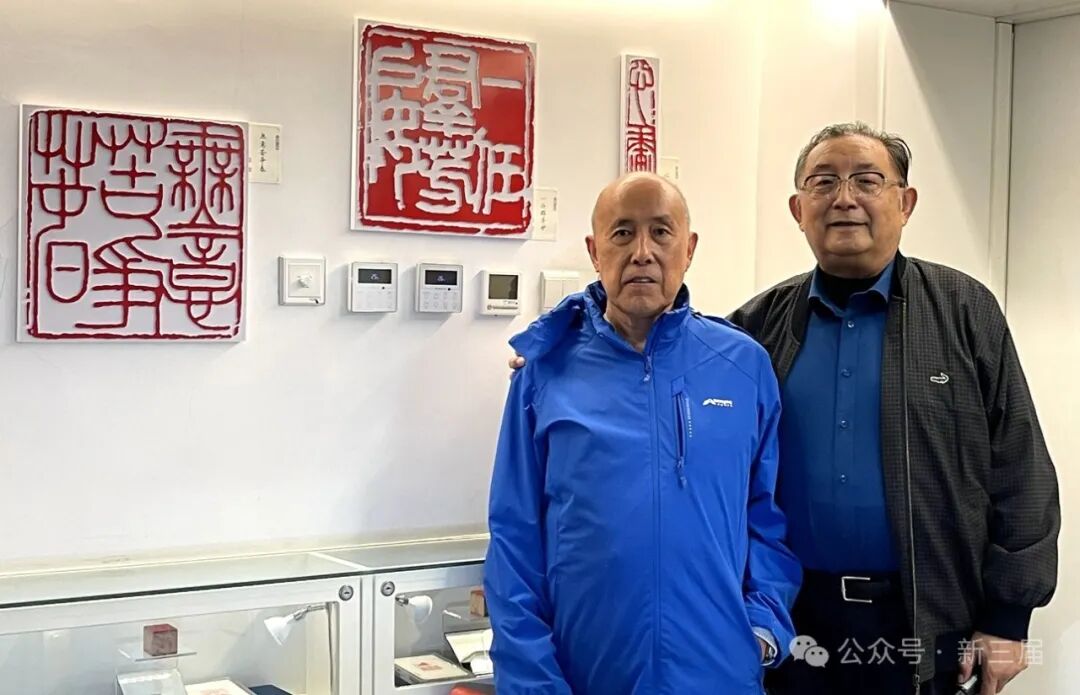
Zhang Xiaotong and Zhang Xiaoshan
Xiaotong is gone, but the experimental field he watered with his own blood keeps growing. Pingxintang carries his spiritual investment and his ideal. In the current environment, the Pingxintang led by Xiaotong (and his colleagues) is a clear current — refreshing, giving hope. They have bound efficiency and fairness together well; their founding commitment — "patients first, efficacy first; hold to integrity, win in the details" — has never wavered. Pingxintang is a clean plot of ground in the Chinese-medicine world, and its reputation is the life of Chinese medicine itself.
Pingxintang implements Xiaotong's ideas. It has let many young men and women from the countryside see where the value of life lies: through hard work they've lifted their own human capital and become a new-generation migrant worker. Pingxintang's rule: every on-duty staff member must be able to do the work of three departments — making each a multi-function worker. Monthly there are professional-knowledge training exams and Chinese-medicine studies — raising everyone's standard from every angle. Xiaotong always put it first in his work to let every specialist and every staff member live a good life. He stressed again and again that everyone should study, set goals for themselves, develop themselves into skilled and technical talent. The part that gets rich first must be the part that keeps studying, keeps growing, and has integrity. From a dispute between two firms to a dispute between two nations (China and the U.S.), in the end it comes down to talent — the emergence of talent and the mechanism that lets it grow.
Pingxintang has also explored mechanisms to encourage "get rich first." Hence the "優合 culture"; hence the Master-Owner Award, the Five-Goods Staff Award, and so on. This was Xiaotong's root, and where his life's meaning lay — even as he carried a body broken by illness. Pingxintang alone is small. But if many enterprises with a sense of social responsibility acted as Pingxintang does, the small streams would join a great river, and the river would reach the sea — realizing a common value for humanity. I believe that day will come.
I have not been to Pingxintang for a long time, and I find I miss it. The atmosphere there, the fresh-faced smiles of the young staff — those stay with me. Xiaotong once said: the soul of Chinese medicine is in efficacy. But efficacy is the result of many factors at work together — it is a product of a systems effort: the selection of skilled, dedicated physicians; the choice of herbs; the layered quality-checks on decoctions; strict medical-records management; the training and deployment of young talent… A systems effort also needs a platform. Pingxintang is the platform on which efficacy is realized. It has bound traditional medicine to modern enterprise-management systems (a mature enterprise culture, a strict yet humane management regime…) — a valuable exploration of the road to Chinese medicine's revival. Pingxintang surely has places it still needs to develop and improve. If one day I can take the subway alone and write freely with my right hand, I will spend a stretch at Pingxintang doing deep interviews and research — finishing, without pay, a research report, as a consolation to Xiaotong's spirit. That is my promise.
Xiaotong was outwardly gentle, but inwardly he was proud, held himself high, and was deeply confident. Tumd Left Banner's CPPCC once planned a volume of memoirs by former Beijing sent-down youth, and invited Xiaotong. He agreed, submitted quickly, and attached a note to his manuscript: "Not one character may be changed." That put the editor in an awkward spot. His wildness was plain to see.
He wrote a poem called Self-Assessment — which, on November 4, 2022, in answer to his son Zhang Xin's question "where does the spirit live?", he personally shared. "Seldom heeding others, often missing the world's sentiments" — "Claiming an extraordinary fate, scornful of being like others; when fortune wavered, refusing to lose, loving the highest peaks" — I think Xiaotong's self-assessment is accurate, fair to the facts. Would he change? No. Character is fate.
When he wrote the poem, Xiaotong's life was near its end. Looking back on the whole, he summed it up briefly: "In old age recalling the past, with some clarity now; tallying merits and faults — no regret for this life. After death, let others speak — caring nothing for gain or fame; if the spirit endures, may it share the clarity of heaven and earth." How true.
As I read Xiaotong's Self-Assessment, I lift my head from silence, and his figure rises before my eyes again: a big fur hat, a set of blue cadre clothes washed to pale, turned-wool leather boots, a gentle and confident smile. With great spirit he says to me: "After the fifth day of the year — start work on the well!"
Xiaotong's spirit does not die.
---
Appendix: Self-Assessment
Zhang Xiaotong, November 4, 2022
Named Xiaotong (Dawn-Red) at birth, half a life spent building anew;
busy with the "Eastern Red," never waiting for the sun to rise.
Claiming an extraordinary fate, scornful of being like others;
when fortune wavered, refusing to lose, loving the highest peaks.
Lowly in station yet grieved for the nation, in hardship still mindful of the people;
quick to right wrongs, righteous and unafraid to contend.
Careless, following his own will, slow to consider, often acting rashly;
seldom heeding others, often missing the world's sentiments.
In old age recalling the past, seeing it with some clarity;
tallying merits and faults — no regret for this life.
After death, let others judge — caring nothing for gain or fame;
if the spirit endures, may it share the clarity of heaven and earth.
— The author Mr. Zhang Xiaoshan was Mr. Zhang Xiaotong's senior and fellow sent-down youth, at Beijing No. 4 High School and at Tabusai Commune. Content copyright remains with the author; the family will reach out in person.