Where Is the Hope of Chinese Medicine? (3) — The Trials of a Spoiled Illness
Where Is the Hope of Chinese Medicine? (3) — The Trials of a Spoiled Illness
People today, when they fall ill, first open the home medicine cabinet. If the over-the-counter doesn't work, they go to the hospital for tests, injections, and IV drips; if that still doesn't work, they check in for treatment. One round of this costs no small sum of money — but more importantly, a simple illness gets made complex, a small illness gets made big, an easily-treated illness gets dragged past its window. Everyone has gotten used to it; no one bats an eye. This has become the fixed formula for seeking care.
How a "spoiled illness" forms
TCM specialists often sigh: illness is harder to treat than ever; we seldom see textbook diseases that match the classical formulas any more. Our specialists have a name for illness that has been "badly handled" — "spoiled illness" (壞病), a term borrowed from Zhang Zhongjing.
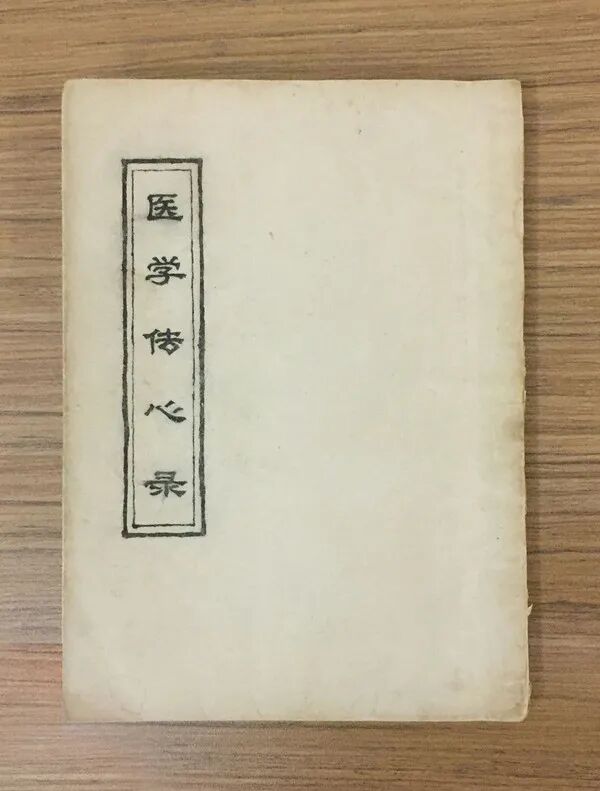
(Professor Fan Zhenglun's handwritten notes)
Every possible cause tangles together; the pot is stirred into a porridge. Cleaning it up calls for real work — sifting the true from the false, tracing down to roots, pulling a tangled mass apart, unraveling one thread at a time. Some of the Chinese-medicine students from Hong Kong have gone to rural Malaysia or the Philippines for clinical practice, where medical resources are thin. They used the ancient classical formulas directly, and with great effect — because those places still have "original illness," not yet much "spoiled illness."
Some patients, out of trust, make Pingxintang the last line of their life's defense: "If Pingxintang says it can't be treated, then it really can't." Such words make us smile and sigh.
If you believe in Chinese medicine's efficacy, then —
- Why not from the start?
- Why wait until the very end?
- Why not when it's easy to treat?
Complex diagnosis, high-wire treatment — what Chinese medicine actually faces is almost always the hardest challenge. Faced with that challenge, if we still had a high-quality traditional corps, it would be bearable — but the Chinese-medicine corps has been churned to chaos by Westernization, and has lost its calm-under-pressure, its composure. This inevitably leaves Chinese medicine entirely on the defensive in clinical practice.
At the same time we should see that Chinese medicine is also growing through these trials. The numbers may be small, and it may be hard to form an influential, powerful team — but the ones who grow up under adversity are the toughest, the best, the most full of life — the seeds.
The spine of Chinese medicine, strengthened in trial
These TCM elites are quietly doing the real work. To draw only from those around us:
Cai Songyan, a master physician of Chinese medicine, aged 96, always carries scraps of paper in her pocket to jot down insights, doubts, or inspirations. Several hundred notebooks filled with her dense handwriting record her climb up the traditional heights of Chinese medicine — saturated with the bloodwork of hard inquiry.
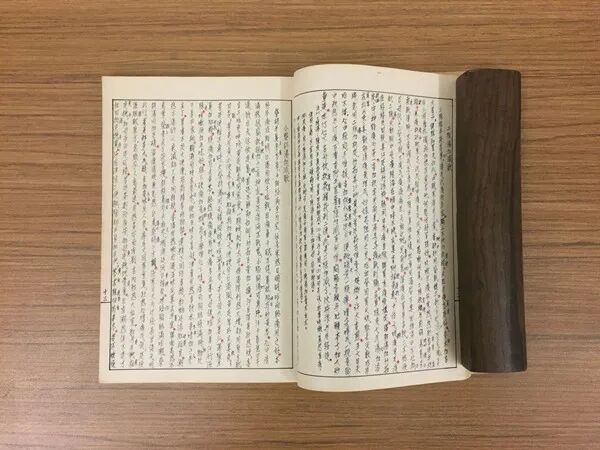
(Professor Fan Zhenglun's handwritten notes)
Professor Fan Zhenglun was once called "the lunatic" when he was studying medicine; the classical texts he copied stroke by stroke then record decades of unbroken learning — he has hardly watched a film or TV drama, and once failed to recognize a famous actress come for a consultation.
Kong Lingyan, the grandson of Kong Bohua — one of Beijing's four great physicians — made his mark early; what the public sees is the extraordinary efficacy of his treatment, but what it does not see is the bound volume after bound volume of case notes and classical-text commentaries, written by hand in neat handwriting, unrelenting perseverance.
In the grass roots, in the folk tradition, in remote villages, spines like these are everywhere.
Many think that to deal with today's increasingly complex diseases, Chinese medicine must be modernized. This is a deeply mistaken view.
The Westernization path cannot be walked; the integration-with-Western-medicine path cannot be walked
Twenty years of Pingxintang practice have shown: whoever stays true to the traditional reasoning, walks Chinese medicine's own way, holds fast to zhibao and zhizhi and treats by diagnosis — that physician's efficacy is good; whoever does not, loses. It was precisely through that practice that we came, step by step, to see clearly: the Westernization path cannot be walked; the Chinese-Western integration path cannot be walked.
Chinese medicine's strength is not the same as Western medicine's, and has little to do with the Newtonian-physics foundation of modern technology. Strictly speaking, Chinese medicine and modern technology are not kindred; it is with post-modern science that Chinese medicine has a matched heart.
Precisely because Chinese medicine is a complex-giant-system science, tightly bound to systems theory, fuzzy logic, information theory, quantum theory, cloud computing, artificial intelligence, and large data, Chinese medicine will lead post-modern science. So to try to drag Chinese medicine onto the modern-medicine rails — "modernization," "standardization," "regulation" — is in fact to drag it backward. This sort of "north-seeking chariot going south" "promotion" had better be shut down and put away. That is not where Chinese medicine's hope lies.
Though Western technology renews itself daily — genetics, minimally-invasive surgery, stem cells, 3D printing — and though no small number of Chinese-medicine people have had their brains washed clean by Westernization, none of it is compatible with the real science of life: they are square pegs in a round hole, cannot even enter the Chinese-medicine system, and Chinese medicine cannot accept their mechanical constraint. In the climb up the mountain of life-science, Chinese medicine is already far ahead; there is no need to start over from the foothill.
True innovation begins with inheritance
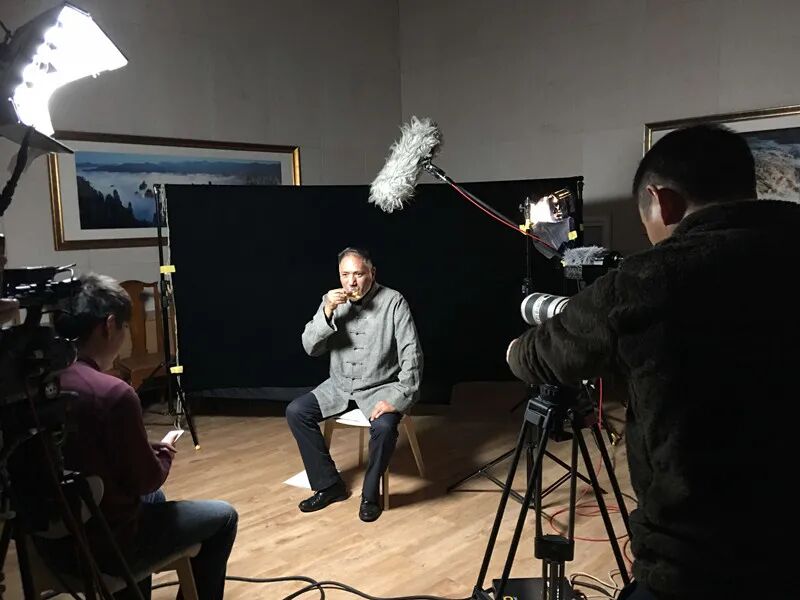
(Filming for A Thousand Years of the Chinese Healing Art at Pingxintang — Professor Guan Qingwei being interviewed.)
To make the television series A Thousand Years of the Chinese Healing Art, the noted director Zhou Bing spent close to ten years. He began with himself — took a master, sat in on consultations, offered TCM-theory lectures for the whole crew, and required every member to learn Chinese medicine seriously, to grasp its Dao. When the high-tech elites set out to help Chinese medicine, this is the only road.
Chinese medicine has always innovated; it has never given up learning, mastering, and using science. But inheritance is the root of Chinese medicine's revival. If you truly have Chinese medicine's interest at heart, put your whole force behind the transmission; let policy and regulation lean toward transmission.
We therefore firmly oppose pairing "innovation" with "encouraging Chinese-Western integration." The reason is simple: "innovation" must never be a fig leaf for the Westernization of Chinese medicine, and there is no reason to "encourage" Chinese medicine toward a Westernization of no return.
Preserving and developing the distinctive features of Chinese medicine, strengthening the transmission — this is the path of hope.