On the Historical Stage of Chinese Medicine's Reform and Opening, There Was a Standard-Bearer Named Cui Yueli
Editor's Note
In the history of Chinese medicine, the name Cui Yueli is worth remembering. From 1979 to 1987 he presided over the country's Chinese-medicine work for eight years, lived through the turbulent early-Reform years of Chinese medicine, raised the call "Revive Chinese Medicine," and drove the field forward. After retirement he kept pressing for Chinese-medicine work, giving himself to its development until the end. As we mark the fortieth anniversary of Reform and Opening, Cui Yueli's daughter Zhang Xiaoping recalls with feeling her father's bond with Chinese medicine.
First encounters with Chinese medicine — "A medicine that can be called great"
In April 1979, after the outgoing Minister of Health Jiang Yizhen stepped down, he left the Chinese-medicine portfolio to Cui Yueli.
Cui Yueli had come up through Western medicine; in his earlier work at the Beijing Municipal Party Committee, he had mostly overseen Western-medicine affairs. He had, effectively, never studied Chinese medicine — never really met it. But his Party character meant he would treat any task the Party gave him seriously. From his first day on the Chinese-medicine portfolio, he set about understanding Chinese medicine, Chinese-Western integration, the debate between the two, and the problems in TCM's development.
To do this well, his travels took him nationwide. He inspected TCM hospitals, TCM colleges, and minority-nationality hospitals; he made friends widely across the Chinese-medicine community — senior physicians, Western-trained doctors who had turned to TCM, administrators, soft-science researchers.
The deeper he understood Chinese medicine, the deeper his love for it grew. Cui Yueli said: this medicine can be called great. "I believe that of all China's gifts to the world — gifts that will survive with the progress of human civilization — there are only two: Chinese cuisine, and Chinese medicine."
But in his visits abroad, Cui Yueli saw that many countries had abolished their traditional medicines. It hurt him deeply.
From May 15 to 30, 1979, Cui Yueli led a five-person TCM Association delegation to the 31st General Assembly of the Oriental Medicine Association, and toured medical education, research, and hospitals in Japan. The head of the Japan Medical Association, Takeda, said to him: "You in China still have traditional medicine; we no longer do." Beginning in the Meiji era (from 1868), Japan through legislation and natural attrition had in just thirty years essentially abolished kampo — the Chinese medicine as transmitted to Japan.
Beyond Japan, Cui Yueli also investigated traditional medicine in other countries. His conclusion: the United States and Europe essentially have no complete traditional medicine; Africa has none; India and Sri Lanka's traditional medicine is mostly rural; South America and Native American traditional medicine has heavy elements of superstition and shamanic "spirit-jumping" — no theoretical system. Comparing all of these, only China has preserved a relatively complete traditional medicine. Drawing the lesson, Cui Yueli held that China must value Chinese medicine.
Taking over TCM — "stabbed by the 'TCM Department' next to the toilet"
When Cui Yueli took over Chinese-medicine work, the Cultural Revolution had just ended. Ten years of upheaval had done severe damage to the Chinese-medicine enterprise. Before the Cultural Revolution there had been 371 county-and-above TCM hospitals nationwide; by 1979 only 171 remained. Many TCM hospitals and TCM departments that had rested on senior physicians collapsed; large numbers of collectively-owned TCM hospitals were torn apart. Of the hundred-plus TCM hospitals that remained, Western medicine was dominant.
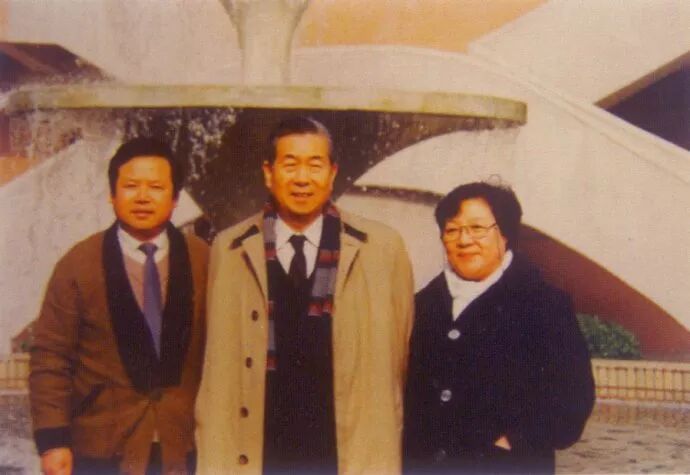
Cui Yueli on a research trip in Jiangsu.
On an inspection visit to a certain regional TCM hospital, Cui Yueli saw that the hospital actually still had a "Chinese-Medicine Department" sign — as a subordinate department of the hospital. In general hospitals, Chinese medicine and the TCM department were universally placed below other departments. Cui Yueli said vividly: walk down a hospital corridor, and you don't need to ask for directions — just follow your nose. Wherever the toilet is, the TCM department is next to it.
These scenes stabbed Cui Yueli. He saw clearly the harsh reality that Chinese medicine had been pulled into Western-medicine management. Beyond the sharp drop in hospital numbers, TCM education had also been badly damaged during the Cultural Revolution. The country's total number of credentialed TCM technical staff had fallen to just 340,000 — 0.34 per thousand of population — far below the 1-per-thousand of the early People's Republic. And most of them held low or mid-level credentials; the share of senior-title holders was small.
Cui Yueli did the arithmetic: the 26 higher TCM schools and 30 mid-level schools nationwide produced about 8,000 graduates per year. Ignoring population growth and staff attrition, restoring TCM to its early-PRC scale at current speed would take at least seventy years.
In his survey he also found two chokepoints on Chinese-medicine development. First: for years, the doctrine of "scientization and modernization" had been used to reshape Chinese medicine — overlooking its own laws of development. Second: funds for the Chinese-medicine enterprise were tiny. Out of the Ministry of Health's ¥3 billion annual operating budget, the TCM allocation was only ¥150 million — less than 5 percent. In short, Chinese medicine was in severe trouble.
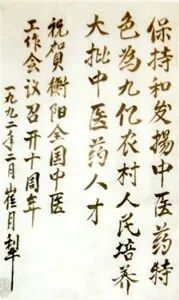
In 1992, on the tenth anniversary of the Hengyang Conference, Cui Yueli's inscription.
The Hengyang Conference — the sword drawn at Chinese medicine's problems
In April 1982, on the banks of the Xiang River, in the quiet city of Hengyang, a few hundred visitors from across the country gathered for the "National Conference on TCM Hospitals and Higher TCM Education."
For the first time in the 33 years since 1949, the Ministry of Health held a nationwide conference on the construction of TCM hospitals and higher TCM colleges. Most of those invited were TCM-community cadres and senior physicians recently returned to work after the Cultural Revolution. Some were friends Cui Yueli had made since taking the portfolio; many he had never met.
Just before the conference began, the Ministry still held two sharply opposed views on how to treat Chinese medicine. One held: "Sound, light, chemistry, electricity are running ahead — why hitch a broken cart to an old ox? Advocating Chinese medicine today is backward." The Chinese-medicine community called out in reply: "The efficacy Chinese medicine has built up over thousands of years is truth tested by practice." There were sharp questions on every lip: "Is a TCM hospital a Chinese-medicine hospital or a Western-medicine hospital? In a TCM hospital, is Chinese medicine in charge or Western medicine?"
The representatives debated the state and development of Chinese medicine with passion. At the close, Cui Yueli — drawing on the delegates' input — gave his speech.
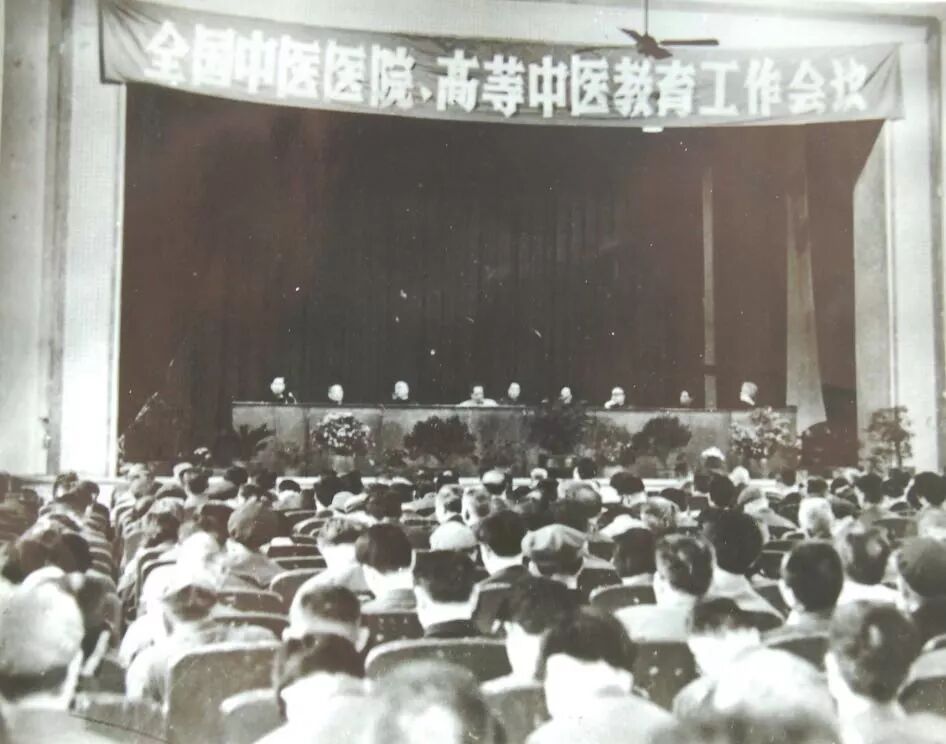
The Hengyang Conference in session.
The draft of the speech was revised repeatedly by Xing Sishao, head of the Chinese-medicine desk at Health News, following Cui Yueli's directions. They settled on the title "We Must Have Something to Show in the Chinese-Medicine Enterprise." The title expressed Cui Yueli's resolve — and that resolve was not easy.
Some older Ministry colleagues tried to dissuade him: Chinese medicine is hard to work with; there's deep internal disagreement; it can even run into policy questions; the Ministry has precedents from history; the safe play is to go light on it — "not to grip it" is the safest move. Cui Yueli knew there would be trouble, and he knew the advisers meant well. But he chose to have something to show.
He said to those cadres: "We are Communists. If you're a minister for a spell, you should do real things for the common people. A topic can't be forbidden to us because it's risky — much less because someone's afraid of losing a hat. Otherwise how do we carry out the Party's line of seeking-facts-from-reality?"
Cui Yueli climbed the podium with the draft in his hand. The speech had no "everything's wonderful" empty phrases, nor the official's "the TCM question awaits further study." Its method was characteristic: bold, seek-facts-from-reality. Cadres who had worked with him said later that only Cui Yueli would dare to speak and act this way.
In the first part of the speech, he stated plainly that the obstacle to TCM work came from the cadres. "Our health-administration system has thinking and practices that prize the West and slight the Chinese. Valuing Western medicine is right; but slighting Chinese medicine and constraining it is wrong, and must be corrected."
Answering those who dismissed Chinese medicine as unscientific and feudal, Cui Yueli said directly: we must "hold up the banner of inheriting and developing the medical learning of the motherland; hold up the banner of inheriting the outstanding scientific and cultural heritage of the motherland; bring forward the spirit of patriotism; and carry this enterprise through without wavering."
In the speech, Cui Yueli said flat out that Chinese medicine's only path is to preserve and develop the distinctive features of Chinese medicine. He pointed out: to erase the distinctive features of Chinese medicine is a "leftist" mindset; we must preserve and advance the features of Chinese medicine, and refuse the road of Westernization. TCM hospitals should, in diagnosis, treatment, emergency care, nursing, and nutrition, truly reflect Chinese-medicine character.
The speech was not long — under five thousand characters. It concentrated three years of Cui Yueli's survey work and thought into a single text, covering TCM hospital direction, funding, talent training, medicine-plus-pharmacy combination, TCM education, Chinese-Western integration, administration. Every line landed.
Speaking of the Westernization of Chinese medicine, Cui Yueli said: Chinese medicine being Westernized is "like the theater that hangs out Mei Lanfang's name but sings inside in Zhu Fengbo's voice." This witty, vivid line later became the canonical way of criticizing the Westernization of Chinese medicine — widely quoted ever since.
"To have something to show in the Chinese-medicine enterprise" was not an order from on high. He placed it on his own shoulder. Daring to act, daring to take responsibility was his style. The hall erupted; the applause ran several minutes.
The delegates said, in moved voices: Chinese medicine is saved! The next day, People's Daily reprinted an excerpt of Cui Yueli's speech on its front page. From that day, the Ministry of Health's clear stand in support of Chinese medicine traveled across the country. The conference went on to shape every aspect of TCM's development. The direction it set and the principles it affirmed were taken up by the Chinese-medicine community — "open your mouth on TCM and you'll land on Hengyang"; thus "the Hengyang Conference" became a shorthand, and the spirit of Hengyang bound the Chinese-medicine corps together.
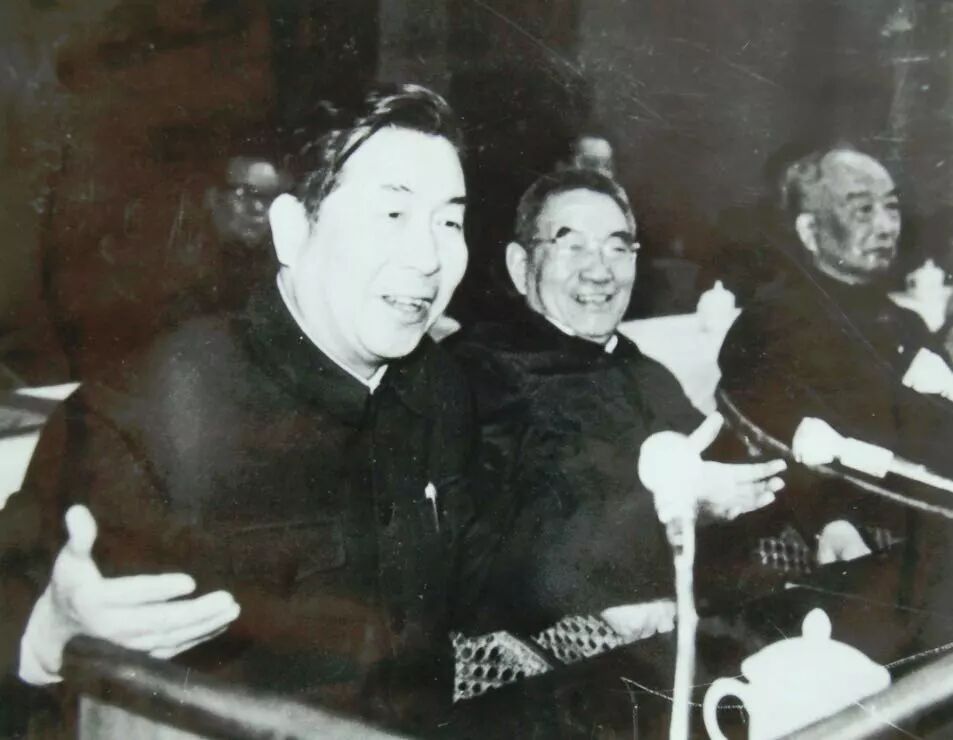
Cui Yueli speaking at the Hengyang Conference.
"Revive Chinese Medicine" — securing central funding
Cui Yueli did not know at the time that the Hengyang Conference he chaired would have such a far-reaching influence on Chinese medicine. He only wanted to do something for inheriting and developing it. He raised the rousing slogan "Revive Chinese Medicine" to encourage the Chinese-medicine community, and with his characteristic "say it and do it" pace, began the work.
Just as he had foreseen, Chinese-medicine work was very troublesome. The most troublesome piece was the restoration of the "temples" of Chinese medicine — the TCM hospitals.
Ten years of Cultural Revolution had left most of those temples existing in name only. Collectively-owned TCM hospitals' senior physicians had been labelled "feudal-era remnants" and shipped back to their home villages; with their dispersal, most of the hospitals collapsed.
Of the 170 TCM hospitals that did survive, most were run by Western medicine. The first job of reviving Chinese medicine was to rebuild those temples. The rebuilding had two parts. One: correct the direction of existing TCM hospitals — make them actually run on Chinese medicine. Two: build more TCM hospitals. To correct existing hospitals' direction meant adjusting the leadership teams. This was Cui Yueli's first hard problem, and his most awkward. It touched the immediate interests of non-TCM people who had been managing TCM hospitals for years and were not a good fit for leading Chinese medicine. "Chinese medicine grabbing back its chair" and "rejecting Chinese-Western integration" were charges that followed. Once the "rejecting Chinese-Western integration" hat was put on, it could not be taken off.
Cui Yueli never yielded under those hats. He said again and again in many settings: I support Chinese-Western integration — but I firmly oppose using Western methods to reshape Chinese medicine.
On the debate between Chinese medicine, Western medicine, and Chinese-Western integration, Cui Yueli said: "Academic disputes should be handled calmly — lay out the facts, speak the reasons, let contention unfold openly." He said: "Doing Chinese-medicine work, one must have resolve; one must have backbone. Treasure the achievements, don't flinch from the problems. In some places TCM work is not well done — don't keep singing praises."
Alongside restoring and building the TCM hospitals, Cui Yueli put even more effort into bringing back the senior physicians. In his words: "Temples alone don't do — you also have to bring the deities back." Since 1949, the main teaching method in Chinese medicine had been master-apprentice. Chinese medicine had never had the professor title; it could not enter regular universities. The Ministry of Health could not award professorships — that was the Ministry of Education's right.
To bring the senior physicians' strengths and enthusiasm to bear, Cui Yueli negotiated with the Ministry of Education for a block of professor slots, and used them to award professorships to the country's celebrated Chinese-medicine physicians. From that point, Chinese medicine had its first cohort of senior-physician professors. With the title came corresponding salary; senior physicians could properly teach at TCM universities.
With the temples built and the deities brought back, you still need money. At the time, there was no real hope of support from provincial or municipal finance. Cui Yueli decided to go to the State Council.
Document (78) No. 56 was his "sword of office." At a State Council standing-committee meeting, Cui Yueli reported on the state of Chinese medicine — every figure was at his fingertips — and requested that the state make dedicated capital-allocation for Chinese-medicine construction. He asked for ¥200 million. That figure embarrassed the Ministry of Finance's lead official, who said: we can't put that much out, how about ¥60 million? Cui Yueli replied: ¥60 million — what can be done with that? The two held their ground. At last the Premier made the call: the State Council granted Cui Yueli ¥100 million.
What did ¥100 million mean in those days? According to the report on the 1982 national budget that the Minister of Finance Wang Bingqian gave at the Fifth People's Congress, national revenue then was about ¥110 billion; the national health budget, only ¥3 billion. For a poor country to commit ¥100 million to dedicated Chinese-medicine construction was no small feat.
With the ¥100 million in hand, Cui Yueli went to a number of provincial leaders. He said to them: I have ¥100 million in dedicated TCM funding; if the province puts in ¥1, I'll match with ¥1. The province was happy; with its commitment, Cui Yueli went to municipal and county leaders: if you put in ¥1, the province and the ministry each add ¥1. The municipal and county leaders found the math worth it too.
In this way, Cui Yueli used his ¥100 million to pull in another ¥200 million from local finance. Some went to the construction of county-and-above TCM hospitals; a portion went to the construction of teaching hospitals attached to TCM universities.
Cui Yueli also played a key role in pushing forward TCM legislation and in securing Central Committee and State Council support.
In 1982 he received a letter from Peng Zhen, urging him to grip Chinese medicine well. Peng then sent Wang Hanbin — then Vice Chair of the Standing Committee's Legislative Affairs Commission — to discuss with Cui Yueli how to protect Chinese medicine legally. After discussion in the People's Congress, the clause — "develop modern medicine and our country's traditional medicine" — was formally written into Article 21 of the General Principles of the Constitution of the People's Republic of China. From then on, the temples of Chinese medicine stood, like the halls of Western medicine, under the legal protection of the state.
In 1985, the State Planning Commission allocated ¥500 million to renovate and expand medical-school teaching hospitals. Cui Yueli directed ¥150 million of that to TCM university teaching hospitals — strengthening the clinical teaching base of Chinese medicine.
Silk from the spinning worm — pressing on after retirement
In 1987, Cui Yueli retired. Apart from his participation in the Central Advisory Commission, most of his activity was Chinese-medicine related. Whenever a TCM conference was held in Beijing, he tried to attend.
Cui Yueli's concern for the development of Chinese medicine was sharpened by a sense of competitive urgency in the world market. In 1989, the Founding Assembly of the World Medical Qigong Association was held in Beijing, and Cui Yueli was elected as its first-term president — a post he continued until after his 1995 retirement. He held that the presidency had to be Chinese; he stood up for it.
"Why do I still hold the presidency of the World Medical Qigong Association? Mainly to compete with foreigners. Qigong is a Chinese treasure; we must not let it slip through our fingers the way cloisonné did." Cui Yueli held that if Chinese medicine did not push forward, Japanese medicine and Korean medicine taking over the world market was not an exaggeration.
In 1997, to produce a sober, scientific reflection on Chinese medicine's past, present, and future, Cui Yueli asked Li Zhizhong and Zhu Guoben to help him gather the best views and essays from the last twenty years on TCM enterprise development, theory research, and strategic thinking, and turn them into a volume. The result was Meditations on Chinese Medicine, Volume One, of which Cui Yueli was editor-in-chief.
Li Zhizhong told Cui Yueli that some specialists planned to write book reviews to recommend the volume to academics. Cui Yueli replied: "Do not publish laudatory reviews in the newspapers. We do not praise ourselves; we also do not ask others to praise. Put the views and arguments out there — do you really think the people will fail to recognize them? I hope that views of every kind can be put on the table, so that everyone can weigh them. What's the harm in that?"
On January 8, 1998, Cui Yueli restarted — with self-raised funds — the Chinese-Medicine Classics Compilation and Translation Series, begun a decade earlier. The series was to translate the TCM classics into readable plain Chinese. He organized more than a hundred specialists into four groups. The four medical classics — Huangdi Neijing: Suwen, Huangdi Neijing: Lingshu, Nan Jing, Shanghan Lun, Jin Gui Yao Lüe, Wen Bing Tiao Bian — were among the first to be published in annotated-vernacular form, with a first print run of 5,000 copies.
Cui Yueli had intended to have them further rendered into English, French, German, and Japanese, but for lack of funds this had to wait. In January 1998, with renewed funding secured, he immediately convened the editors and translators to continue the vernacular-TCM-classics project.
It was the last meeting he chaired. Fourteen days after it, he was gone.
On January 20, 1998 — Dahan (Great Cold) — Cui Yueli wrote a letter to Li Zhizhong about how properly to handle the differing views in Chinese medicine's development. The next day, he attended a meeting of the Beijing Political Consultative Conference. When he got home, he added a line on the as-yet-unsent envelope: "Give me some more copies of Meditations on Chinese Medicine."
On January 22, just past Dahan, Beijing's hard winter carried the old man away: Cui Yueli passed suddenly. The unposted letter on his desk became his last writing. When Li Zhizhong later read that letter, he said: "Reading it breaks my heart."
For his outstanding contribution to Chinese medicine, Cui Yueli was loved across the Chinese-medicine community. At his farewell, many TCM figures came. Dong Demao — favored student of Shi Jinmo, one of the four great Beijing physicians — came in a wheelchair. Speaking of Cui Yueli, Dong's tears flowed freely. He said, not without regret: "Chinese medicine's banner — Cui Yueli carried it. He should not have gone."
Unlike other farewells, that day there were no white flowers. Cui Yueli had disliked the gloomy white and grieving scenes in life; he loved the frank, burning red rose. On February 10, what saw him off was nothing but a wall of red roses.
Zhu Guoben, former Vice-Director of the State Administration of Traditional Chinese Medicine, wrote of Cui Yueli: "On the great stage of life, some people can only be seen up close — they look dazzling for a moment, but cannot stand the test of history. And some people stand up to looking from afar: the further back history goes, the clearer their value. No matter how Chinese medicine may develop at home and abroad in the future, through whatever difficulties, Cui Yueli's name will keep coming back into people's minds. That is the meaning of enduring."
Cui Yueli has gone. What he left Chinese medicine is both the cohesion of love for Chinese medicine, and a warning heavy with meaning: do not let Japan's abolition of kampo be repeated in China.